Part I: Short-term
Lines 1a to 7 cover assets generally held 1 year or less, with columns for proceeds, cost, adjustments and gain or loss, plus the short-term capital loss carryover.
1041
Capital Gains and Losses
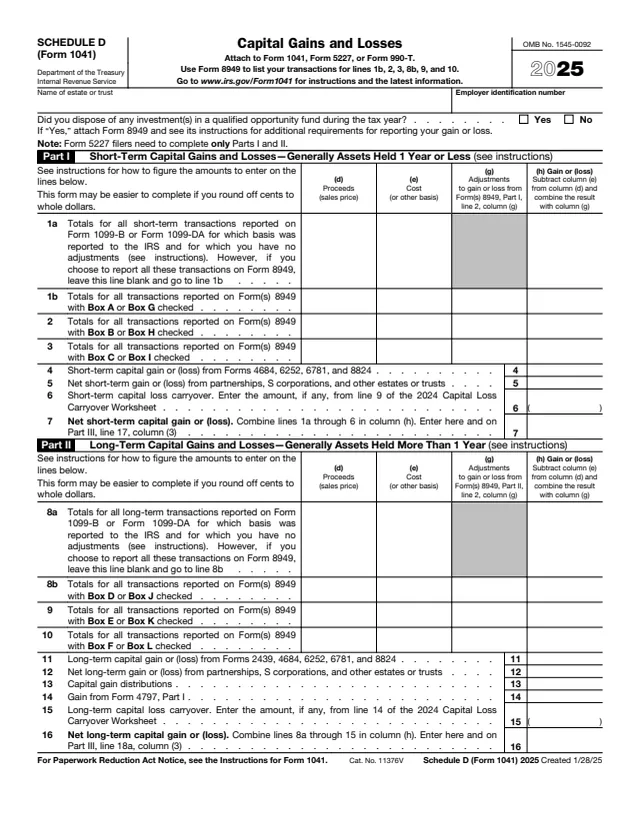
Schedule D (Form 1041) reports the capital gains and losses of an estate or trust. The About Form 1041 page says to use it to report gains and losses from the sale or exchange of capital assets by an estate or trust. The form says to attach it to Form 1041, Form 5227, or Form 990-T, and to use Form 8949 to list transactions for lines 1b, 2, 3, 8b, 9, and 10.
The instructions say any reference to "you" means the fiduciary of the estate or trust. The schedule totals short-term and long-term gains and losses, splits the net results between the beneficiaries and the estate or trust, limits a net capital loss, and figures the tax using the maximum capital gains rates. The form says Form 5227 filers need to complete only Parts I and II.
You can fill out Schedule D (Form 1041) free in your browser on this page and download it without an account.
Lines 1a to 7 cover assets generally held 1 year or less, with columns for proceeds, cost, adjustments and gain or loss, plus the short-term capital loss carryover.
Lines 8a to 16 cover assets generally held more than 1 year, plus gains from Forms 2439, 4684, 6252, 6781 and 8824, capital gain distributions and gain from Form 4797, Part I.
Lines 17 to 19 split net short-term and long-term results into the beneficiaries' share, the estate's or trust's share and the total, including unrecaptured section 1250 gain and 28% rate gain.
Line 20 is the smaller of the loss on line 19, column (3), or $3,000, entered as a loss on Form 1041, line 4.
Lines 21 to 45 figure the tax using the maximum capital gains rates of 0%, 15% and 20%, with the result going to Form 1041, Schedule G, Part I, line 1a.
Check Yes or No for whether the estate or trust disposed of any investment in a qualified opportunity fund. If Yes, attach Form 8949.
The instructions say to complete Form 8949 before lines 1b, 2, 3, 8b, 9, or 10. Sales with basis reported to the IRS and no adjustments can go on line 1a or 8a as totals instead.
Subtract the cost or other basis in column (e) from the proceeds in column (d), combine the result with any adjustments in column (g), and enter negative amounts in parentheses.
Split net gains and losses between the beneficiaries in column (1) and the estate or trust in column (2). The instructions say a net loss is allocated to the estate or trust, not the beneficiaries.
If line 19, column (3), is a net loss, enter the smaller of that loss or $3,000 on line 20. The Capital Loss Carryover Worksheet in the instructions figures any carryover to 2026.
Form 1041 filers complete Part V when the form's conditions are met, such as gains on both lines 18a and 19 in column (2). The form says to use the Schedule D Tax Worksheet instead when line 18b or 18c in column (2) is more than zero.
You get the real form, filled in a browser tab, with nothing standing between you and the finished PDF.
The form says to attach it to Form 1041, Form 5227, or Form 990-T. It goes in with that return, not on its own.
The instructions say that if Form 1041 is e-filed, any Schedule D (Form 1041) and Form 8949 that are part of the return must also be e-filed.
Cents can be rounded to whole dollars. The instructions say that if you round, round all amounts: drop amounts under 50 cents and increase amounts from 50 to 99 cents to the next dollar.
The instructions say a capital loss carryover may be carried forward indefinitely and keeps its short-term or long-term character. On a final return, carryovers also go on Schedule K-1 (Form 1041), box 11, codes C and D.
The instructions say a disposal of a qualified opportunity fund investment also requires Part III of Form 8997.
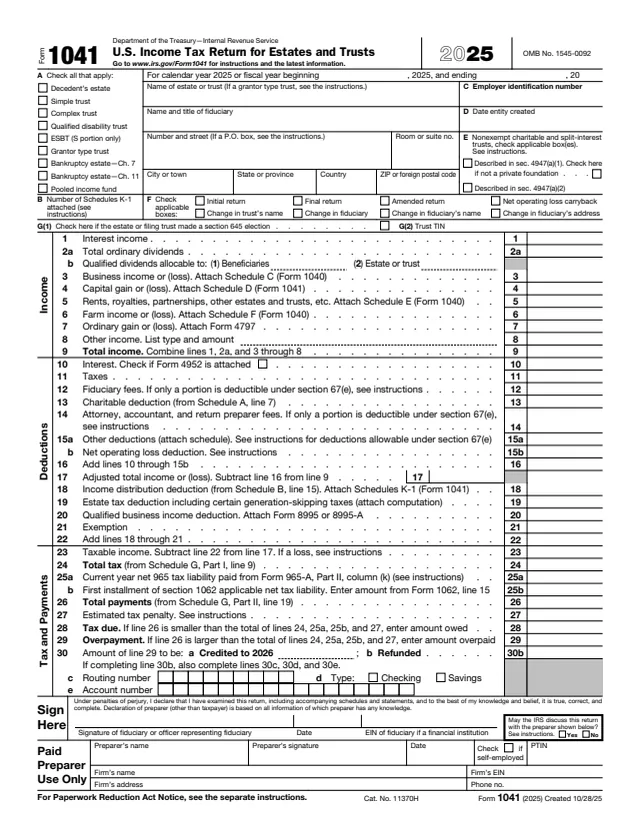
1041
173 fields, 3 pages
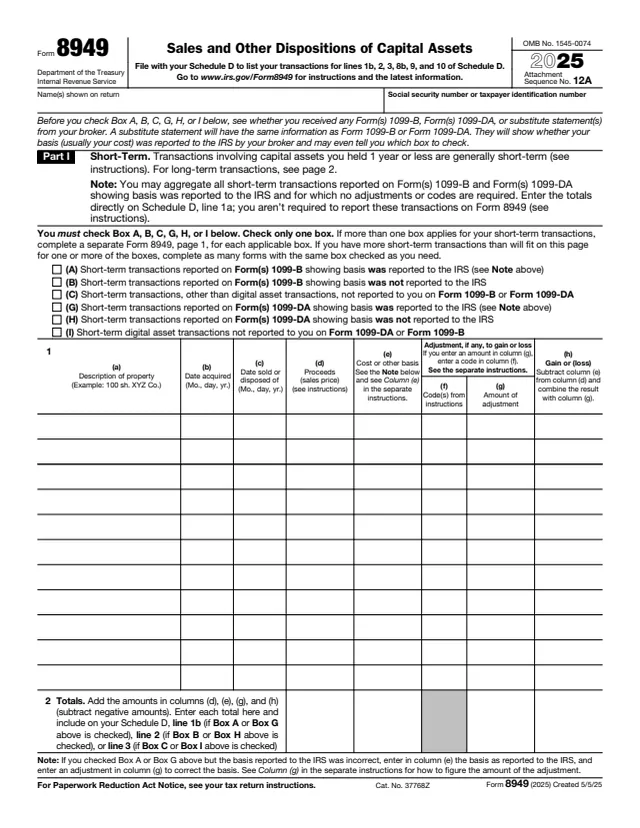
8949
202 fields, 2 pages
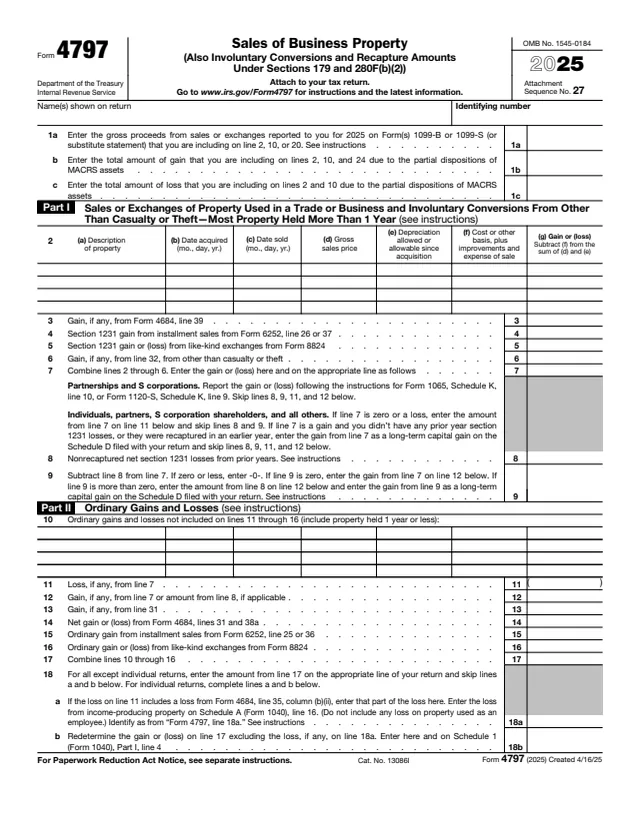
4797
182 fields, 2 pages
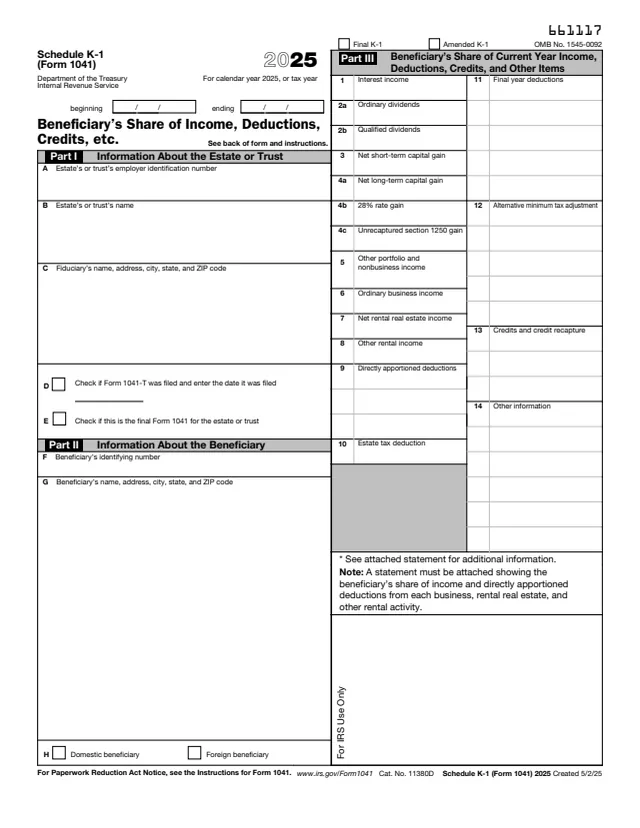
1041
74 fields, 2 pages
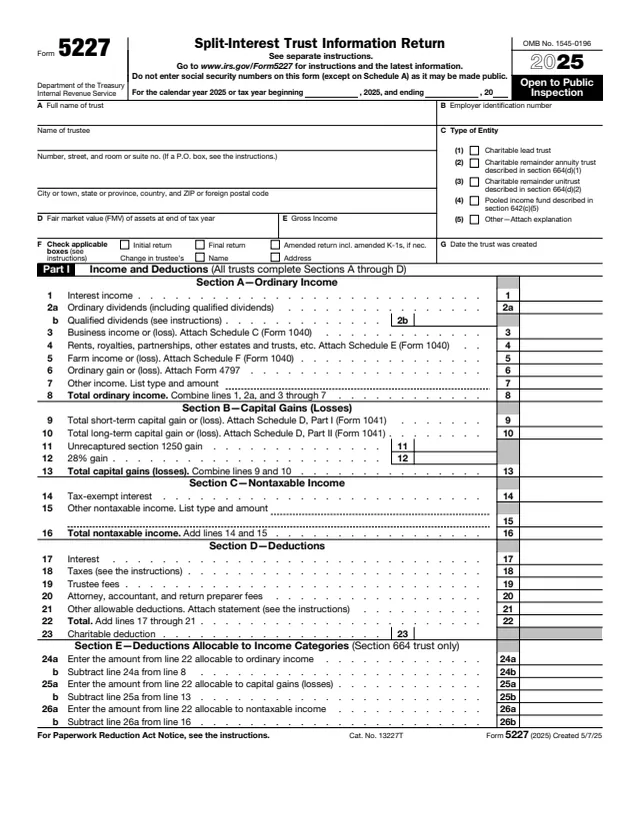
5227
411 fields, 7 pages
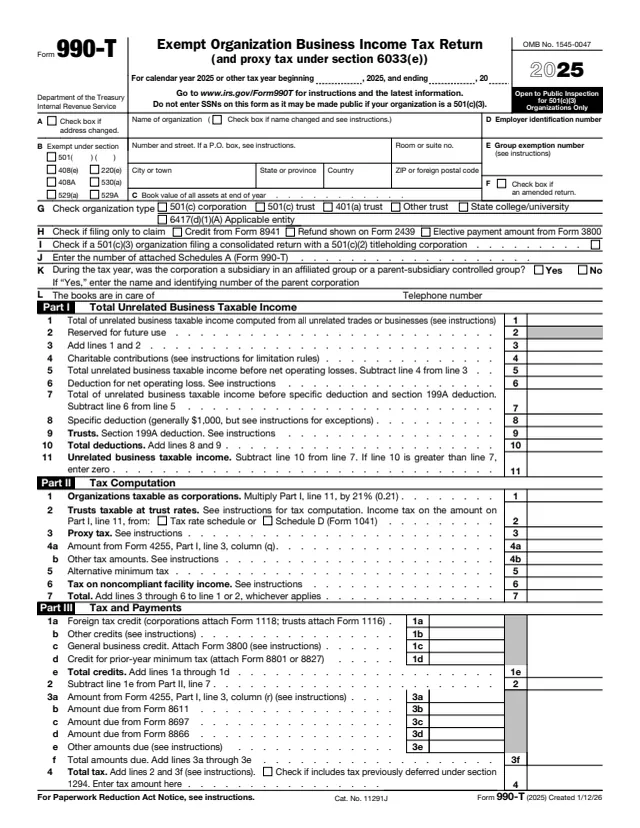
990-T
128 fields, 2 pages
The fiduciary of an estate or trust completes it and attaches it to the return the estate or trust files with the IRS.
No tool matches that search.
The form says to attach it to Form 1041, Form 5227, or Form 990-T.
No. Totals for Form 1099-B or 1099-DA sales with basis reported to the IRS and no adjustments can go on line 1a or 8a without Form 8949. Other transactions are listed on Form 8949 first.
Line 20 allows the smaller of the net loss on line 19, column (3), or $3,000. The Capital Loss Carryover Worksheet in the instructions figures what carries over.
The instructions say the 0% rate applies up to $3,250, the 15% rate to amounts over $3,250 and up to $15,900, and the 20% rate to income above $15,900.
The form says Form 5227 filers need to complete only Parts I and II.
The instructions say codes G, H, I, J, K, and L were added to lines 1b, 2, 3, 8b, 9, and 10 to represent the reporting of digital asset transactions.