Tax year and K-1 type
The calendar year 2025 or fiscal year dates, and boxes for a Final K-1 or an Amended K-1.
1065
Partner's Share of Income, Deductions, Credits, etc.
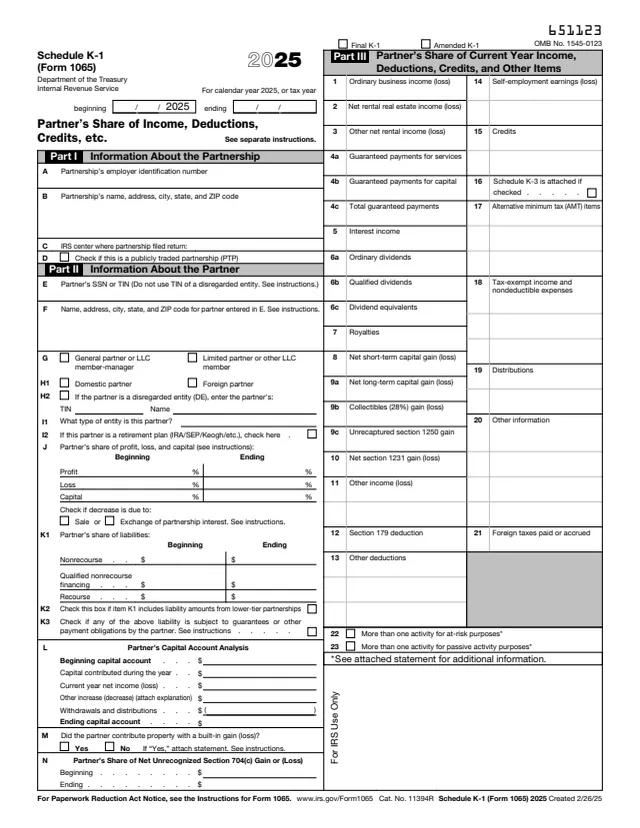
Schedule K-1 (Form 1065), Partner's Share of Income, Deductions, Credits, etc., is the statement a partnership prepares for each partner. The Partner's Instructions say the partnership uses it to report your share of the partnership's income, deductions, credits, etc., and files a copy of it with the IRS.
The instructions say that although the partnership generally isn't subject to income tax, a partner may be liable for tax on their share of partnership income, whether or not distributed, and include it on their own return. They also say to keep the Schedule K-1 for your records and not file it with your tax return unless specifically required to do so.
Part I identifies the partnership, Part II the partner, with ownership percentages, liabilities and the capital account, and Part III lists the partner's share of current year items in boxes 1 to 23. This page hosts the 2025 schedule. You can fill out the PDF free in your browser on this page and download it without an account.
The calendar year 2025 or fiscal year dates, and boxes for a Final K-1 or an Amended K-1.
Item A the partnership's EIN, B its name and address, C the IRS center where it filed its return, and D a box for a publicly traded partnership (PTP).
The partner's SSN or TIN, name and address, general or limited partner status, domestic or foreign status, disregarded entity details, entity type and the retirement plan box.
Share of profit, loss and capital at the beginning and end of the year, share of liabilities, the capital account analysis, contributed built-in gain or loss property and net unrecognized section 704(c) gain or loss.
Ordinary business income, rental income, guaranteed payments, interest, dividends, royalties, capital gains, net section 1231 gain, other income, the section 179 deduction and other deductions.
Self-employment earnings, credits, the Schedule K-3 box, AMT items, tax-exempt income and nondeductible expenses, distributions, other information, foreign taxes, and boxes for more than one activity.
Enter the partnership's EIN, name and address and the IRS center where it filed its return. Check item D for a publicly traded partnership.
For an individual, enter the SSN or ITIN; for other partners, the EIN. For a disregarded entity, enter the beneficial owner's TIN in item E and address in item F. For an IRA, enter the custodian's number. The partner's copy may show only the last four digits.
Enter beginning and ending percentages, generally based on the partnership agreement, and check Sale or Exchange if a decrease came from one. The instructions say the ending capital percentage is zero if the capital account is negative or zero. Item K1 shows the partner's share of liabilities.
Report the beginning and ending capital account using the tax-basis method. Check Yes in item M and attach a statement if the partner contributed property with a built-in gain or loss. Item N shows net unrecognized section 704(c) gain or loss.
Enter the partner's share in boxes 1 to 21. In box 11, boxes 13 to 15 and boxes 17 to 20, each item gets a code. An asterisk after a code means a statement is attached, and STMT in the amount space means the details are on it.
Check box 16 if Schedule K-3 is attached. If it isn't checked, the instructions say the partnership attached or issued a statement that the partner won't receive Schedule K-3 unless they request it.
The partnership completes the schedule. These steps follow what the Partner's Instructions say the partnership enters in each part.
You get the real form, filled in a browser tab, with nothing standing between you and the finished PDF.
The instructions say the partnership files a copy of Schedule K-1 (Form 1065) with the IRS.
The partner keeps it for their records and doesn't file it with their return unless specifically required. The instructions point to Code O under box 15 for that case.
The instructions say to notify the partnership and ask for a corrected Schedule K-1, not to change any items on your copy, and to be sure the partnership sends the corrected copy to the IRS.
For a partnership that hasn't elected out of the centralized partnership audit regime, partners report items the same way the partnership did. Any inconsistency is explained on Form 8082 with the return.
A calendar-year partner reports the amounts for the year in which the partnership's fiscal year ends. The instructions' example: a tax year ending February 2026 goes on the 2026 return.
The instructions say a partner in a section 751(a) exchange generally notifies the partnership in writing within 30 days, or by January 15 of the next calendar year if earlier. See Form 8308.
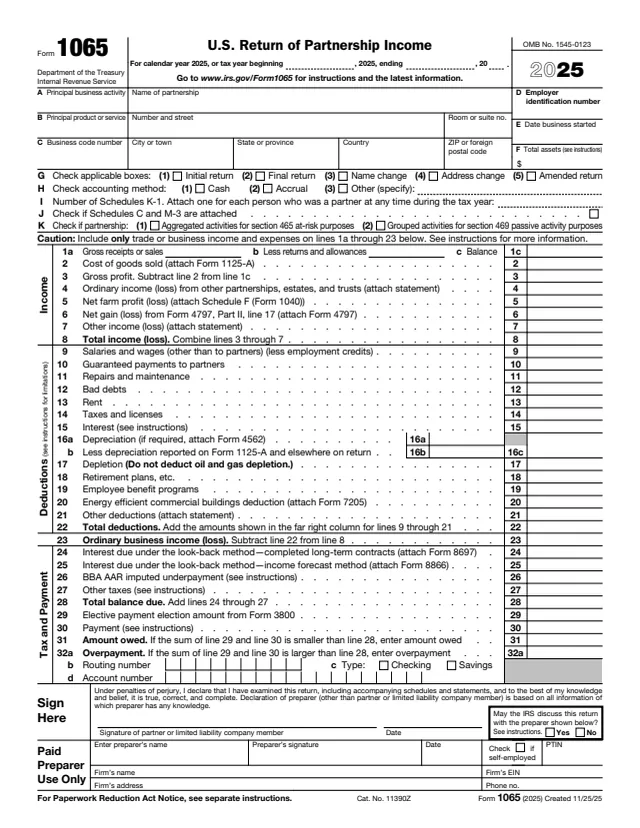
1065
440 fields, 6 pages
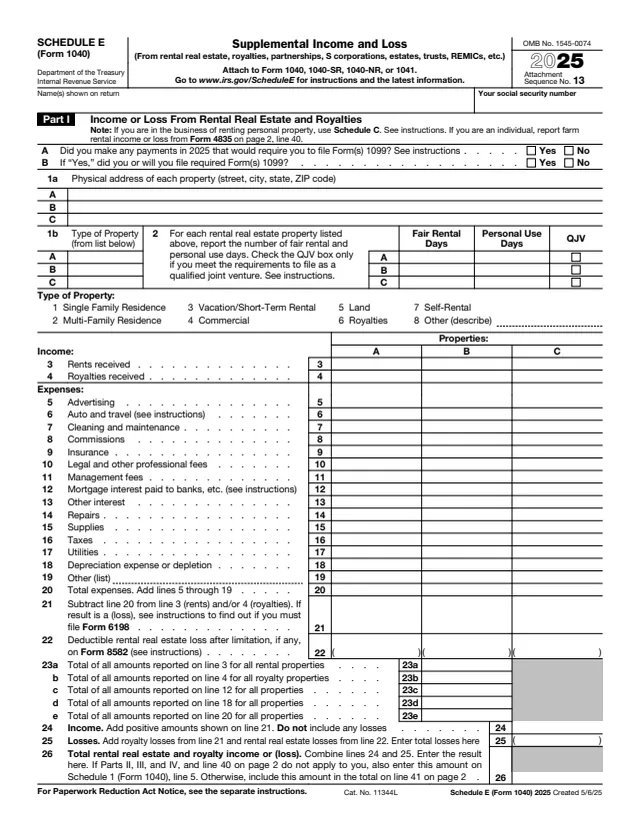
1040
185 fields, 2 pages
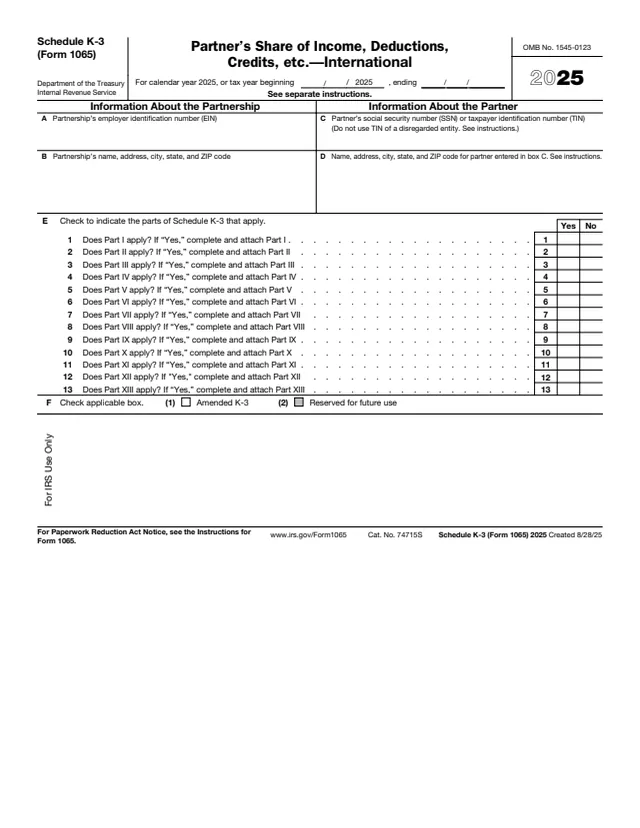
1065
2,862 fields, 21 pages
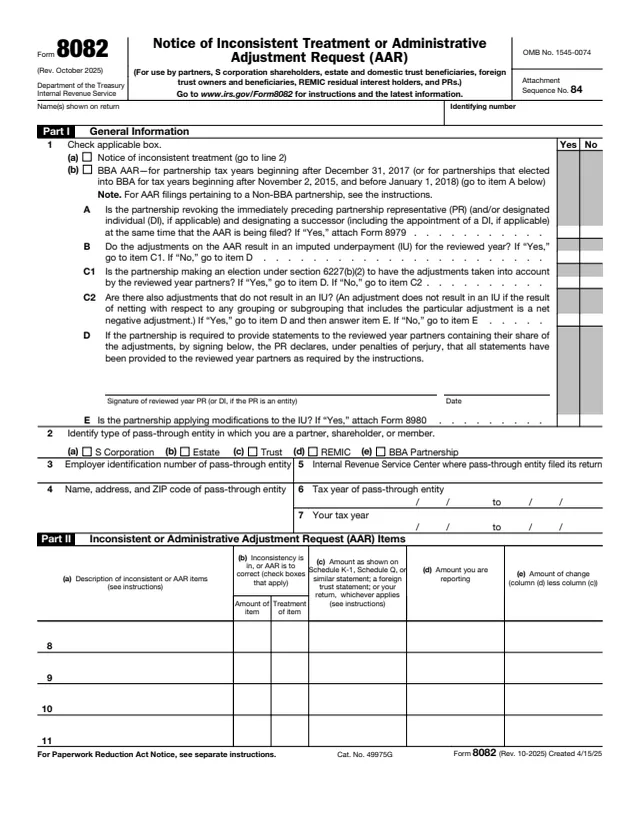
8082
59 fields, 2 pages
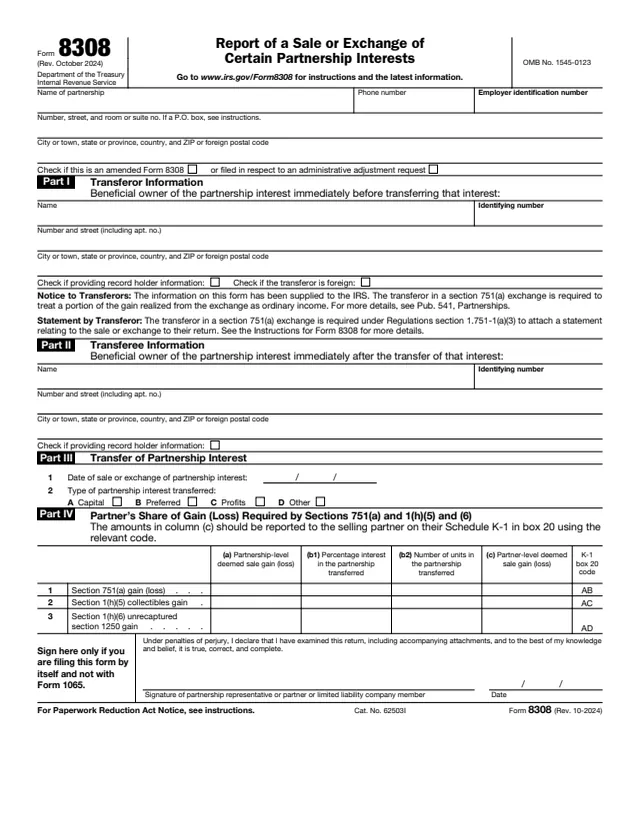
8308
40 fields, 1 page
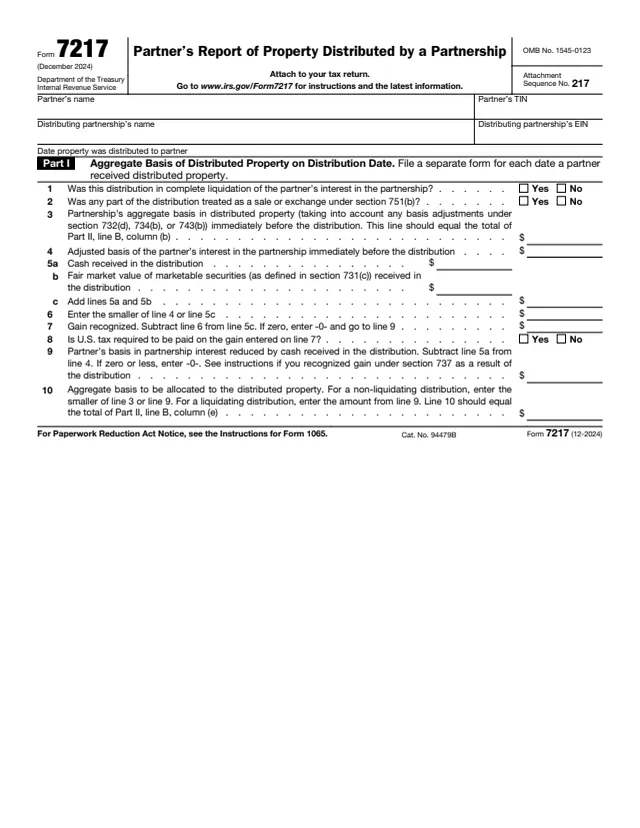
7217
306 fields, 2 pages
The partnership completes a Schedule K-1 for each partner, files a copy with the IRS and gives the partner a copy. The partner uses it to report the items on their own return.
No tool matches that search.
The instructions say to keep it for your records and not file it with your tax return unless you're specifically required to do so. The partnership files a copy with the IRS.
The instructions say the schedule may show only the last four digits for your protection, but the partnership has reported the complete identifying number to the IRS.
Not necessarily. The instructions say the ending capital account may not equal the adjusted tax basis in the partnership interest, partly because basis includes a share of partnership liabilities. The partner tracks their own basis.
The instructions say the loss and deduction a partner may claim may be less than the amount reported. They list the basis, at-risk, passive activity and excess business loss limitations, applied in that order.
Notify the partnership and ask for a corrected Schedule K-1. The instructions say not to change any items on your copy.
If it is checked, Schedule K-3 is attached with items of international tax relevance. The Partner's Instructions for Schedule K-3 have more detail.
The instructions say a calendar-year partner reports the amounts on the return for the year in which the partnership's fiscal year ends.