Introduction and common errors
Explains the seven tools in the series and lists errors from IRS audits of public employers, including treatment of certain groups of workers as independent contractors instead of as employees.
14581-G
Employee or Independent Contractor Compliance Self-Assessment For Public Employers
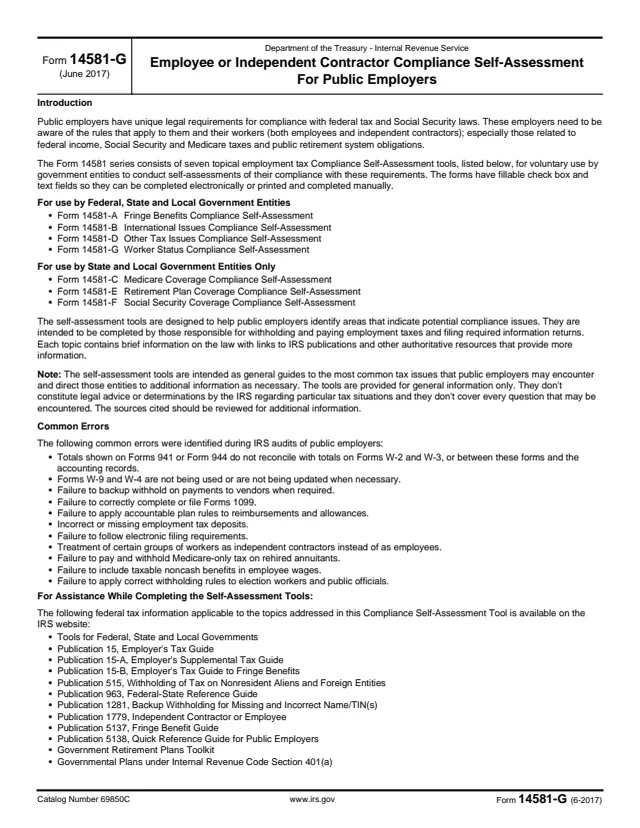
Form 14581-G, Employee or Independent Contractor Compliance Self-Assessment For Public Employers, is a checklist for government employers. The form says the Form 14581 series consists of seven topical employment tax Compliance Self-Assessment tools for voluntary use by government entities. Its list calls this one the Worker Status Compliance Self-Assessment, for use by federal, state and local government entities.
This form covers worker status and refers to Publication 963. It summarizes the common law categories of evidence (behavioral control, financial control and type of relationship), then asks whether all workers are properly classified as employees or independent contractors, how elected officials, appointed officials and fee-based positions are classified, and whether any employees receive Form 1099-MISC for services substantially similar to services reported as wages on Form W-2. Each question has Yes, No and Follow Up boxes, a note and a Comments field.
The form says the tools are provided for general information only and don't constitute legal advice or determinations by the IRS. You can fill out the PDF free in your browser on this page and download it without an account.
Explains the seven tools in the series and lists errors from IRS audits of public employers, including treatment of certain groups of workers as independent contractors instead of as employees.
Three categories of evidence with their factors: behavioral control (such as type of instructions and training), financial control (such as significant investment and method of payment) and type of relationship (such as written contracts and employee benefits).
Whether all workers are properly classified as employees or independent contractors, with references to Publication 963, Chapter 4, and Form SS-8.
Whether the entity has elected officials, appointed officials or fee-based positions, and if so, whether they are classified as employees. A note explains each category.
Whether any employees receive Form 1099-MISC for services substantially similar to services performed by employees and reported as wages on Form W-2.
A closing space for notes and follow-up items after all questions are answered.
The form says the tools are intended for those responsible for withholding and paying employment taxes and filing required information returns. It has fillable fields for completing it on screen or on paper.
Read the behavioral control, financial control and type of relationship factors on page 2, and use the Comments field below them for notes.
Check Yes, No or Follow Up for whether all workers are properly classified. The note says the three categories of evidence should be considered for each worker.
Answer whether the entity has workers in categories a, b and c and whether they are classified as employees, then mark the boxes for elected officials, appointed officials and fee-based positions.
Mark the boxes for dual-status workers. If yes, the form says the amounts reported on Forms 1099-MISC should be reported as wages subject to applicable employment taxes and not on Form 1099-MISC.
Use the Comments field under each question to record details, and list open items in Notes/Follow-up at the end.
You get the real form, filled in a browser tab, with nothing standing between you and the finished PDF.
The form prints no filing address, deadline or signature line. It describes itself as a self-assessment tool for voluntary use by government entities.
The form says the tools are provided for general information only. They don't constitute legal advice or determinations by the IRS regarding particular tax situations, and they don't cover every question.
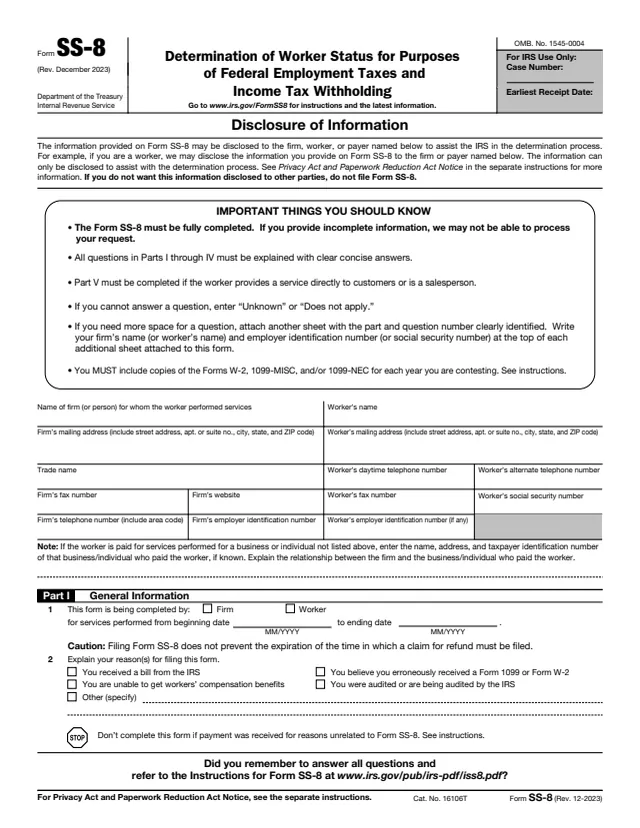
The form says Form SS-8, Determination of Worker Status for Purposes of Federal Employment Taxes and Income Tax Withholding, can be submitted to the IRS for a determination on a particular worker.
The form says elected officials are employees for income tax withholding purposes under Internal Revenue Code Section 3401(c).
The form points to Publication 963, Chapter 4, for worker classification. Page 1 also lists Publication 1779, Independent Contractor or Employee, and Publication 5138, Quick Reference Guide for Public Employers.
SS-8
299 fields, 5 pages
1099-MISC
179 fields, 6 pages
W-2
568 fields, 11 pages
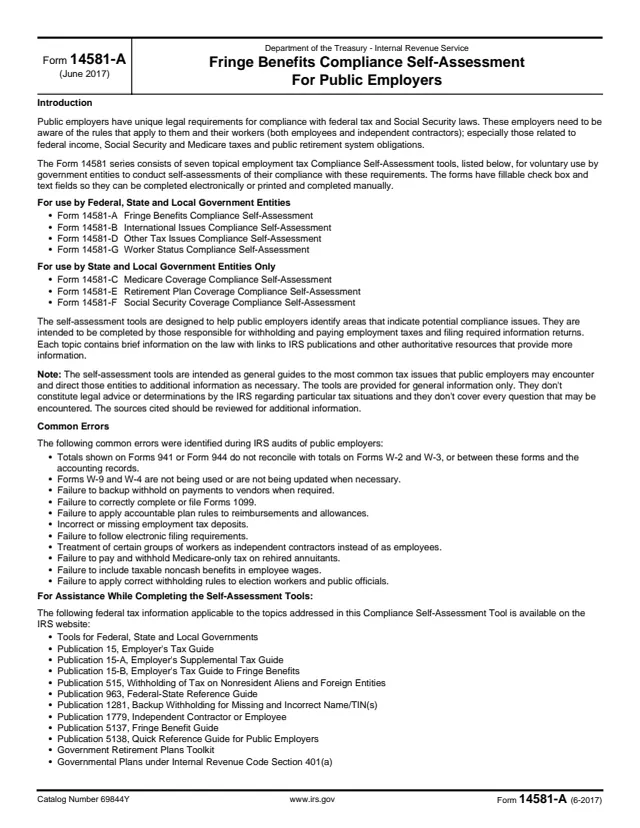
14581-A
45 fields, 4 pages
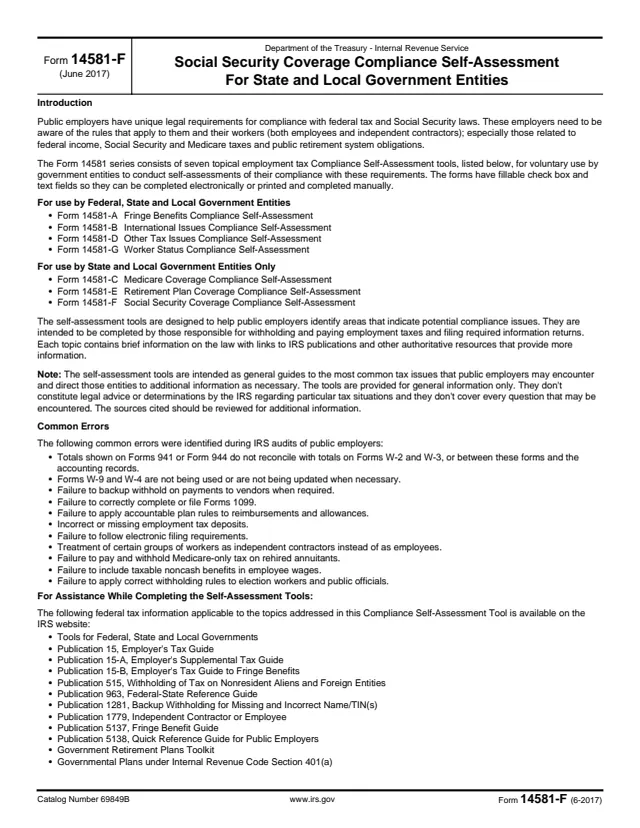
14581-F
19 fields, 4 pages
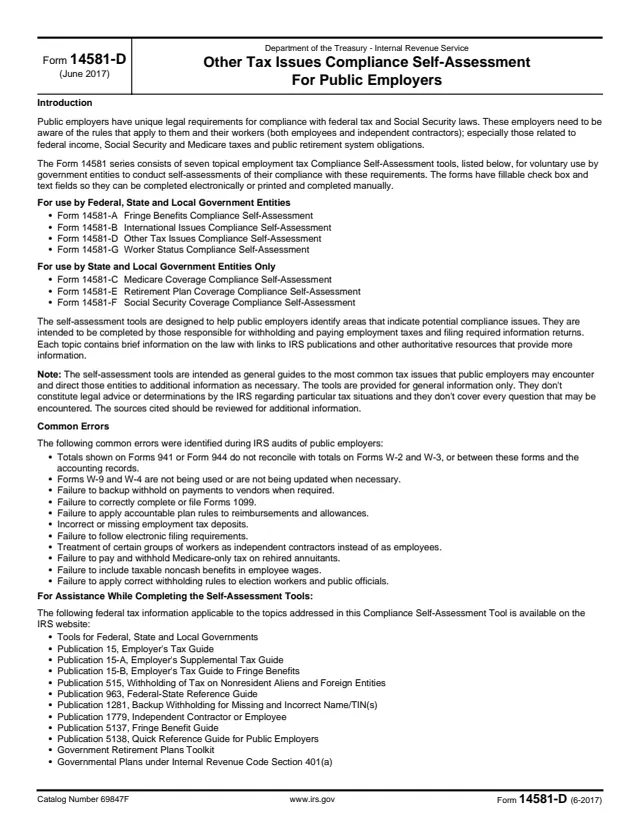
14581-D
100 fields, 3 pages
The form says the self-assessment tools are intended to be completed by those responsible for withholding and paying employment taxes and filing required information returns at a public employer.
No tool matches that search.
The form prints no filing address or deadline. It describes the Form 14581 series as tools for voluntary use by government entities to assess their own compliance.
Public employers. The form lists it for use by federal, state and local government entities, completed by those responsible for employment taxes and information returns.
No. The form says the tools don't constitute determinations by the IRS. It points to Form SS-8, which can be submitted to the IRS for a determination on a particular worker.
Behavioral control, financial control and type of relationship. The form lists the factors that fall under each one.
The form says the Supreme Court has held that public officials are employees, and that elected officials are employees for income tax withholding purposes under IRC Section 3401(c).
Question 3 asks about employees who receive Form 1099-MISC for services substantially similar to services performed by employees and reported as wages on Form W-2.