Section I: Applicability
Whether the plan offers elective deferrals and whether elective deferrals are properly defined under the plan.
15417-G
403(b) Plan Elective Deferrals Worksheet 12A – Determination of 403(b) Status
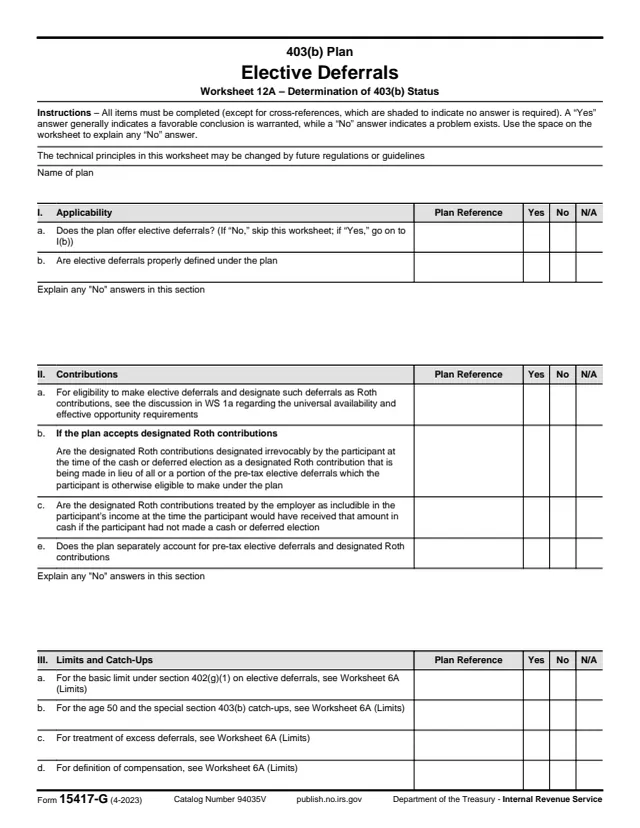
Form 15417-G (4-2023) is a two-page IRS worksheet titled 403(b) Plan Elective Deferrals. Its title also calls it Worksheet 12A, Determination of 403(b) Status. It goes through a named 403(b) plan's elective deferral terms in six sections: applicability, contributions, limits and catch-ups, universal availability, vesting, and eligible automatic contribution arrangements (EACAs). Each question has a Plan Reference column and Yes, No and N/A boxes.
The instructions printed at the top of page 1 say "All items must be completed (except for cross-references, which are shaded to indicate no answer is required)." A "Yes" answer generally indicates a favorable conclusion is warranted, while a "No" answer indicates a problem exists. The form also notes that its technical principles may be changed by future regulations or guidelines.
The worksheet does not say who fills it out or where it goes, and no separate instructions are linked to it. You can fill it out free in your browser on this page and download the result without an account.
Whether the plan offers elective deferrals and whether elective deferrals are properly defined under the plan.
A cross-reference to WS 1a on eligibility, then three questions on designated Roth contributions: irrevocable designation, inclusion in income, and separate accounting from pre-tax elective deferrals.
Four cross-references to Worksheet 6A (Limits): the section 402(g)(1) basic limit, the age 50 and special section 403(b) catch-ups, excess deferrals, and the definition of compensation.
Cross-references to Worksheet 1A for universal availability under 1.403(b)-5(b), and to Worksheet 2B for vesting.
Items a to i on covered employees, the uniformity of the default percentage, notice, permissible withdrawals and their fees, the 402(g) limit, matching contributions, and the time to distribute excess aggregate contributions.
Enter the name of the 403(b) plan in the box at the top of page 1.
Answer item I(a). The form says a "No" means skipping this worksheet and a "Yes" means going on to I(b).
The instructions say cross-references are shaded to indicate no answer is required. Sections III, IV and V consist of items that point to Worksheets 6A, 1A and 2B.
Check one box for each remaining item. Each row also has a Plan Reference column; the form gives no further directions for it.
Complete Section VI if the plan contains EACA provisions. Items VI(e) and VI(f) begin with "If applicable".
Sections I, II and VI end with a space headed Explain any "No" answers in this section. The instructions at the top say to use it for every "No".
You get the real form, filled in a browser tab, with nothing standing between you and the finished PDF.
The worksheet prints no mailing address, filing method, recipient or deadline, and it has no signature line.
No IRS About page or instructions are linked to it. The directions are the paragraph at the top of page 1 and the notes printed under some items.
Each page footer prints Form 15417-G (4-2023), Catalog Number 94035V, Department of the Treasury, Internal Revenue Service.
The title calls it Worksheet 12A. It points to Worksheets 1A, 2B, 6A and 15, which the IRS listing titles as Forms 15417, 15417-A, 15417-D and 15417-H.
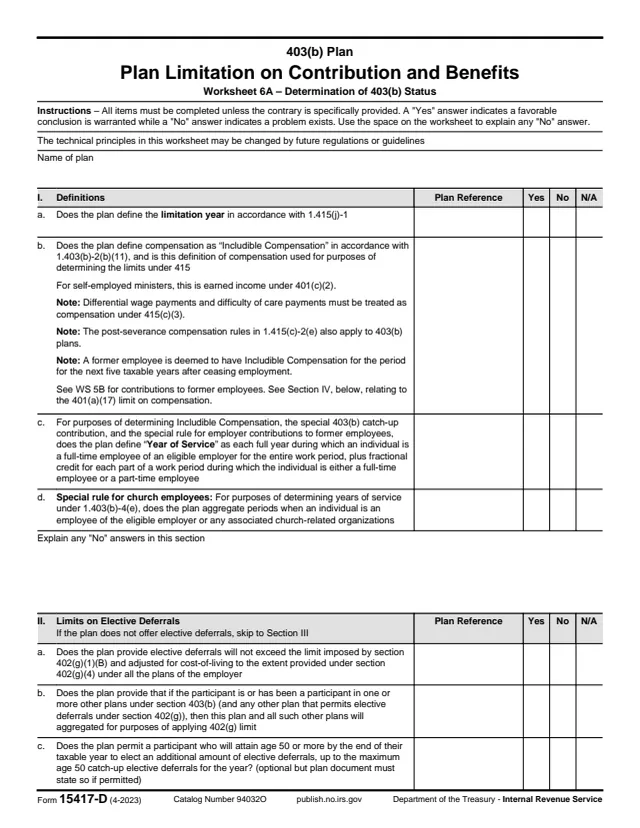
15417-D
105 fields, 3 pages
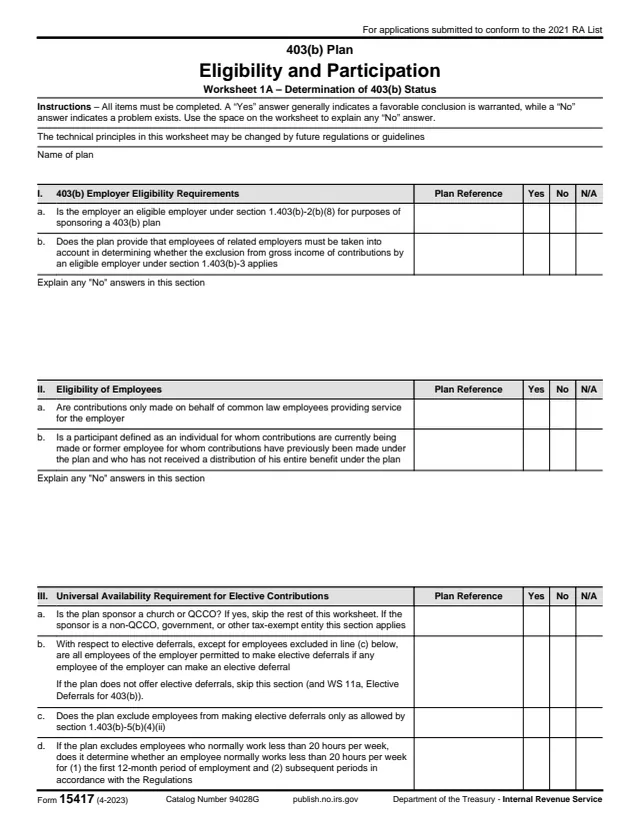
15417
81 fields, 2 pages
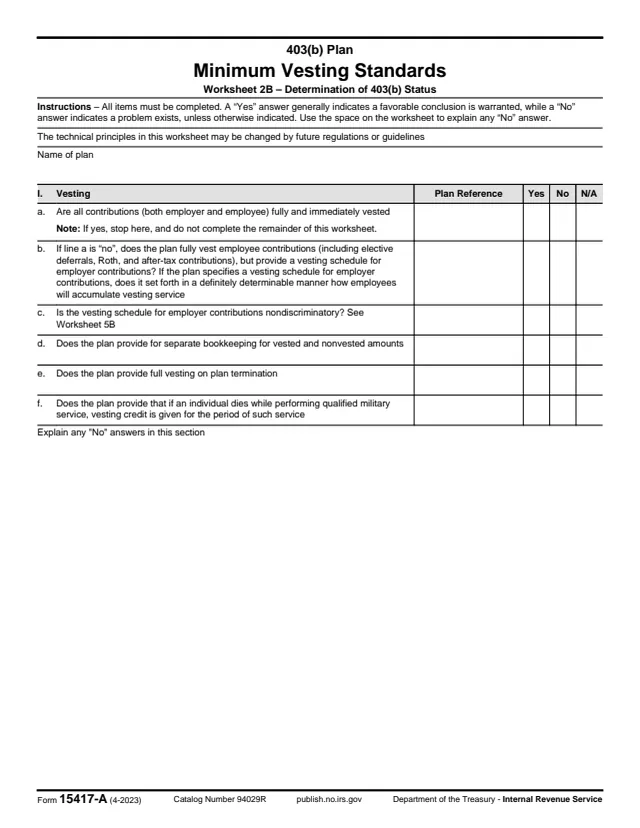
15417-A
26 fields, 1 page
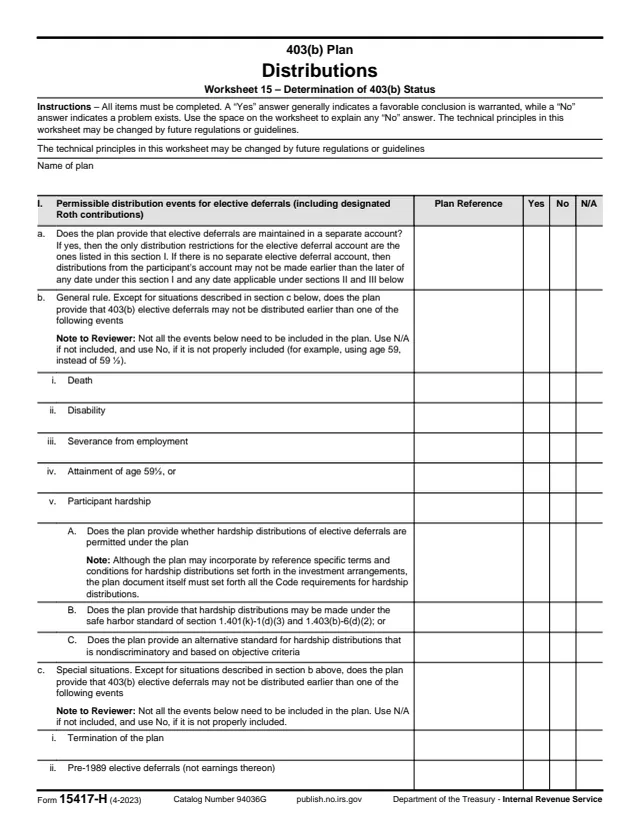
15417-H
257 fields, 5 pages
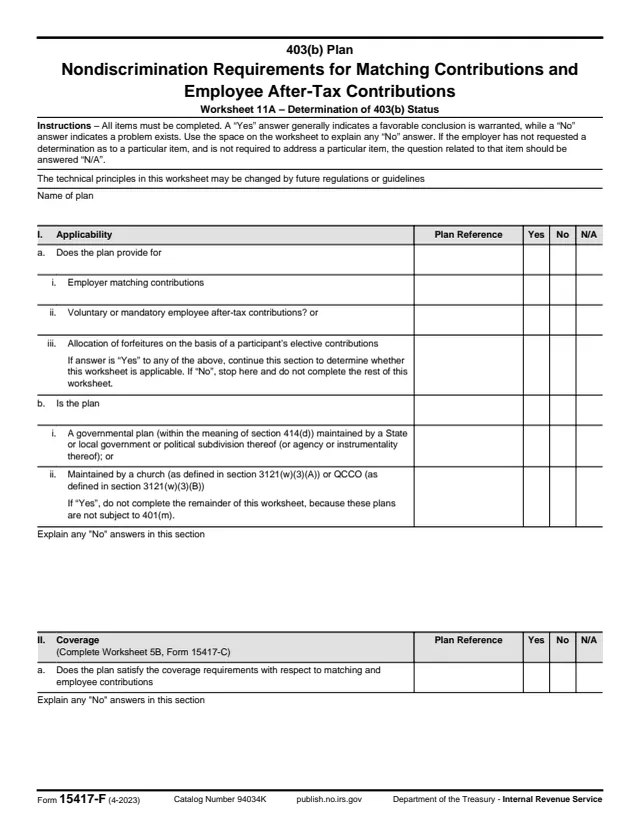
15417-F
286 fields, 6 pages
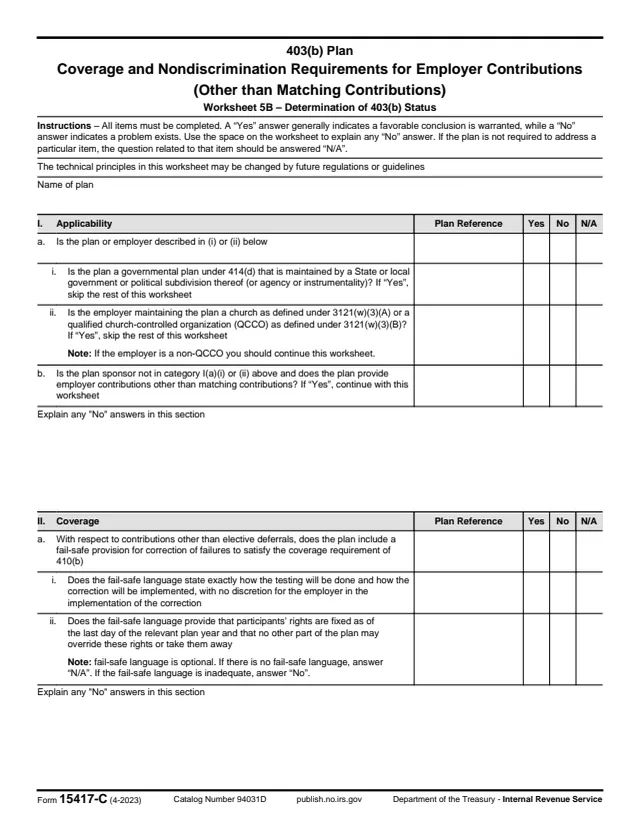
15417-C
104 fields, 3 pages
The worksheet does not name who completes it or who receives it. Its questions ask what a 403(b) plan document provides, not about a person's own taxes.
No tool matches that search.
The worksheet does not say. It asks about the elective deferral provisions of a named 403(b) plan and has no preparer, signature or recipient lines.
Item I(a) says that if the plan does not offer elective deferrals, the worksheet is skipped.
The instructions say cross-references are shaded to indicate no answer is required.
Section III points to Worksheet 6A (Limits) for the section 402(g)(1) basic limit, the age 50 and special section 403(b) catch-ups, excess deferrals and the definition of compensation.
If all participants are covered employees, it asks whether the plan states it has until 6 months (rather than 2½ months) after the end of the plan year to distribute excess aggregate contributions and avoid the Code § 4979 10% excise tax.
A note at the end of Section VI says to see WS 15 for requirements of distributions concerning elective deferrals. The IRS listing titles Form 15417-H as Worksheet 15.