Part 1: Type of application
An initial application (1.a.) or re-registration (1.b.), who granted TPS, whether you are filing Form I-765 for an EAD at the same time, and the name of the designated TPS country.
I-821
Application for Temporary Protected Status
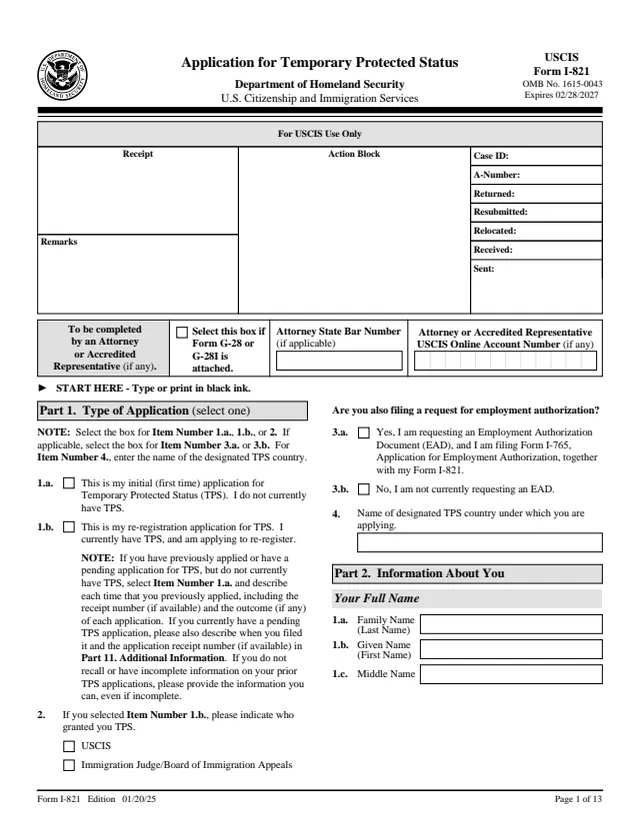
Form I-821, Application for Temporary Protected Status, is how a national of a country designated for TPS, or a person without nationality who last habitually resided there, applies for Temporary Protected Status. The instructions say the same form is used to re-register for TPS.
The USCIS page says TPS applicants wait to file until the Federal Register notice for their country is published. A first-time applicant registers during the period set in the notice announcing the designation or re-designation, and a TPS holder re-registers during the period set in the notice announcing an extension. The country pages on the USCIS Temporary Protected Status page give the dates.
The instructions say Form I-821 is only for TPS and not for Deferred Action for Childhood Arrivals (DACA), which uses Form I-821D. A request for an Employment Authorization Document (EAD) is made on Form I-765, filed with Form I-821 or later.
An initial application (1.a.) or re-registration (1.b.), who granted TPS, whether you are filing Form I-765 for an EAD at the same time, and the name of the designated TPS country.
Names, U.S. mailing address, A-Number, Social Security number, birth details, countries you entered before the United States, citizenship, marital status, last entry, Form I-94, passport, current status and any immigration proceedings.
Ethnicity, race, height, weight, eye color and hair color. The instructions say this can reduce the time spent at a biometrics appointment.
The instructions say Parts 4 and 5 are completed only for a late initial application. Part 6 lists your children, their addresses and any TPS they have had.
Nationality, date of entry and residence since, travel through other countries, and Items 8 to 41 on criminal history, persecution, security grounds and other admissibility questions.
Your statement, contact details and signature, the interpreter and preparer sections, and additional information space in Part 11.
The USCIS page says to wait for the Federal Register notice for your TPS country and to file during the registration or re-registration period it sets. The country pages also explain when a late filing may be possible.
The instructions say 1.a. is for anyone who does not have TPS now, even after an earlier application, with prior filings described in Part 11. 1.b. is only for a current TPS holder re-registering, who also completes Item 2.
The USCIS page says the form is rejected without the Part 1 type of application, your family name, a U.S. mailing address, your date of birth, or, for re-registration, your A-Number.
Select 3.a. if Form I-765 is filed with this application, or 3.b. if no EAD is requested now. The instructions say waiting means the EAD arrives several weeks after a later Form I-765 is filed.
The instructions say all of Part 7 is answered, and any Yes to Items 3 to 41 is explained in Part 11 with the places and dates of the events.
The instructions say a stamped or typewritten name is not accepted, and a parent or legal guardian may sign for an applicant under 14. This page lets you fill the form online free, then print it for signature.
You get the real form, filled in a browser tab, with nothing standing between you and the finished PDF.
The USCIS page says all applicants eligible under a current designation may file Form I-821 online. A paper application goes to the address listed on the TPS page for the country. The instructions say people in Immigration Court proceedings file with that court.
The fee is on the USCIS Fee Schedule page, and the instructions point to Form G-1055. The USCIS page says certain inflation-adjusted H.R.-1 fees took effect Oct. 16, 2026, and that requests postmarked on or after that date without the proper filing fee are rejected. Check the fee on the day you file.
The instructions list copies of a passport, a birth certificate with photo identification or a national identity document, plus proof of entry such as Form I-94, and proof of residence such as pay stubs, rent receipts, utility bills, school or medical records.
The instructions say re-registration does not need copies of documents, though USCIS may ask for more. A first re-registration with USCIS after an Immigration Judge or Board of Immigration Appeals grant includes a copy of that decision.
The instructions ask for certified copies of arrest reports, court dispositions and sentencing documents for any arrest, charge or conviction, even if the record was sealed or expunged, and explain what to send when records are not available.
The instructions say applicants give fingerprints, photographs and a digital signature, and USCIS may reuse earlier biometrics for re-registration. An EAD is not a travel document, and travel abroad uses Form I-131 for an Advance Parole Document.
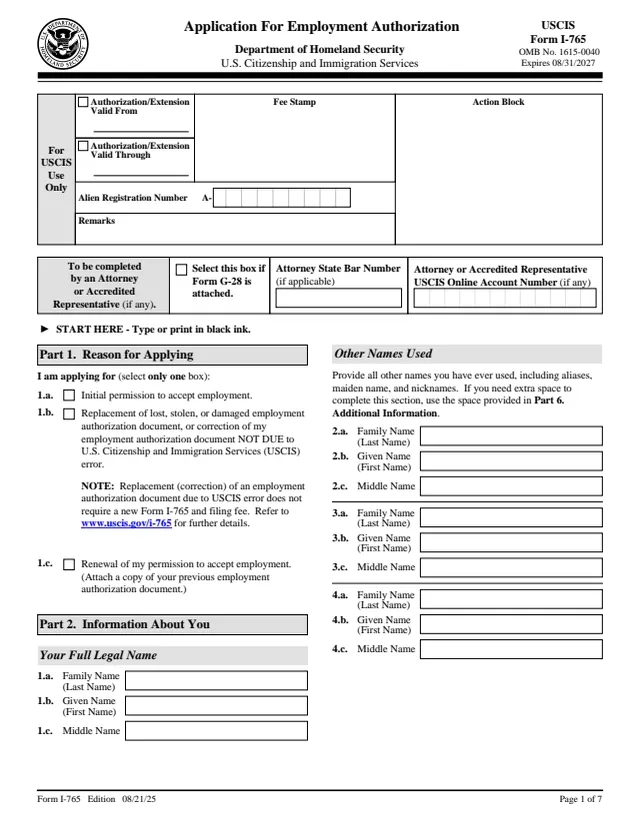
I-765
161 fields, 7 pages
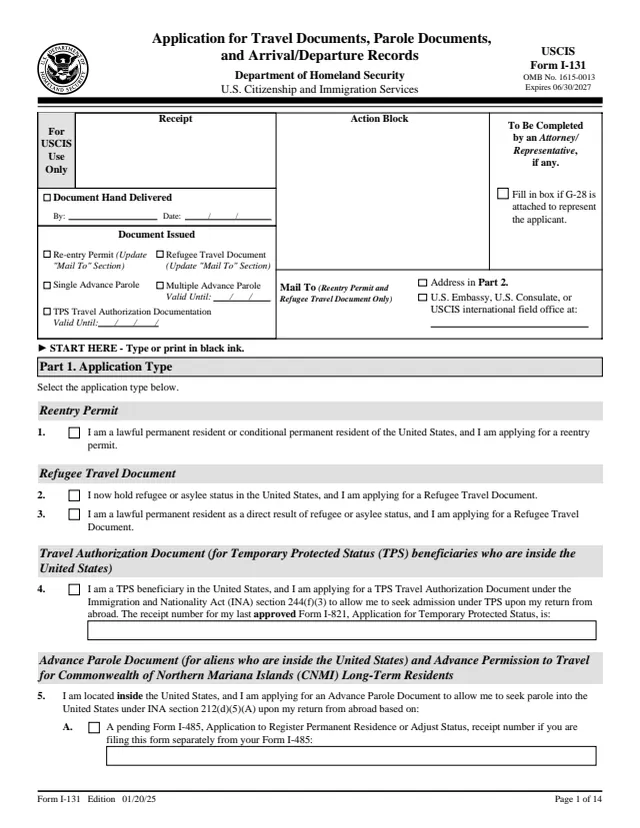
I-131
339 fields, 14 pages
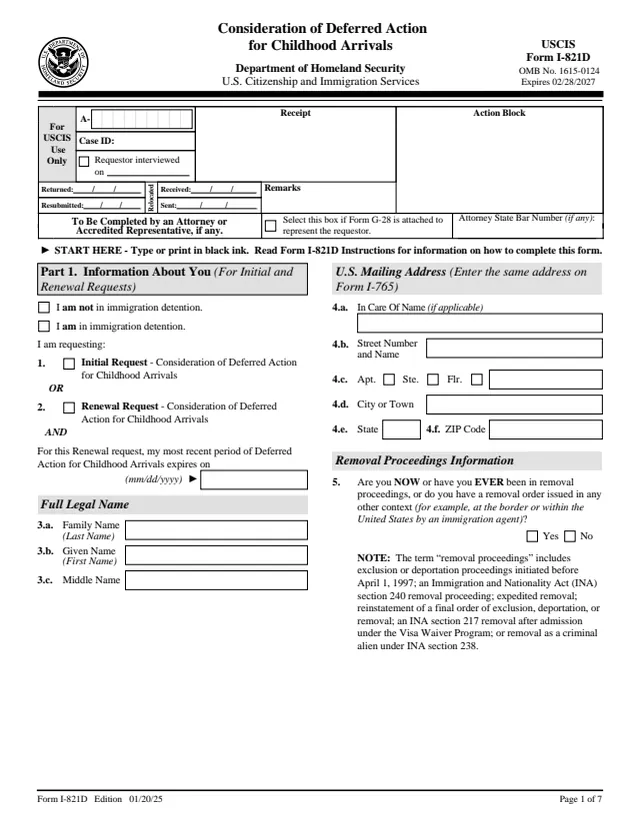
I-821D
234 fields, 7 pages
G-1145
6 fields, 1 page
I-102
115 fields, 5 pages
G-28
101 fields, 4 pages
No tool matches that search.
No. The instructions say there is no derivative TPS. Each spouse, child or parent files a separate Form I-821 and qualifies individually.
Yes. The USCIS page says all applicants eligible to file under one of the current designations may file online. A paper application goes to the address on the TPS page.
The USCIS page says to wait until the Federal Register notice for your country is published, then file during the registration or re-registration period that notice sets.
It can be. The instructions say Form I-765 is needed only to request an EAD, and it may be filed with Form I-821 or later. Filing later means the EAD comes several weeks after that Form I-765 is filed.
No. The instructions say Form I-821 is only for TPS. DACA requests use Form I-821D.
The instructions say an EAD is not a travel document. A TPS holder who travels abroad and returns requests an Advance Parole Document with Form I-131.
USCIS fees change, so this page does not list one. The I-821 page points to the USCIS Fee Schedule and says certain new inflation-adjusted H.R.-1 fees apply to requests postmarked on or after Oct. 16, 2026.