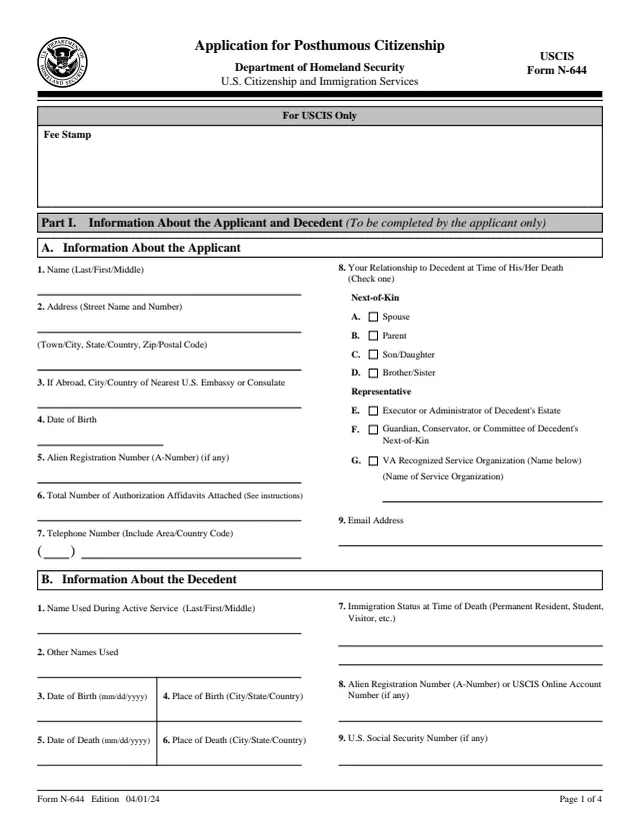
Part I.A: Information About the Applicant
Your name, address, the nearest U.S. Embassy or Consulate if abroad, date of birth, A-Number, the number of authorization affidavits attached, phone, email, and your relationship to the decedent.
N-644
Application for Posthumous Citizenship
Under Public Law 101-249, Form N-644 is used to request posthumous citizenship for an alien or noncitizen national whose death resulted from injury or disease incurred on active duty with the U.S. armed services during specified periods of military hostilities.
The USCIS page calls posthumous citizenship an honorary status commemorating the bravery and sacrifices of these persons. If the application is approved, USCIS sends Form N-645, Certificate of Citizenship, in the name of the decedent. The page says the certificate only establishes that USCIS considers the person a citizen of the United States as of the date of death.
The instructions say the application is filed no later than two years after the date of the decedent's death, by a close relative or a representative listed in the instructions.
Your name, address, the nearest U.S. Embassy or Consulate if abroad, date of birth, A-Number, the number of authorization affidavits attached, phone, email, and your relationship to the decedent.
The name used during active service, other names, dates and places of birth and death, immigration status at the time of death, A-Number or USCIS online account number, and Social Security number.
Parents, marital status, service number, active duty dates and place, branch, discharge type, rank, VA claim number, and each child and sibling with whether they are living or deceased.
A certification under penalty of perjury that the information in Part I is true and correct, with your signature, date, printed name and address.
Parts II and III are completed by a Department of Defense official for the branch of service, and Part IV by USCIS. The instructions say to complete only Part I.
The instructions say the application is filed no later than two years after the date of the decedent's death.
When affidavits from higher next of kin are needed, enter the total number attached in Part I.A, Item 6. The instructions say an affidavit in another language comes with a certified English translation.
Type or print in black ink. The instructions say to write N/A where an item does not apply and none where the answer is none, and to attach a separate sheet with your name and A-Number for extra space.
Items 22 to 25 ask for the total number of children and of brothers and sisters, writing None if there are none, and the name, date of birth and living or deceased status of each one.
The instructions say USCIS does not accept a stamped or typewritten name in place of a signature, and rejects an unsigned application.
The instructions list Form DD214, Form DD 1300 or another military or state certificate of death, if available. They say a missing document may not lead to denial but delays the certification.
You get the real form, filled in a browser tab, with nothing standing between you and the finished PDF.
The USCIS page says to mail the completed application to the USCIS California Service Center, P.O. Box 30113 / ALL OTHER, Tustin, CA 92781. Check the page before you send.
The instructions say a United States address is needed to file this application.
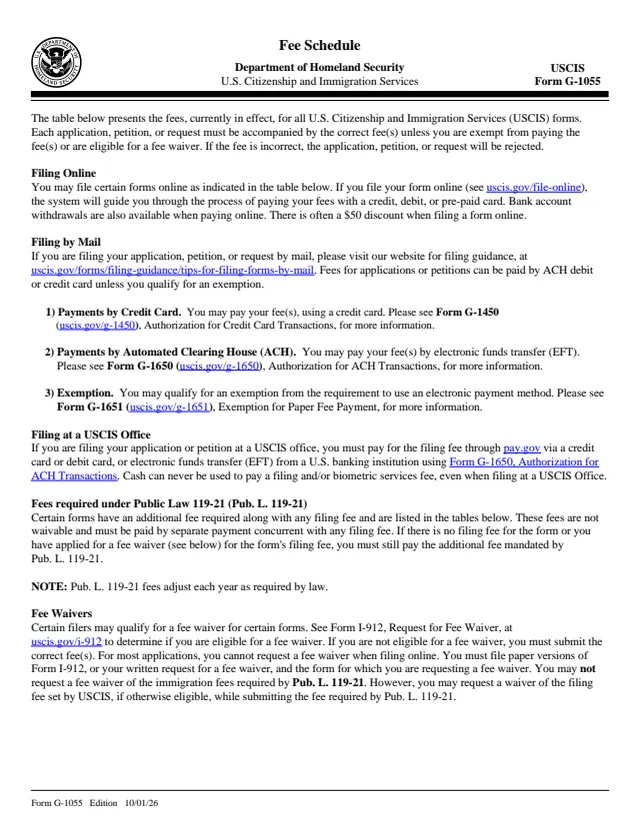
The USCIS page says the filing fee is on its Fee Schedule page, and the instructions point to Form G-1055. Fees can change, so check them on the day you file.
The page lists authorization documents from all living next of kin above the applicant (not needed for a spouse or executor or administrator), a certified copy of a letter of appointment if one applies, and evidence of VA recognition for an organization.
Send legible photocopies unless an original is requested, and include a full English translation with the translator's certification for any foreign-language document.
The instructions say that once a Certificate of Citizenship is issued for a veteran, USCIS does not approve a later application for that person, except to replace a certificate that was lost, mutilated or destroyed.
No tool matches that search.
The two USCIS sources word this differently. The N-644 page says it does not convey any benefits under the INA to any relative. The instructions say the certificate allows certain qualifying family members to apply under INA section 319(d) or remain classified as immediate relatives.
Yes. The instructions say the application is filed no later than two years after the date of the decedent's death.
The form reserves Parts II and III for a Department of Defense official for the branch of service and Part IV for USCIS. The instructions say the applicant completes only Part I.
The USCIS page says it sends Form N-645, Certificate of Citizenship, in the name of the decedent, and that the certificate is invalid for purposes other than establishing citizenship as of the date of death.
USCIS fees change, so this page does not list one. The N-644 page points to the USCIS Fee Schedule, and the instructions point to Form G-1055.