Tax year
The top of the form takes a calendar year or a short year with beginning and ending dates.
1041-QFT
U.S. Income Tax Return for Qualified Funeral Trusts
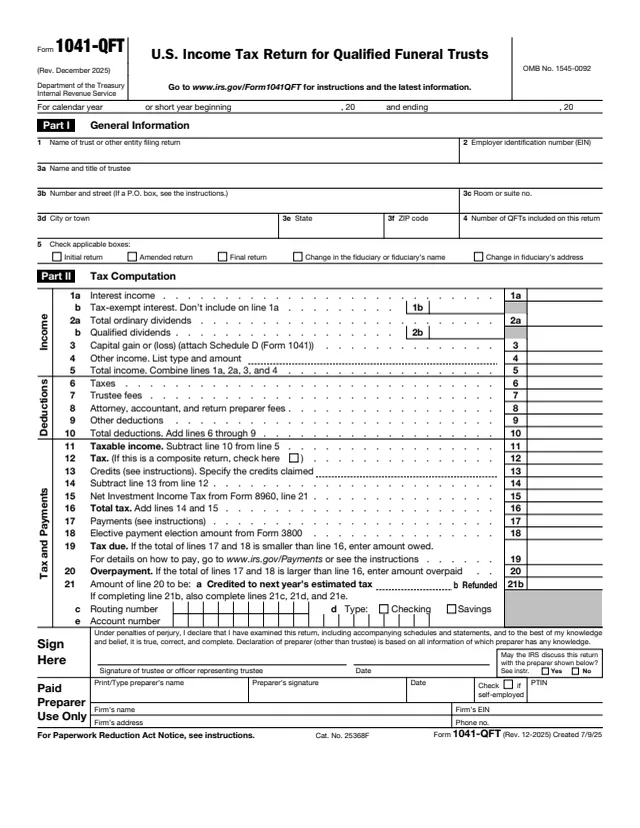
Form 1041-QFT is the income tax return for qualified funeral trusts. The IRS says the trustee of a trust that has elected to be taxed as a qualified funeral trust (QFT) files Form 1041-QFT to report the income, deductions, gains, losses, etc., and income tax liability of the QFT.
The form is filed by the trustee, not by the people the funeral trust serves. It has two parts: general information about the trust and trustee, and a tax computation covering income, deductions, tax, payments and any refund. The trustee or an officer representing the trustee signs it.
One return can include more than one QFT: line 4 asks for the number of QFTs included, and line 12 has a box for a composite return. The trustee can fill out Form 1041-QFT free in the browser on this page and download the result without an account.
The top of the form takes a calendar year or a short year with beginning and ending dates.
Lines 1 to 5: name of the trust or other entity, EIN, trustee name, title and address, number of QFTs, and boxes for initial, amended or final return and fiduciary changes.
Lines 1a to 5: interest, tax-exempt interest (not included on line 1a), ordinary and qualified dividends, capital gain or loss from Schedule D (Form 1041), other income and total income.
Lines 6 to 11: taxes, trustee fees, attorney, accountant and return preparer fees, other deductions, total deductions and taxable income.
Lines 12 to 21: tax, credits, Net Investment Income Tax from Form 8960, payments, the elective payment election amount from Form 3800, tax due or overpayment, and refund details.
The trustee's declaration and signature, a Yes or No box on whether the IRS may discuss the return with the preparer, and the Paid Preparer Use Only section.
Enter the calendar year or short year dates, then the trust's name and EIN, the trustee's name, title and address, and the number of QFTs on the return. If the address is a P.O. box, the form says to see the instructions.
Check any box that applies: initial return, amended return, final return, change in the fiduciary or fiduciary's name, or change in fiduciary's address.
Enter interest and dividends, show tax-exempt interest on line 1b only, attach Schedule D (Form 1041) for capital gain or loss, list the type and amount of other income, and total lines 1a, 2a, 3 and 4.
Enter taxes, trustee fees, professional fees and other deductions, add lines 6 through 9, and subtract line 10 from line 5 for taxable income.
Figure the tax and any credits, add Net Investment Income Tax from Form 8960, line 21, then compare lines 17 and 18 with line 16 to show tax due or an overpayment. A refund on line 21b needs the routing number, account type and account number.
The trustee or an officer representing the trustee signs and dates the return, and checks whether the IRS may discuss it with the preparer shown.
You get the real form, filled in a browser tab, with nothing standing between you and the finished PDF.
The form says to go to www.irs.gov/Form1041QFT for instructions and the latest information. The About page links no separate instructions file, so the filing address and due date are not shown here.
Line 19 says that for details on how to pay, go to www.irs.gov/Payments or see the instructions.
Line 21 splits an overpayment between a credit to next year's estimated tax and a refund, with direct deposit details on lines 21c to 21e.
Schedule D (Form 1041) for line 3, Form 8960 for line 15 and Form 3800 for line 18.
The IRS About page lists Form 1041, Form 1041-ES, Form 2210, Form 3115, Form 7004, Form 8822-B, Form 8960 and Form SS-4 as related.
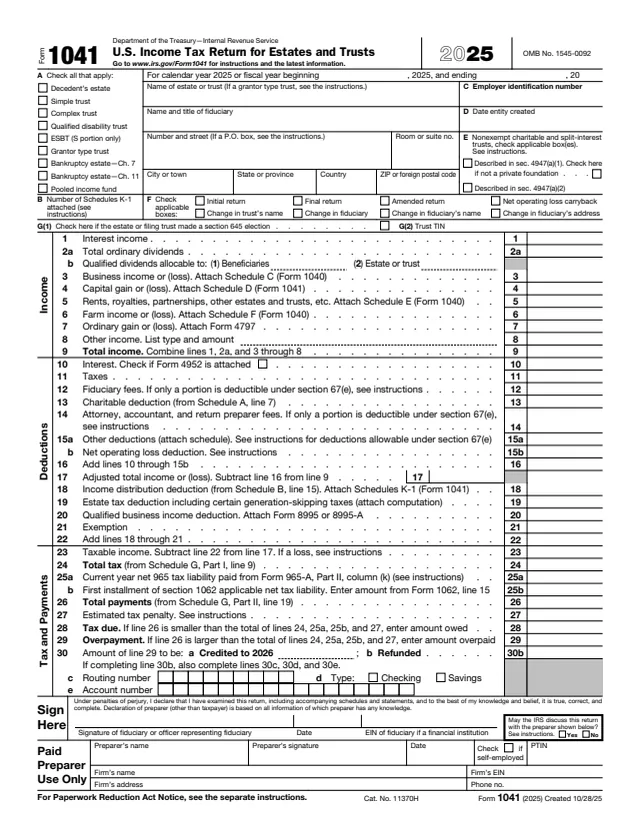
1041
173 fields, 3 pages
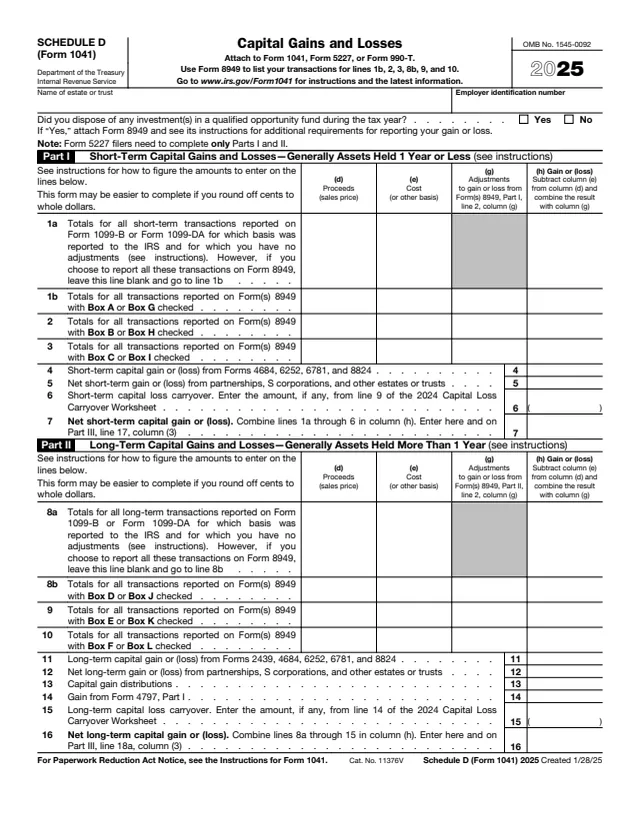
1041
87 fields, 2 pages
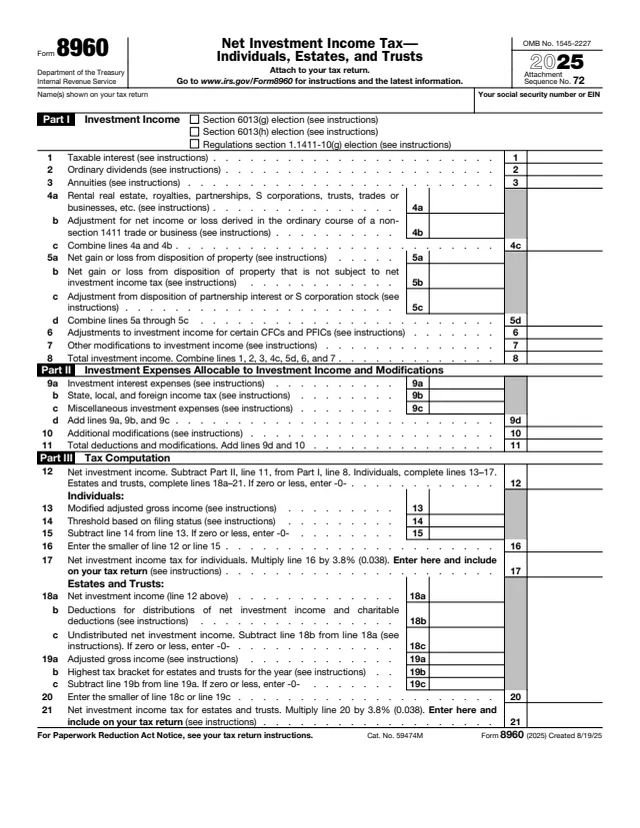
8960
38 fields, 1 page
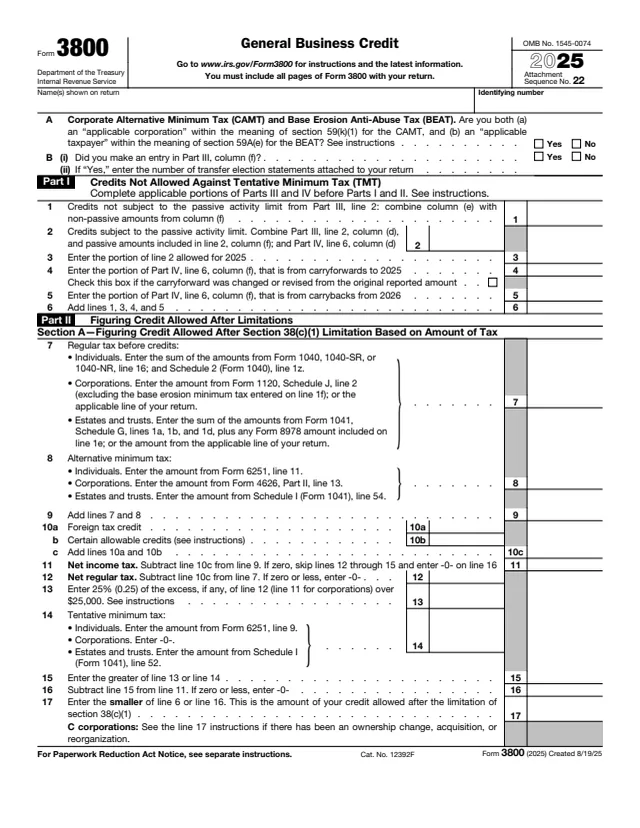
3800
1,921 fields, 9 pages
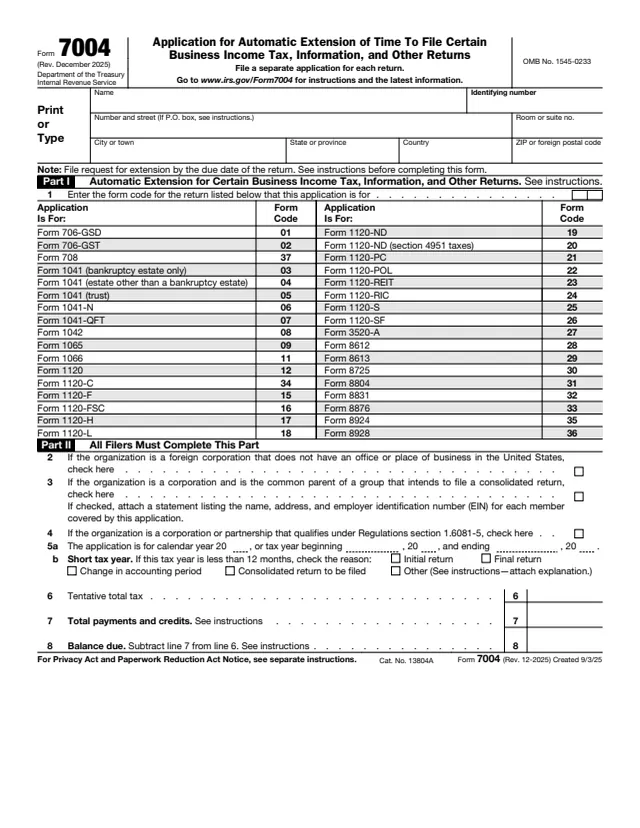
7004
26 fields, 1 page
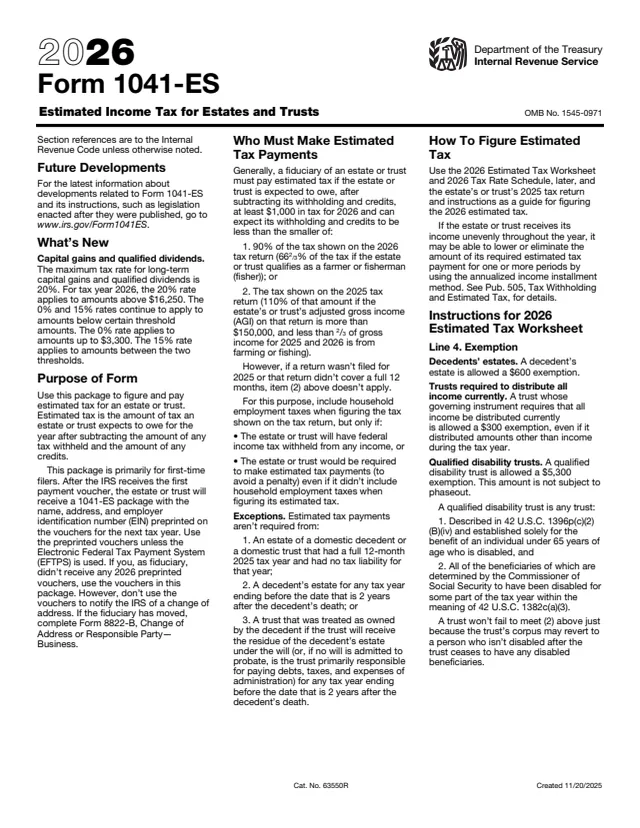
1041-ES
116 fields, 7 pages
The IRS About page says the trustee of a trust that has elected to be taxed as a qualified funeral trust files this return.
No tool matches that search.
The IRS says the trustee of a trust that has elected to be taxed as a qualified funeral trust files it to report the QFT's income, deductions, gains, losses and income tax liability.
The form has room for it. Line 4 asks for the number of QFTs included on the return, and line 12 has a box to check for a composite return.
It is shown on line 1b. The form says not to include it on line 1a, so it does not enter total income on line 5.
The form names Schedule D (Form 1041) for capital gain or loss, Form 8960 for Net Investment Income Tax and Form 3800 for the elective payment election amount.
The form points to www.irs.gov/Form1041QFT for instructions and the latest information. The About page lists no separate instructions file.