Page 1: income and deductions
Gross receipts, cost of goods sold, dividends, interest, rents and other income, then deductions such as salaries, depreciation and the section 199A(g) deduction, down to taxable income.
1120-C
U.S. Income Tax Return for Cooperative Associations
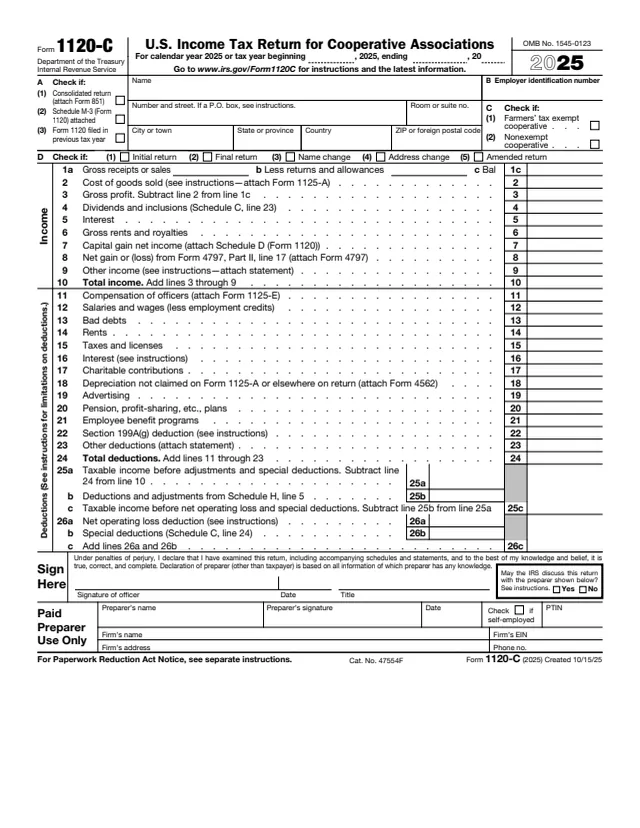
Form 1120-C, U.S. Income Tax Return for Cooperative Associations, is the annual income tax return of a corporation operating on a cooperative basis. The IRS About page says cooperatives file it to report their income, gains, losses, deductions and credits, and to figure their income tax liability.
Besides income, deductions, tax and payments, the return has schedules specific to cooperatives: Schedule G allocates income and deductions between patronage and nonpatronage business, and Schedule H covers deductions and adjustments under section 1382, such as patronage dividends. It also carries Schedule C for dividends and special deductions, Schedule J for the tax computation, Schedule K for other information, and the balance sheet and reconciliation schedules.
This page has the 2025 form. The instructions note new lines 29 and 30i for the section 1062 farmland election. You can fill out Form 1120-C free in your browser on this page and download it without an account.
Gross receipts, cost of goods sold, dividends, interest, rents and other income, then deductions such as salaries, depreciation and the section 199A(g) deduction, down to taxable income.
Taxable income, total tax, section 1062 lines, estimated payments and credits, the estimated tax penalty, amount owed or overpayment, and direct deposit fields.
Dividends and inclusions by type with the printed deduction percentages, totaled to page 1, lines 4 and 26b.
Schedule G splits income and deductions between patronage and nonpatronage. Schedule H lists dividends on capital stock, nonpatronage income allocated to patrons and patronage dividends.
The tax computation with credits, and yes or no questions on accounting method, ownership, foreign patrons, NOLs and the corporate alternative minimum tax.
Balance sheets per books, the reconciliation of book income with return income, and the analysis of unappropriated retained earnings.
Enter the tax year, name, address and EIN. Item A covers a consolidated return, an attached Schedule M-3 (Form 1120) or Form 1120 filed last year. Item C asks if the cooperative is farmers' tax exempt or nonexempt.
The form says that if total receipts and total assets at year end are less than $250,000, the cooperative is not required to complete Schedules G, L, M-1 or M-2.
Complete Schedule H before Schedule G, line 8, as the instructions say. Allocate the Schedule H, line 5 amount between patronage and nonpatronage, and carry it to page 1, line 25b.
Report income and deductions to reach taxable income on line 27, then total tax from Schedule J, payments and credits, and the amount owed or overpaid.
An authorized officer signs, dates and enters a title. Check Yes to let the IRS discuss the return with the paid preparer who signed it.
You get the real form, filled in a browser tab, with nothing standing between you and the finished PDF.
The instructions say a cooperative with its principal business, office or agency in the United States files at Department of the Treasury, Internal Revenue Service, Ogden, UT 84201-0012.
If the principal business, office or agency is in a foreign country or a U.S. territory, the instructions give Internal Revenue Service, P.O. Box 409101, Ogden, UT 84409.
The instructions say a cooperative described in section 6072(d) generally files by the 15th day of the 9th month after its tax year ends. Others generally file by the 15th day of the 4th month, or the 3rd month for a June 30 year end.
The instructions say Form 7004 requests an extension of time to file and is generally filed by the regular due date of the return.
The instructions say that for returns required to be filed in 2026, the minimum penalty for a return more than 60 days late is the lesser of the tax due or $525.
The instructions say cooperatives use electronic funds transfer for federal tax deposits, and estimated tax installments are due by the 15th day of the 4th, 6th, 9th and 12th months of the tax year.
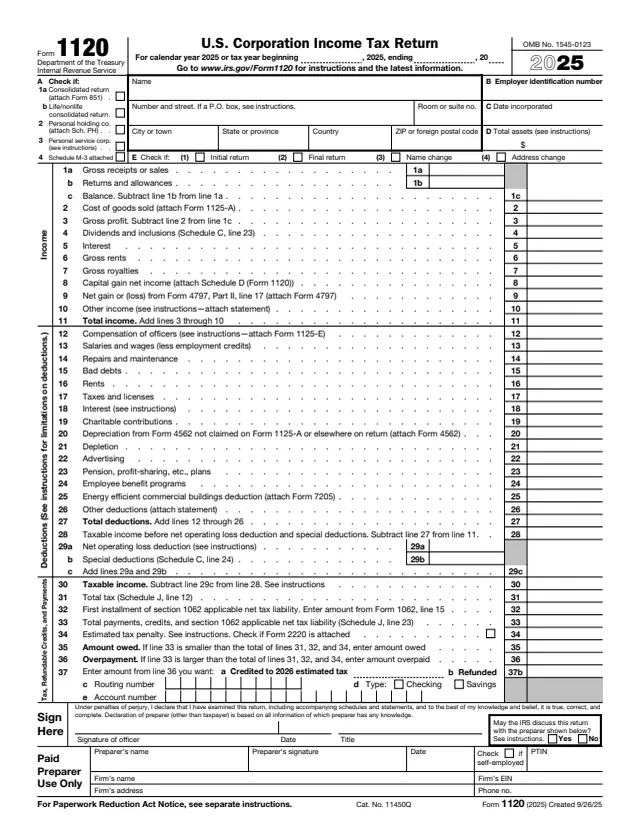
1120
481 fields, 6 pages
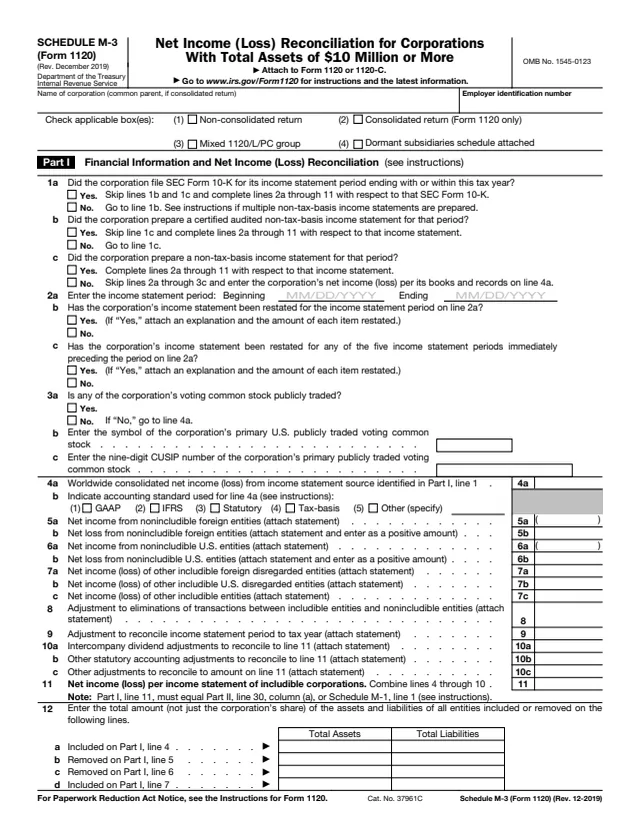
1120 Sch. M-3
380 fields, 3 pages
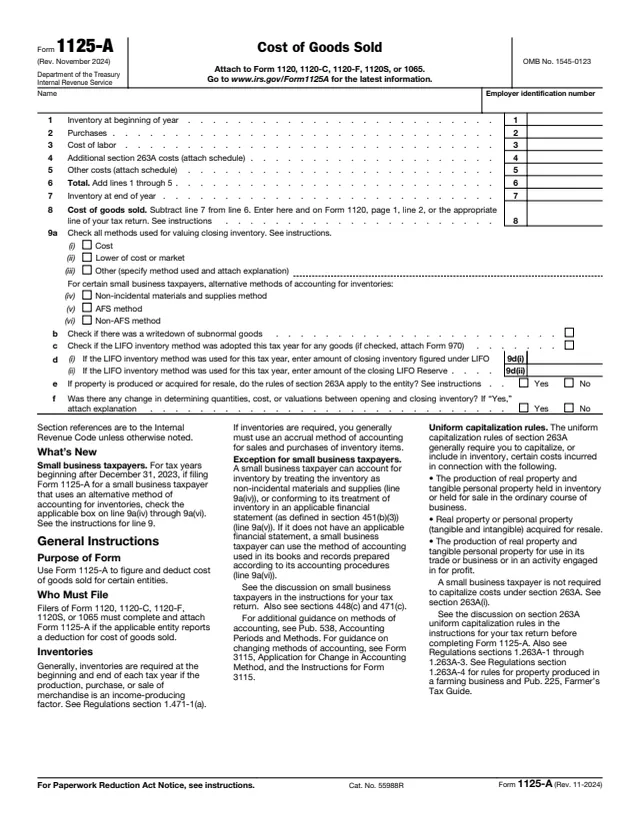
1125-A
25 fields, 3 pages
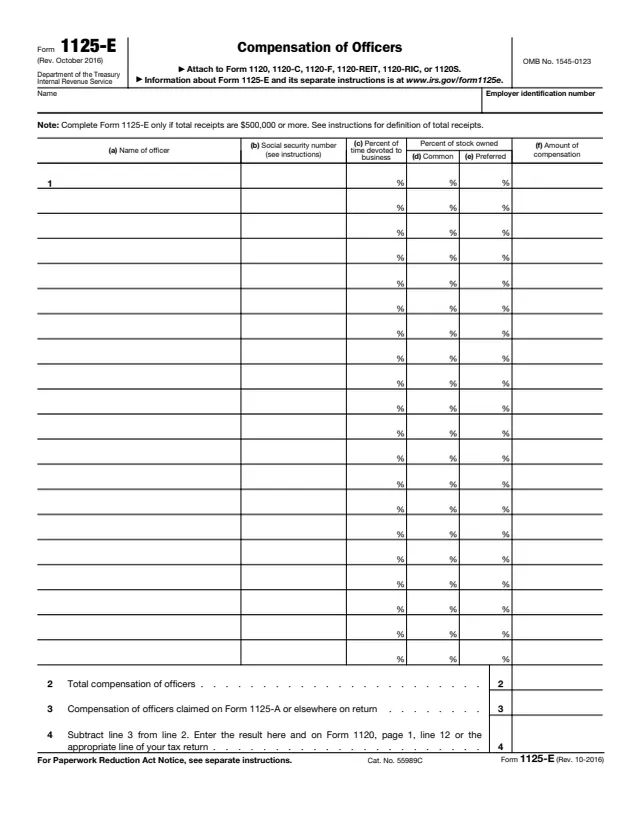
1125-E
125 fields, 1 page
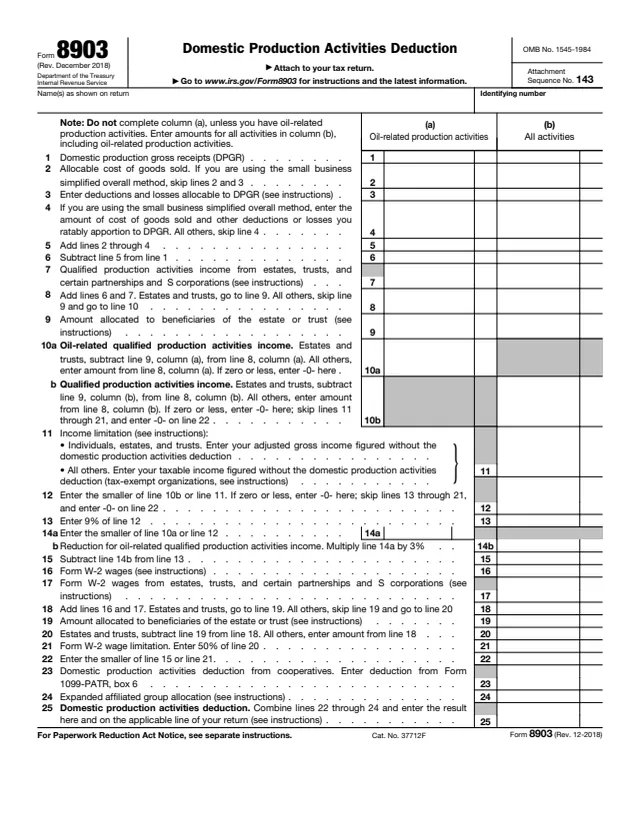
8903
78 fields, 1 page
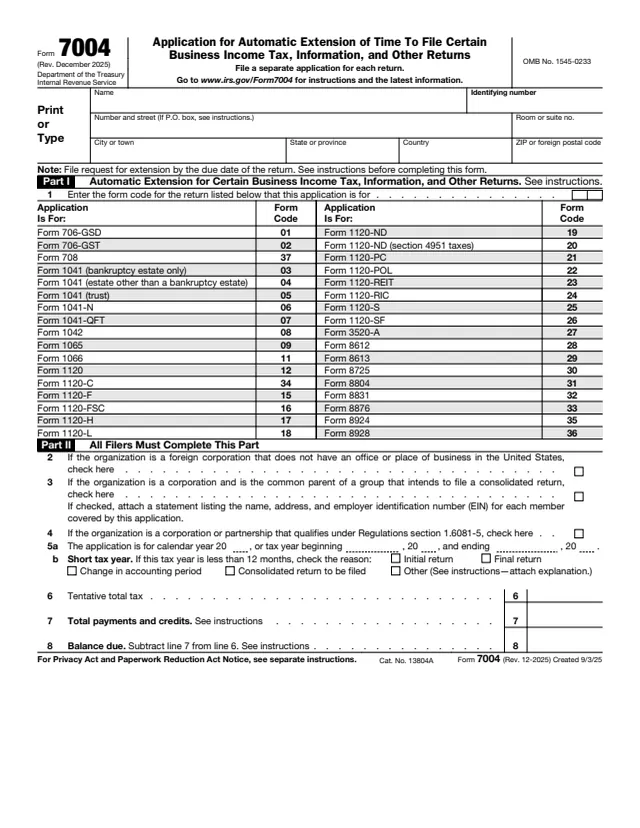
7004
26 fields, 1 page
The return is filed by the cooperative and signed by an authorized officer, not by individual members. The instructions say any corporation operating on a cooperative basis under section 1381 and allocating amounts to patrons on the basis of business done with or for them should file Form 1120-C.
No tool matches that search.
The instructions say any corporation operating on a cooperative basis under section 1381 that allocates amounts to patrons on the basis of business done with or for them, including section 521 farmers' cooperatives.
The instructions say income merely incidental to the cooperative's operation is nonpatronage, while income from an activity that is an integral part of its business may be patronage.
The instructions say a cooperative with total assets of $10 million or more on the last day of the tax year files Schedule M-3 (Form 1120) instead of Form 1120-C, Schedule M-1.
No. The Schedule G instructions say patronage-source losses cannot be used to offset nonpatronage income.
The instructions say installments are made if the cooperative expects total tax, less credits, of $500 or more, and are due by the 15th day of the 4th, 6th, 9th and 12th months of the tax year.
The instructions say they report the section 1062 applicable net tax liability for gain from sales of qualified farmland property to qualified farmers, with the full amount on line 30i and the first installment on line 29.