Page 1: income and deductions
Gross premiums, reserve decreases, investment income and capital gain net income on lines 1 to 8, then deductions such as death benefits, reserve increases and policyholder dividends on lines 9 to 19.
1120-L
U.S. Life Insurance Company Income Tax Return
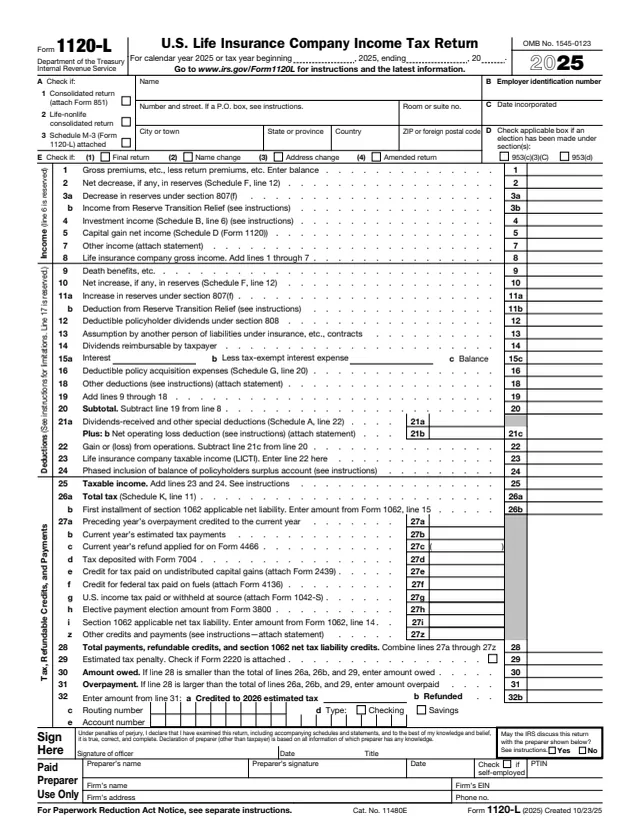
Form 1120-L, U.S. Life Insurance Company Income Tax Return, is a six-page return for calendar year 2025 or a tax year beginning in 2025. The IRS About page says life insurance companies use it to report income, gains, losses, deductions, credits, and to figure their income tax liability.
The instructions say every domestic life insurance company and certain foreign corporations that would qualify as life insurance companies if they were U.S. corporations file Form 1120-L. That includes organizations described in section 501(m)(1) that provide commercial-type life insurance. Insurance companies other than life insurance companies file Form 1120-PC.
A corporate officer signs the return. You can fill out Form 1120-L free in your browser on this page and download it without an account.
Gross premiums, reserve decreases, investment income and capital gain net income on lines 1 to 8, then deductions such as death benefits, reserve increases and policyholder dividends on lines 9 to 19.
Life insurance company taxable income (LICTI) on line 23, taxable income on line 25, total tax, credits and payments on lines 26a to 28, and the amount owed or overpayment on lines 30 to 32.
Schedule A covers dividends, inclusions, the dividends-received deduction and other special deductions. Schedule B totals investment income from interest, dividends, rents, royalties and leases.
Schedule F figures the increase or decrease in reserves under section 807. Schedule G figures deductible policy acquisition expenses under section 848.
Income tax, corporate alternative minimum tax from Form 4626, credits such as the foreign tax credit, other taxes, and the total tax carried to page 1, line 26a.
Schedule L reports total assets and total insurance liabilities. Schedule M asks about accounting method, company type, ownership, loss reserves, state of domicile and other items.
Enter the name, EIN, date incorporated and address. Check the consolidated, life-nonlife consolidated or Schedule M-3 boxes in item A, any section 953 election in item D, and any item E box that applies.
Enter gross premiums and other consideration received on insurance and annuity contracts, less return premiums and premiums and other consideration paid for indemnity reinsurance, the instructions say.
Schedule A, line 22 goes to page 1, line 21a; Schedule B, line 6 to line 4; Schedule F, line 12 to line 2 or line 10; and Schedule G, line 20 to line 16.
Line 23 is LICTI. Line 24 is the phased inclusion of the policyholders surplus account balance, which the instructions say cannot be reduced by an NOL. Line 25 adds lines 23 and 24.
The instructions say corporations figure their tax by multiplying taxable income by 21% (0.21). Schedule K, line 11 is entered on page 1, line 26a.
Enter estimated tax payments, credits and any Form 2220 penalty, then the amount owed or overpayment. An officer signs and dates the return, and a paid preparer completes the Paid Preparer Use Only section.
You get the real form, filled in a browser tab, with nothing standing between you and the finished PDF.
The instructions say a corporation generally files by the 15th day of the 4th month after the end of its tax year. Form 7004 requests an extension of time to file.
If the principal business, office, or agency is in the United States: Department of the Treasury, Internal Revenue Service Center, Ogden, UT 84201-0012. In a foreign country or U.S. territory: Internal Revenue Service Center, P.O. Box 409101, Ogden, UT 84409.
The instructions say a life insurance company generally attaches a copy of the NAIC annual statement filed with its state of domicile, but not to an electronically filed return.
The instructions say a life insurance company with total assets of $10 million or more on the last day of the tax year files Schedule M-3 (Form 1120-L). Others may file it voluntarily.
Installments are generally due by the 15th day of the 4th, 6th, 9th, and 12th months when total tax is expected to be $500 or more. Form 2220 figures any underpayment penalty.
The instructions say section 843 requires all insurance companies to file on a calendar year basis, unless they join in the filing of a consolidated return.
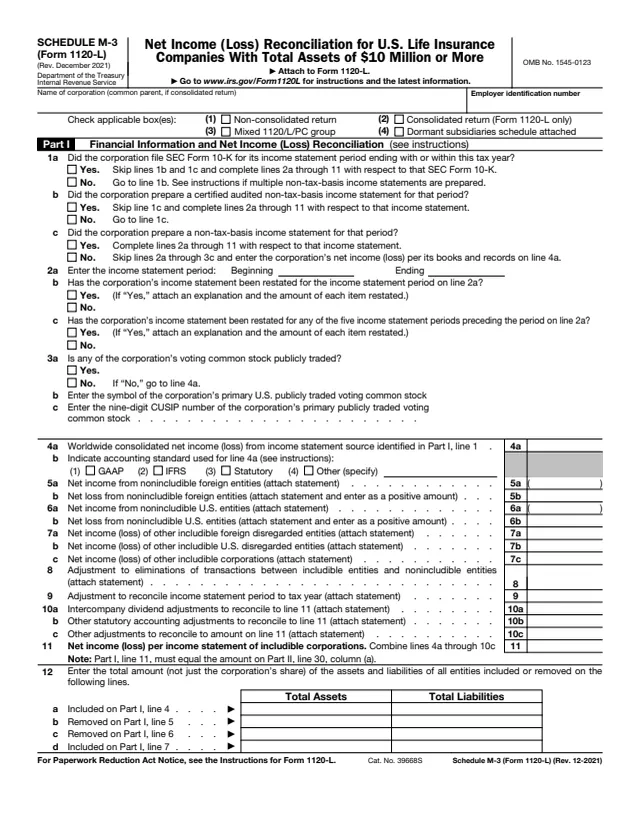
1120-L Sch. M-3
383 fields, 3 pages
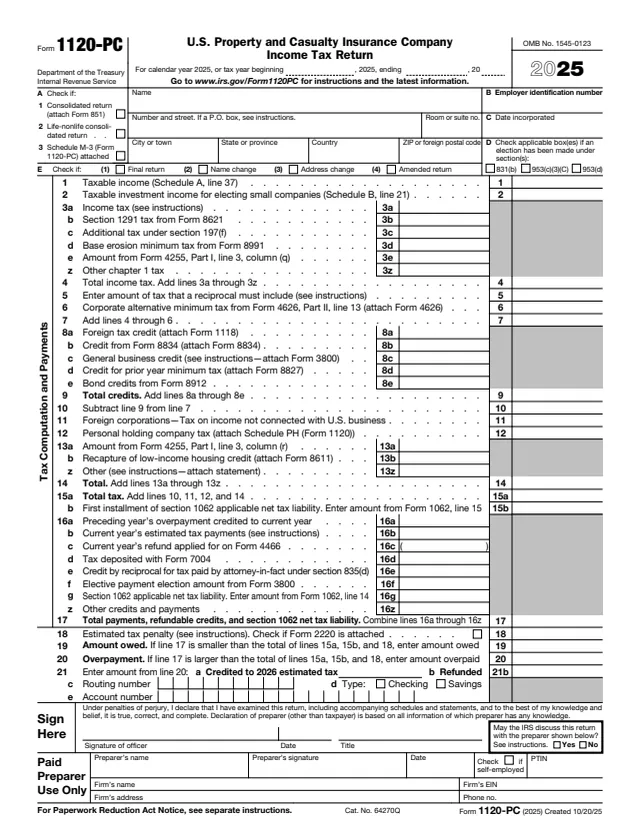
1120-PC
565 fields, 9 pages
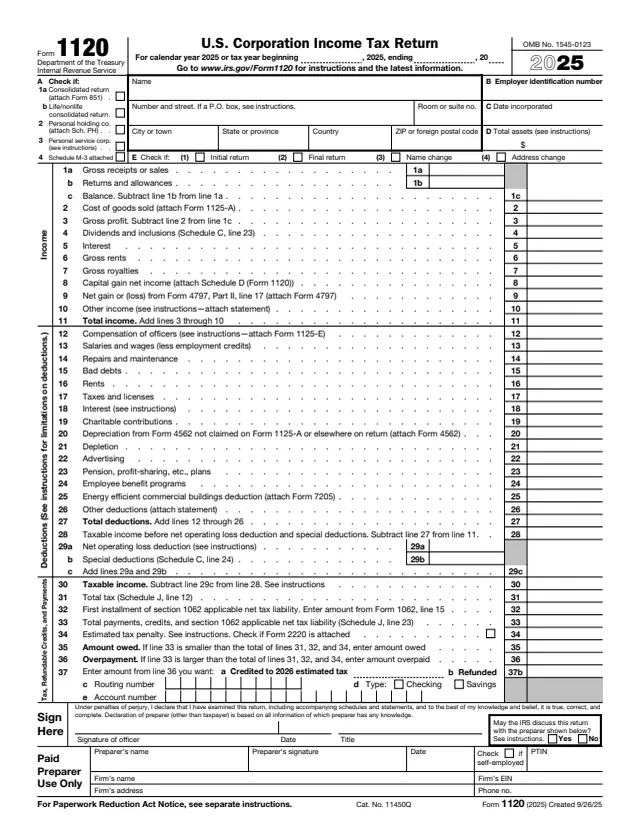
1120
481 fields, 6 pages
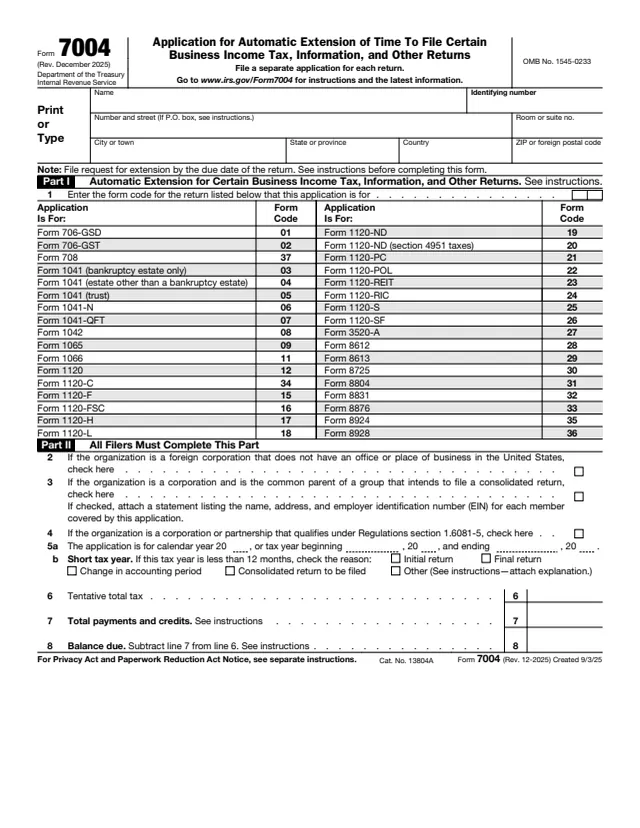
7004
26 fields, 1 page
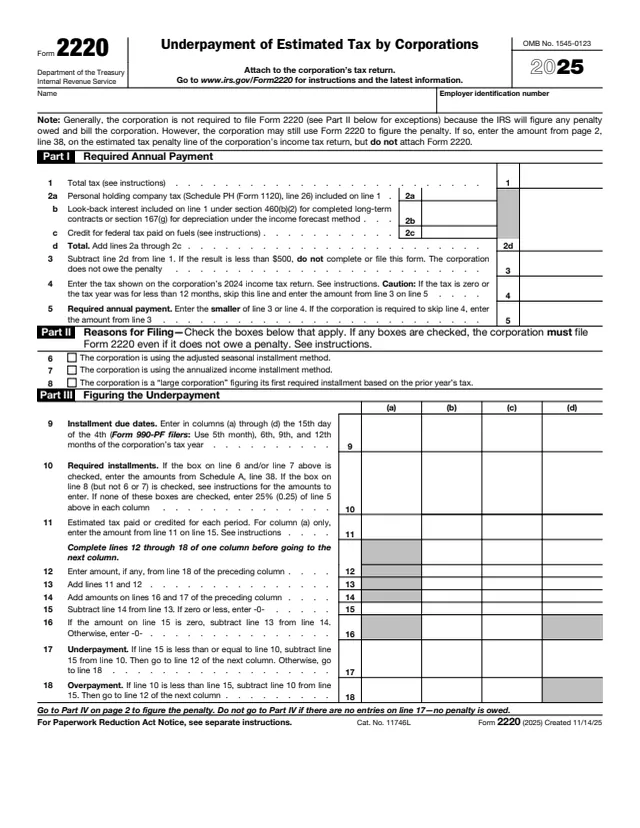
2220
322 fields, 4 pages
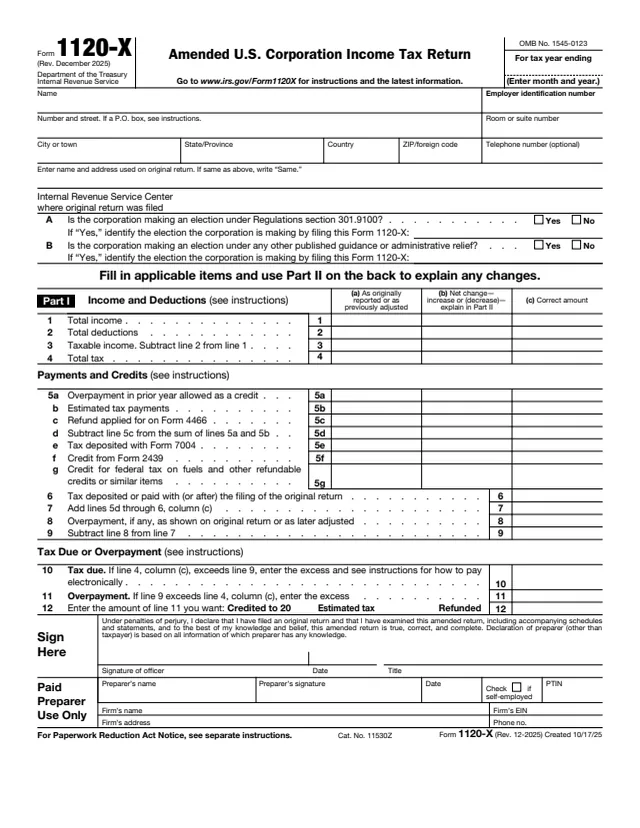
1120-X
70 fields, 2 pages
The return is filed by insurance companies, not by policyholders.
No tool matches that search.
The instructions say every domestic life insurance company and certain foreign corporations that would qualify as life insurance companies if they were U.S. corporations, including section 501(m)(1) organizations providing commercial-type life insurance.
No. The instructions say insurance companies other than life insurance companies file Form 1120-PC.
Generally by the 15th day of the 4th month after the end of the tax year, the instructions say. Form 7004 is used to request an extension.
The instructions say it is filed by a life insurance company with total assets of $10 million or more on the last day of the tax year, and may be filed voluntarily by others.
The instructions say corporations figure their tax by multiplying taxable income by 21% (0.21).
The instructions say 5% of the unpaid tax for each month or part of a month late, up to 25%. For a return due in 2026 over 60 days late, the minimum is the smaller of the tax due or $525 (adjusted for inflation).
Among others, "No penalty for not electronically filing Forms 1120-REIT, 1120-RIC, 1120-L, and 1120-PC for 2025", dated 20-FEB-2026, and updated 2025 accident year unpaid loss and salvage discount factors.