Header and page count
The entity's name as shown on page 1 of the tax return, its EIN, and a page count for each part, such as page 1 of 2 Part I pages.
1120 Sch. UTP
Uncertain Tax Position Statement
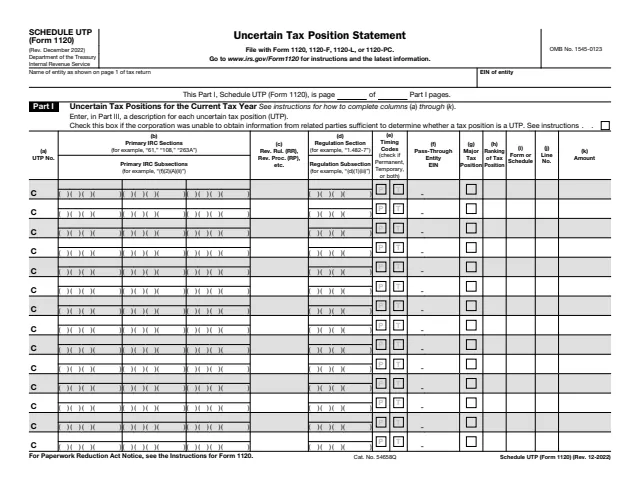
Schedule UTP (Form 1120) is the Uncertain Tax Position Statement. The About page says it asks for information about tax positions that affect the U.S. federal income tax liabilities of certain corporations that issue or are included in audited financial statements and have assets that equal or exceed $10 million.
The instructions say a tax position is reported when the corporation took it on a return for the current or a prior tax year and the corporation or a related party recorded a liability for unrecognized tax benefits for it in audited financial statements, or recognized the benefit because it expects to litigate.
The schedule says to file it with Form 1120, 1120-F, 1120-L, or 1120-PC. It is a corporate schedule, not an individual form. You can fill out the PDF free in your browser on this page and download the result without an account.
The entity's name as shown on page 1 of the tax return, its EIN, and a page count for each part, such as page 1 of 2 Part I pages.
One row per uncertain tax position taken on the current return, numbered with a preprinted C, with columns (a) through (k).
Primary IRC sections, revenue rulings or procedures, regulation sections, timing codes P and T, pass-through entity EIN, the major tax position box and the ranking of each position.
The form or schedule, line number and amount where the tax position appears on the return.
Positions taken on a prior year's return that were not reported on an earlier Schedule UTP, numbered with a preprinted P, with an added column (l) for the year of the position.
A concise description of each uncertain tax position, tied to its UTP number from Part I or Part II.
Number positions C1, C2 and so on without skipping or grouping. Enter up to three primary IRC sections, such as 61 or 263A, with no text like "IRC" or "Section". Columns (c) and (d) are for positions contrary to a rule or regulation.
Check T for a temporary difference, P for a permanent difference, or both. If the position relates to a pass-through entity, enter its EIN, or "F" for a foreign entity without one.
Check column (g) if the position's relative size is greater than or equal to 0.10 (10%). In column (h), rank all positions in Parts I and II together, using T for transfer pricing positions and G for all others.
Enter the form or schedule and line number where the position appears and the amount reported on that line, for example Sch. M-3, line 20, for deferred income.
Report prior-year positions not already reported, continuing the number sequence from Part I with the P prefix. In column (l), enter a six-digit year and month, such as 202212.
Describe every position listed. The instructions say to include the relevant facts, the identity of the position and the nature of the issue, and that "Available upon request" is not an adequate description.
You get the real form, filled in a browser tab, with nothing standing between you and the finished PDF.
The instructions say to attach Schedule UTP to the corporation's income tax return and not to file it separately. A protective Form 1120, 1120-F, 1120-L, or 1120-PC also carries it when the four conditions are met.
A corporation filing Schedule UTP checks Yes on Form 1120, Schedule K, Question 14; Form 1120-F, Additional Information, Question AA; Form 1120-L, Schedule M, Question 15; or Form 1120-PC, Schedule I, Question 13.
The instructions say a complete and accurate disclosure on Schedule UTP is treated as if the corporation filed Form 8275 or Form 8275-R for that position.
An amended return that claims the benefit of a reported position includes the disclosure. For carryovers of attributes such as net operating losses, the instructions describe an attached statement instead.
The instructions say a tax position taken in a tax year beginning before January 1, 2010, is not reported.
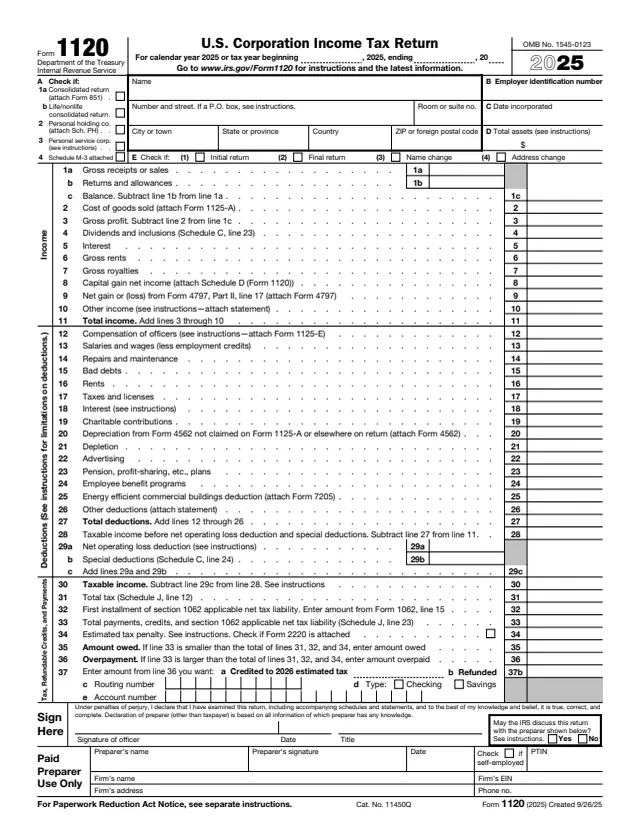
1120
481 fields, 6 pages
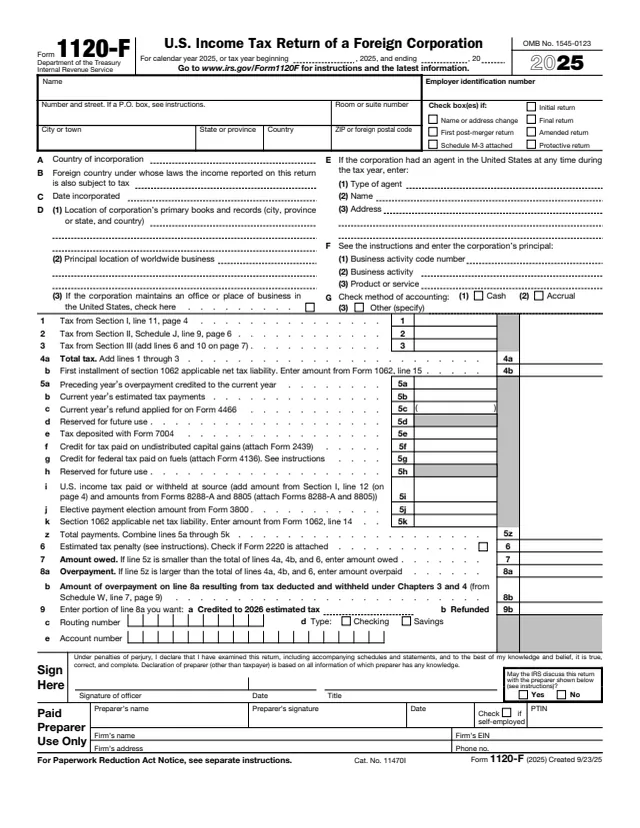
1120-F
527 fields, 9 pages
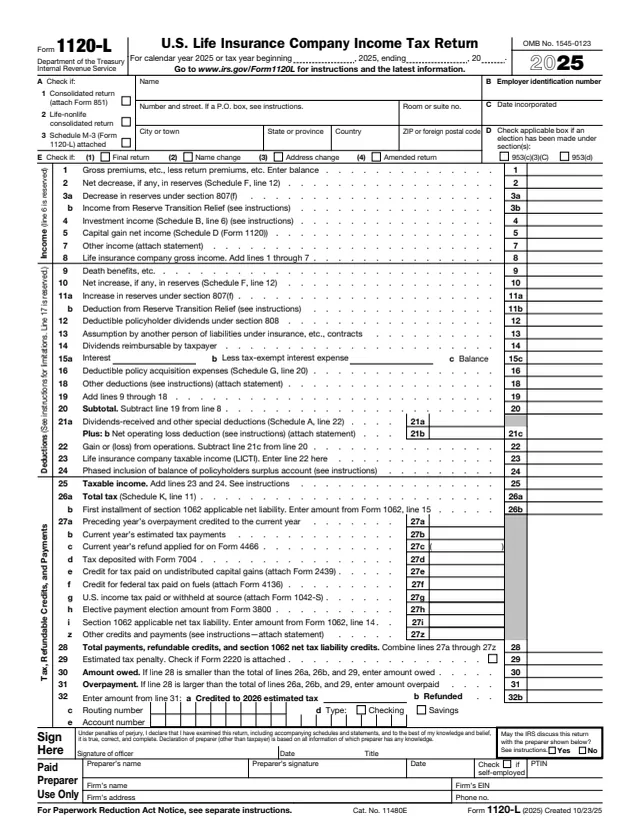
1120-L
337 fields, 6 pages
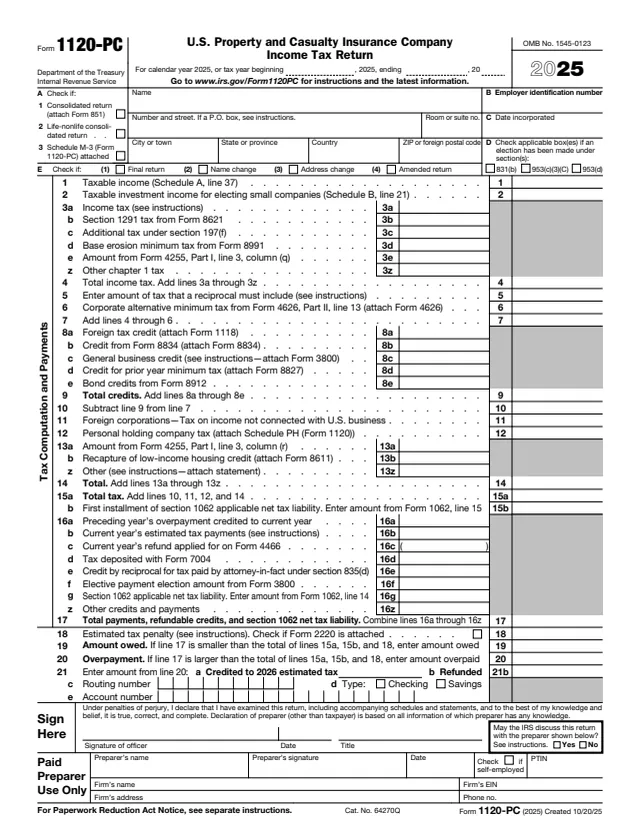
1120-PC
565 fields, 9 pages
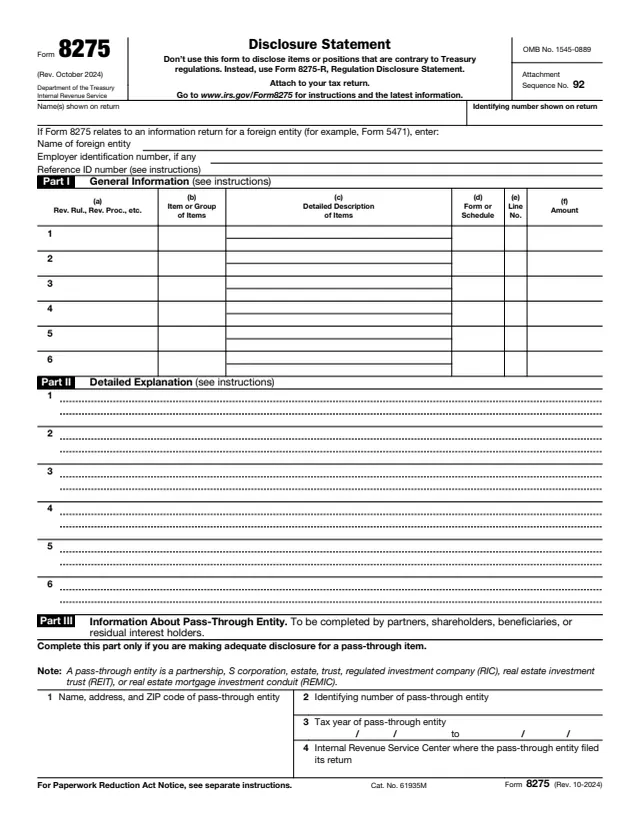
8275
95 fields, 2 pages
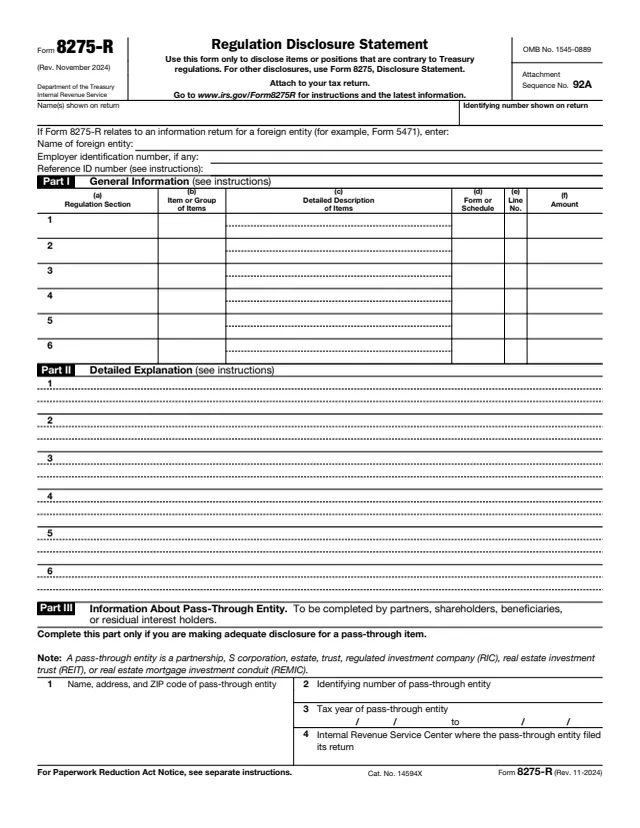
8275-R
102 fields, 2 pages
The instructions say a corporation files it for the current tax year when all four conditions below are met.
No tool matches that search.
No. The instructions limit it to corporations filing Form 1120, 1120-F, 1120-L, or 1120-PC with assets of $10 million or more, audited financial statements and at least one reportable tax position.
The instructions say not to file a blank Schedule UTP if there are no tax positions to be reported.
The instructions say a prior-year position already reported on a Schedule UTP filed with a prior year return is not reported again. If a transaction results in tax positions on more than one return, each is reported on Part I of the Schedule UTP attached to the return in which it is taken.
The instructions define it as any entity with a relationship described in section 267(b), 318(a), or 707(b), or any entity included in consolidated audited financial statements with the corporation.
For the positions it covers, the instructions say a complete and accurate disclosure on Schedule UTP is treated as if Form 8275 or 8275-R were filed, so a separate one is not needed for certain accuracy-related penalties.
The instructions say a concise description should not include an assessment of the hazards of a tax position or an analysis of the support for or against it.