Part I: Identification
Decedent's name, date of death and social security number, the executor's name, address and daytime phone, any other application filer, the domicile and the estate tax return due date.
4768
Application for Extension of Time To File a Return and/or Pay U.S. Estate (and Generation-Skipping Transfer) Taxes
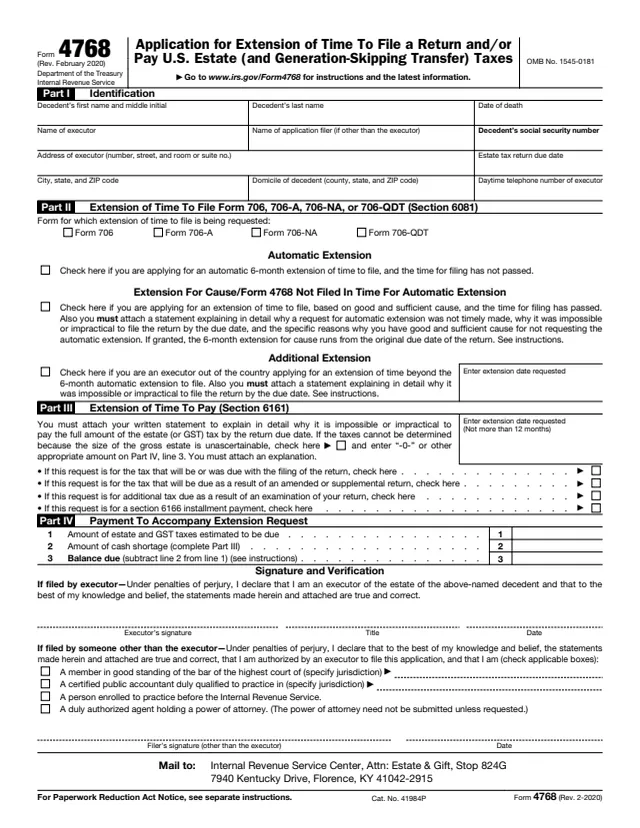
Form 4768, Application for Extension of Time To File a Return and/or Pay U.S. Estate (and Generation-Skipping Transfer) Taxes, is filed for a decedent's estate. The IRS says it is used to apply for an automatic 6-month extension of time to file Form 706, 706-A, 706-NA or 706-QDT, for a discretionary (for cause or additional) extension of time to file Form 706, and for an extension of time to pay estate or generation-skipping transfer (GST) tax under section 6161.
The instructions say an extension of time to file does not extend the time to pay, and an extension of time to pay does not extend the time to file. They also say not to use Form 4768 for Form 706-GS(T) or Form 706-GS(D); Form 7004 is used for those.
The February 2020 revision removed page 2, and the IRS replies to a request to pay on Form 4768-A. You can fill out Form 4768 free in your browser on this page and download the result without an account.
Decedent's name, date of death and social security number, the executor's name, address and daytime phone, any other application filer, the domicile and the estate tax return due date.
Boxes for Form 706, 706-A, 706-NA or 706-QDT, then three choices: automatic extension, extension for cause, or additional extension with the date requested.
The extension date requested, not more than 12 months, a box for an unascertainable gross estate, and four boxes for the kind of tax the request covers.
Line 1 estimated estate and GST taxes due, line 2 cash shortage, and line 3 balance due.
An executor's signature, title and date, or the signature of another filer who checks whether they are an attorney, CPA, enrolled agent or agent holding a power of attorney.
Enter the decedent's name, date of death and social security number, the executor's details, any other filer and the estate tax return due date. The instructions say Form 706 is due 9 months after the date of death.
Check the return being extended, then one box. The instructions say a separate Form 4768 is filed for each return, and an automatic and an additional extension cannot be combined on one form.
For an extension for cause or an additional extension, the form says to attach a statement explaining in detail why the return could not be filed by the due date.
Enter the extension date requested and check the box for the tax covered. The form says to attach a written statement explaining why paying the full amount by the return due date is impossible or impractical.
Enter the estimated estate and GST taxes due on line 1, the cash shortage on line 2, and line 1 minus line 2 as the balance due on line 3.
The executor signs with title and date, or another authorized filer signs and checks the box for their qualification. The form says a power of attorney need not be submitted unless requested.
You get the real form, filled in a browser tab, with nothing standing between you and the finished PDF.
Internal Revenue Service Center, Attn: Estate & Gift, Stop 824G, 7940 Kentucky Drive, Florence, KY 41042-2915. The instructions give the same address for private delivery services.
The instructions say an automatic extension is filed by the original due date of the return, and an extension for cause no later than 6 months after the original due date.
The instructions say that when requesting an extension of time to pay, Form 4768 is not sent with Form 706 but mailed in a separate envelope.
The instructions say to make a check or money order payable to "United States Treasury" and write the decedent's social security number and the type of return on it.
The instructions say interest is charged on tax not paid by the original due date even with an extension, and an executor granted more time to pay may be required to furnish a bond.
The instructions say the IRS contacts the filer only if an extension to file is denied, and sends Form 4768-A to the executor on a request for more time to pay.
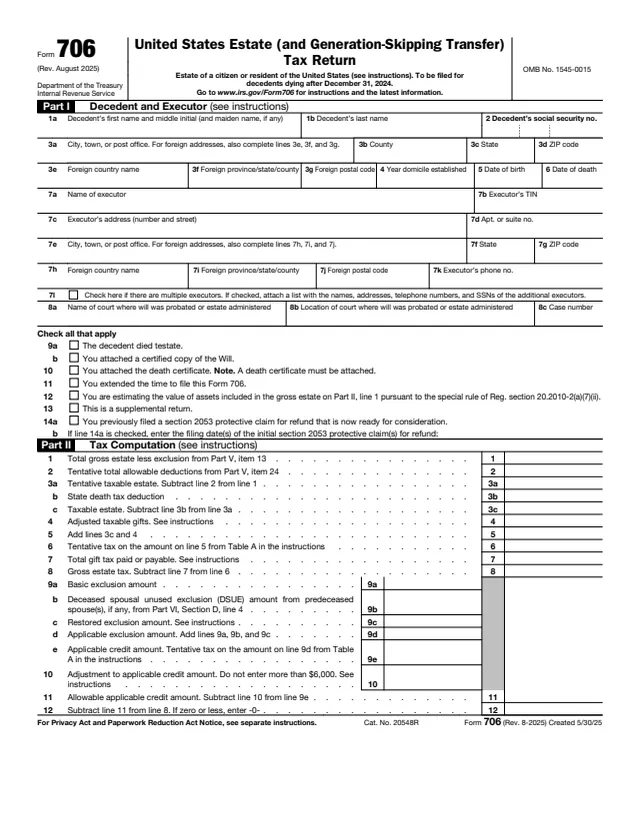
706
316 fields, 5 pages
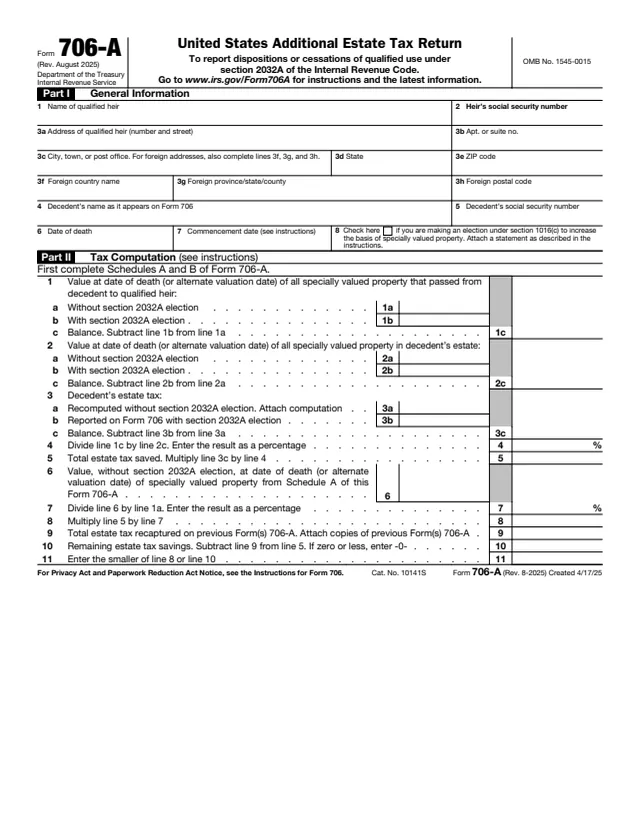
706-A
464 fields, 5 pages
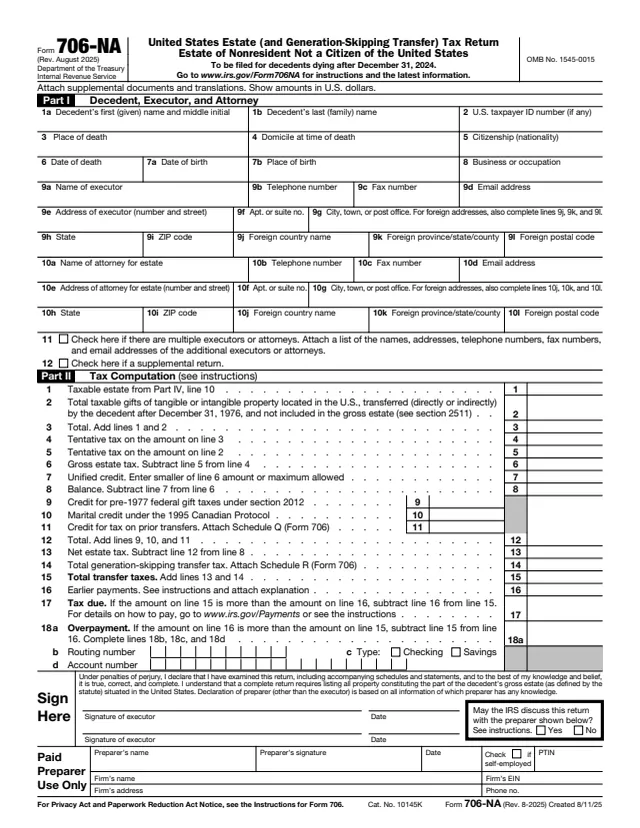
706-NA
259 fields, 3 pages
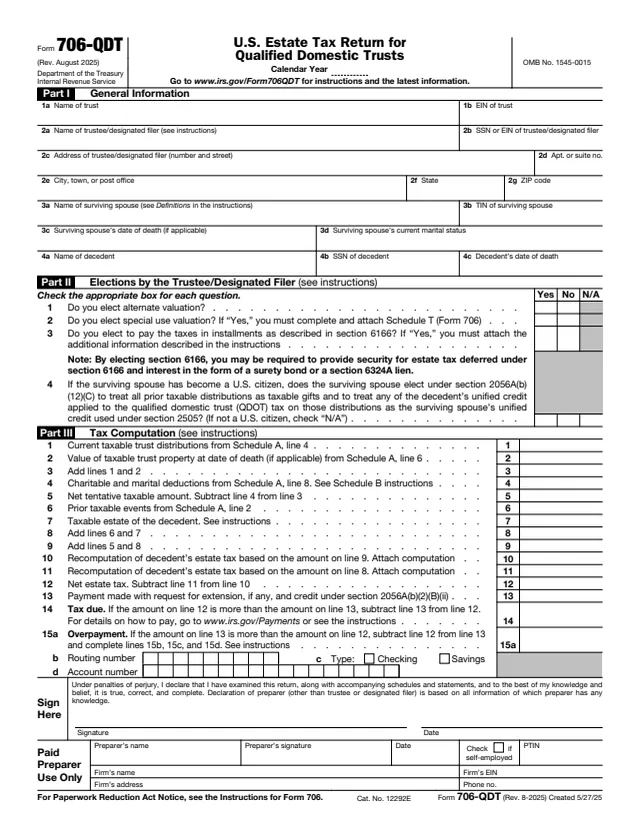
706-QDT
896 fields, 6 pages
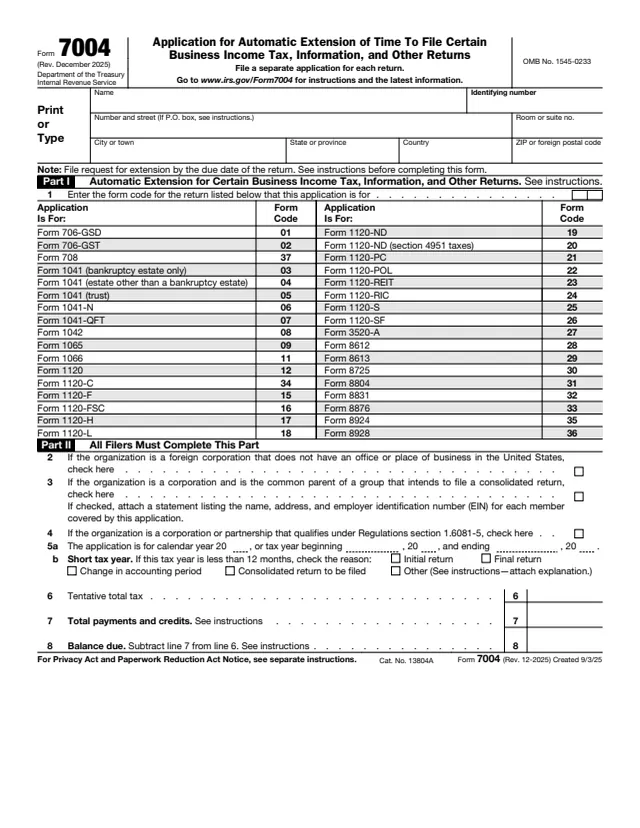
7004
26 fields, 1 page
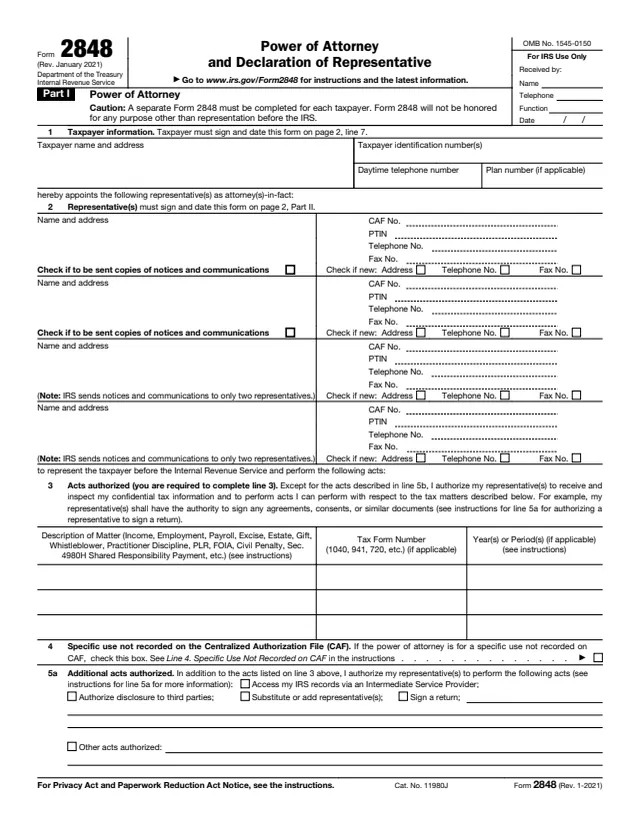
2848
92 fields, 2 pages
The instructions say the application is filed for a decedent's estate by its executor, by a representative on the executor's behalf, or by the filer of Form 706-A or Form 706-QDT. It is mailed to the IRS.
No tool matches that search.
The instructions say 6 months from the original due date of the return, unless the executor is out of the country.
No. The instructions say an extension of time to file does not extend the time to pay, and interest is charged on tax not paid by the original due date.
Part III says not more than 12 months per request. The instructions say an extension for reasonable cause may be granted 1 year at a time, up to 10 years.
No. The instructions say to use Form 7004 for an automatic extension of those returns.
The instructions say the IRS contacts the filer only if the request is denied, and to keep a copy of the form.
The instructions say a written appeal can be sent to the address on Form 4768-A within the 10-day period beginning the day after the date on that form.