Part I: Identification
The name, identifying number and address of the person you act for, the decedent's Social Security number when there is one, and the fiduciary's name, address and phone number.
56
Notice Concerning Fiduciary Relationship
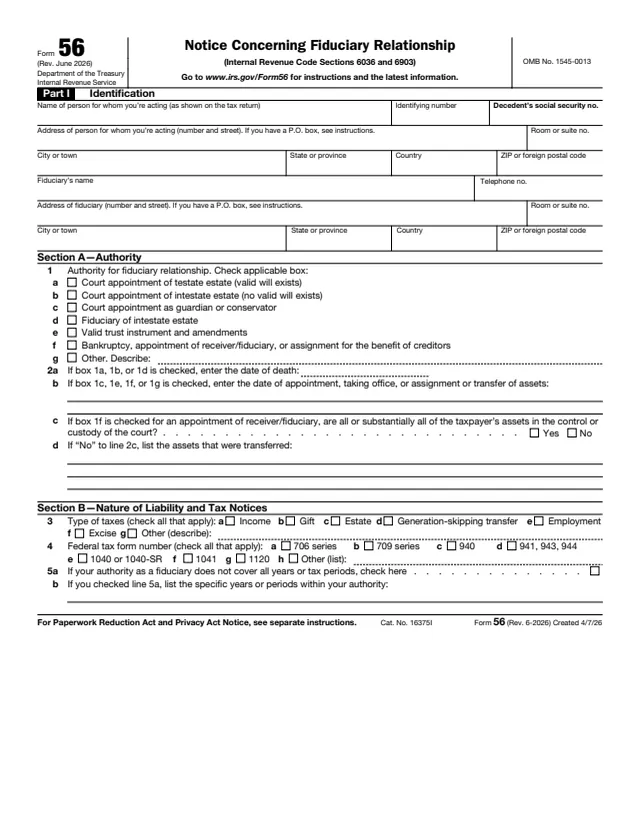
Form 56 is the notice a fiduciary sends the IRS. The instructions say it is used to notify the IRS of the creation or termination of a fiduciary relationship under section 6903 and to give notice of qualification under section 6036. A fiduciary can be an executor, administrator, guardian, conservator, trustee, receiver or other person acting on behalf of another person.
The instructions explain that the IRS treats a fiduciary as if the fiduciary is actually the taxpayer, with the right and the responsibility to take the actions the taxpayer would take, such as filing returns and paying tax due. That is different from an authorized representative, who uses Form 2848 instead.
The instructions also say Form 56 cannot be used to update the last known address of the person you act for (Form 8822 or Form 8822-B does that) or to request copies of notices. You can fill out the Form 56 PDF free in your browser on this page and download the result without an account.
The name, identifying number and address of the person you act for, the decedent's Social Security number when there is one, and the fiduciary's name, address and phone number.
Line 1 has seven boxes for the source of authority, from a court appointment of a testate estate to other. Lines 2a to 2d hold the date of death or appointment and, for a receiver, the court custody question.
Line 3 lists the types of taxes, line 4 the federal tax form numbers such as 706, 709, 941, 1040 and 1041, and line 5 the years or periods if your authority does not cover all of them.
Section A for a total revocation or termination with its reason, Section B for a partial revocation, and Section C for naming a substitute fiduciary.
The name and address of the court or agency, the docket number, the date the proceeding started and the date, time and place of other proceedings.
The fiduciary signs under penalties of perjury and adds a title and the date.
Enter the name of the person you act for as shown on the tax return. The instructions say an individual's number is the SSN or ITIN and any other person's number is the EIN. File a separate Form 56 for each person you act for, such as one for the decedent and one for the estate.
Check the one box that matches your authority. For lines 1a and 1b, the instructions say to attach current letters testamentary or a court certificate as proof of the court appointment.
Enter the date of death on line 2a for boxes 1a, 1b or 1d, or the date of appointment or transfer of assets on line 2b for boxes 1c, 1e, 1f or 1g. Lines 2c and 2d apply only to an appointed receiver or fiduciary on line 1f.
Check the type of tax and the forms you will file as fiduciary. If your authority does not cover all years or periods, check line 5a and list them on line 5b.
Complete Part II only when revoking or ending a prior notice. Complete Part III only when a court or other governmental unit appointed you in a proceeding other than bankruptcy.
Sign under penalty of perjury and enter a title for your role, such as executor, trustee, guardian, receiver or personal representative.
You get the real form, filled in a browser tab, with nothing standing between you and the finished PDF.
The instructions say to file Form 56 with the Internal Revenue Service Center where the person you act for files tax returns. For a Form 1040 filer, the Form 1040 instructions list that address.
The instructions say Form 56 is generally filed when you create or terminate a fiduciary relationship.
A receiver or an assignee for the benefit of creditors files on or within 10 days of the date of appointment, with Internal Revenue Service, Insolvency, MS 5027 DAL, Dallas, TX 75242, according to the instructions.
The instructions say each fiduciary files a separate Form 56 or otherwise gives notice of their status to the IRS.
An assignee for the benefit of creditors attaches a brief description of the assets assigned and an explanation of the action to be taken on them, such as hearings, sales or meetings of creditors.
The instructions say to be prepared to furnish evidence that substantiates your authority to act as a fiduciary.
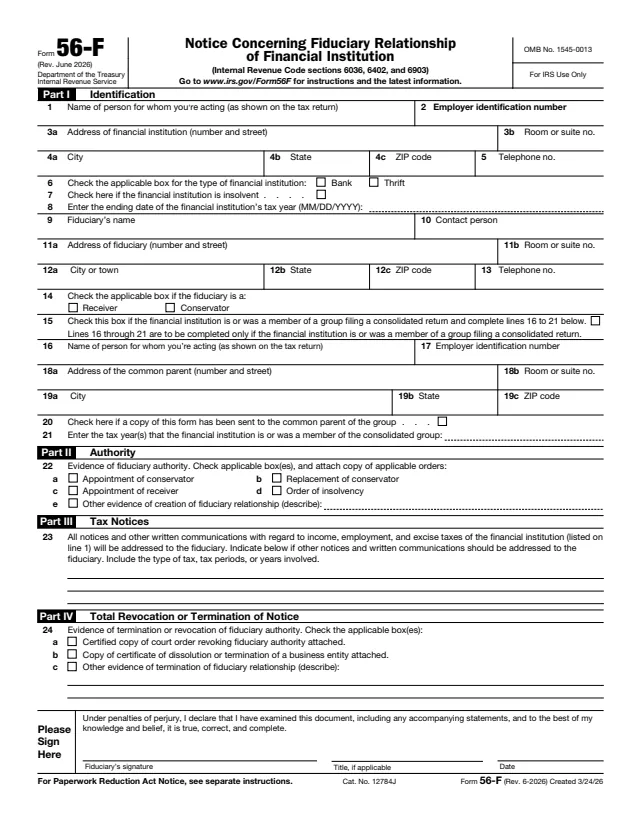
56-F
44 fields, 1 page
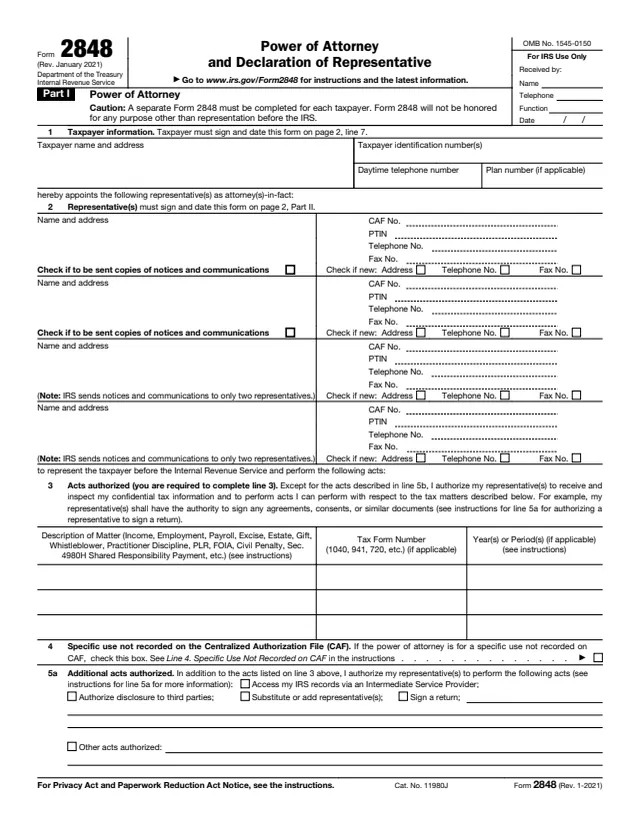
2848
92 fields, 2 pages
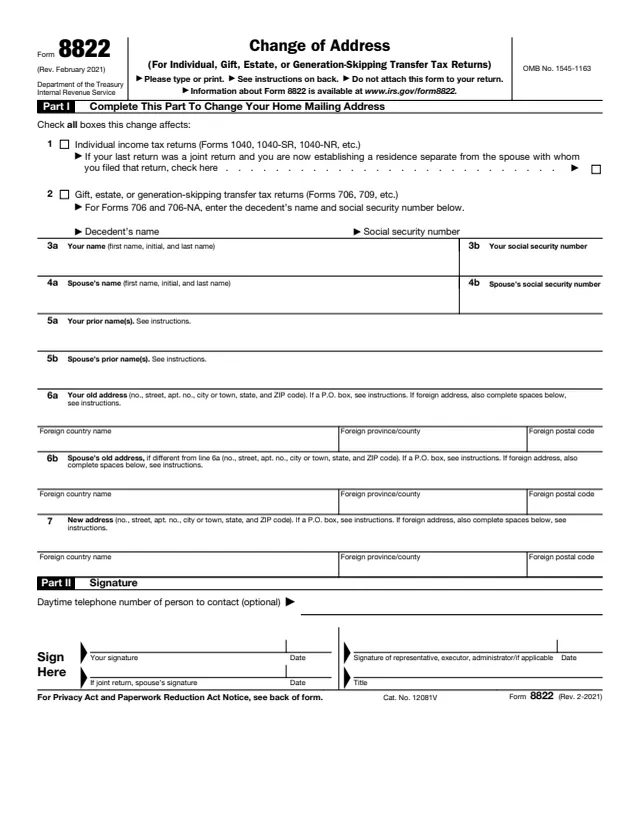
8822
25 fields, 2 pages
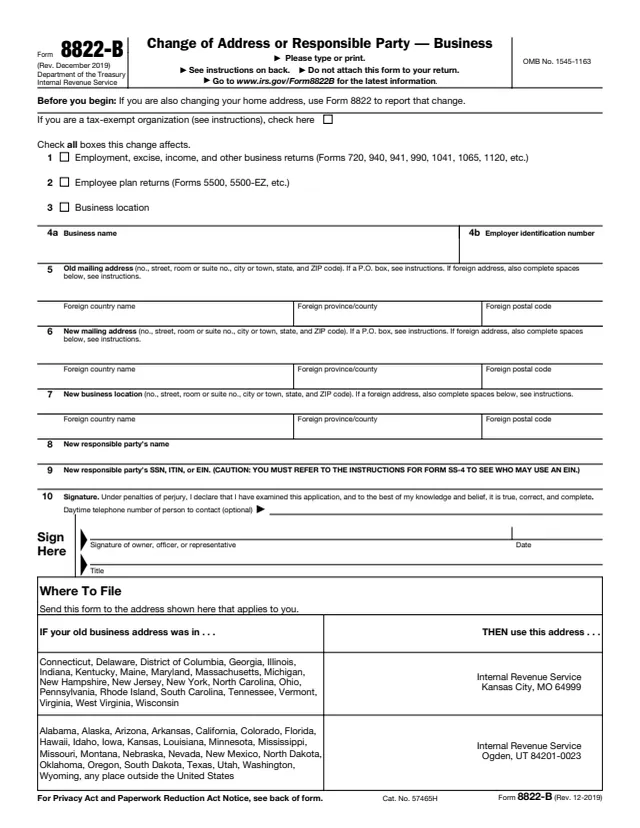
8822-B
22 fields, 2 pages
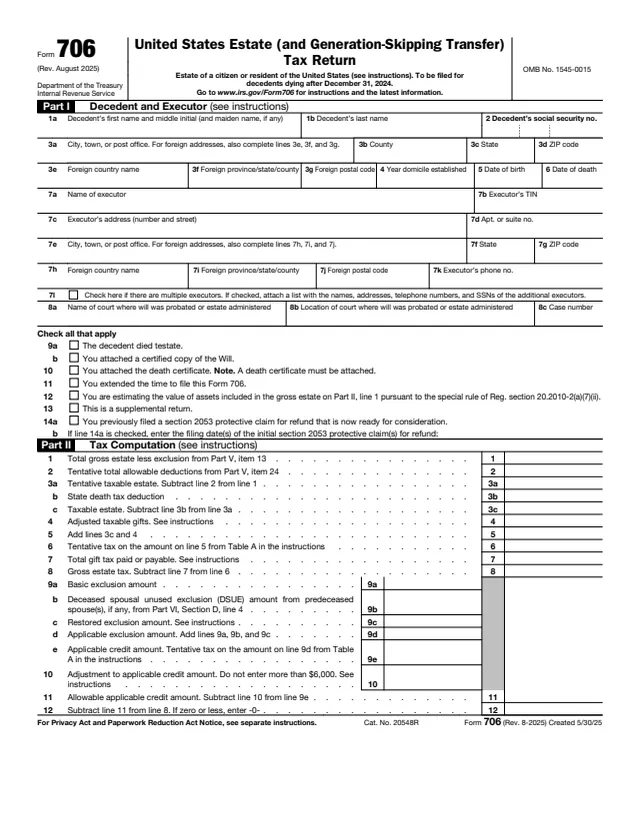
706
316 fields, 5 pages
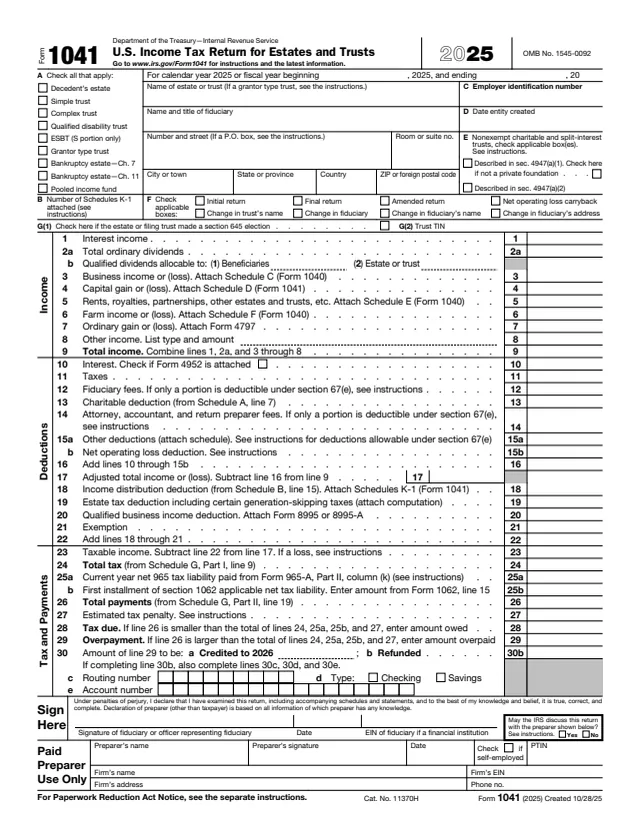
1041
173 fields, 3 pages
The instructions say a fiduciary who seeks to act on behalf of a taxpayer before the IRS, or to tell the IRS that the fiduciary capacity has ended, files the form. It goes to the IRS, not to the taxpayer.
No tool matches that search.
The instructions say a fiduciary is treated as if it is the taxpayer and files Form 56. An authorized representative acts only as the taxpayer's agent and uses Form 2848.
No. The instructions say Form 56 cannot update the last known address. Form 8822 or Form 8822-B is used for that.
The instructions give the example of filing one Form 56 in the decedent's name and one in the estate's name when you file the final Form 1040 and also act for the estate.
To the IRS service center where the person you act for files returns. Receivers and assignees for the benefit of creditors send it to the insolvency address in Dallas listed in the instructions.
Use Part II of Form 56. Section A covers a total revocation or termination, Section B a partial revocation and Section C a substitute fiduciary.
No. The instructions say Form 56 cannot be used to request copies of notices and correspondence.