Part I: General Information
The name and TIN of the trust, and the trustee's name and address, with extra lines for a foreign address.
706-GS
Generation-Skipping Transfer Tax Return For Terminations
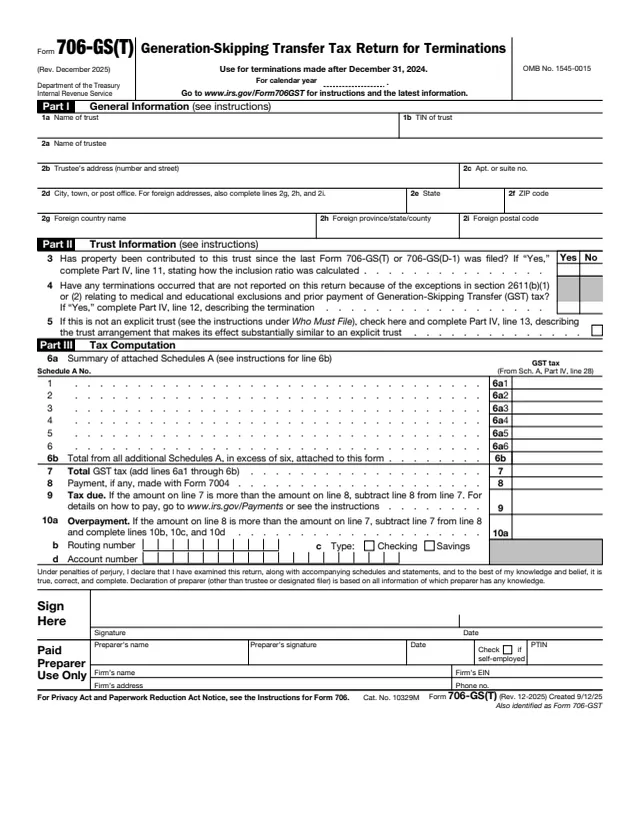
Form 706-GS(T) is the generation-skipping transfer (GST) tax return for trust terminations. The IRS says trustees use this form to figure and report the tax due from certain trust terminations that are subject to the GST tax. The December 2025 revision prints "Use for terminations made after December 31, 2024." The form is also identified as Form 706-GST.
The instructions say a taxable termination is the conclusion of an interest in property held in trust unless, immediately after the termination, a non-skip person has an interest in the property, or no distribution may ever be made from the trust to a skip person. The return has four parts plus Schedule A, where the trustee lists the terminated property, deducts trust expenses, applies the inclusion ratio and figures the GST tax.
The trustee or an authorized representative signs the return. You can fill out Form 706-GS(T) free in your browser on this page and download the result without an account.
The name and TIN of the trust, and the trustee's name and address, with extra lines for a foreign address.
Line 3 asks about new contributions, line 4 about unreported terminations under section 2611(b)(1) or (2), and line 5 is a box for a trust that is not an explicit trust.
The GST tax from up to six Schedules A, any payment made with Form 7004, the tax due or overpayment, and direct deposit fields.
Lines 11, 12 and 13 explain the Yes answers in Part II: the inclusion ratio, unreported terminations and the nonexplicit trust arrangement.
Part I lists skip persons, the terminating interest and each property with its termination date, valuation date and value. Parts II and III list trust debts, expenses and taxes.
Part IV figures the taxable amount, inclusion ratio, maximum federal estate tax rate, applicable rate and GST tax. Part V explains the inclusion ratio.
Enter the trust and trustee details. The instructions say every filing trust has a TIN, and if it has not arrived by the due date, write "Applied for" on line 1b.
Answer lines 3 and 4 and check line 5 if it applies. Each Yes answer is explained later in Part IV.
List the skip persons, describe the terminating interest and list each property with its value. The instructions say to use a separate Schedule A for each terminating interest with a different inclusion ratio.
Enter expenses of the entire trust in Part II, such as trustee's fees, with the percentage on line 15. Enter expenses related only to the terminated interest in Part III.
Enter the inclusion ratio on line 25 and the rate on line 26. The instructions' table gives 40% for a transfer that occurred after December 31, 2012. Line 28 is the GST tax.
Carry each Schedule A tax to line 6, total it on line 7 and figure the tax due or overpayment. Complete Part IV, and the trustee or an authorized representative signs.
The instructions say to complete the form in this order: Parts I and II, Schedule A, and Parts III and IV.
You get the real form, filled in a browser tab, with nothing standing between you and the finished PDF.
The instructions say generally by April 15 of the year following the calendar year in which the termination occurs, or the next business day if that falls on a weekend or legal holiday.
An extension can be requested on Form 7004, filed on or before the regular due date. The instructions say the extension is automatic, with no signature or reason needed.
Department of the Treasury, Internal Revenue Service Center, Kansas City, MO 64999. With a private delivery service: Internal Revenue Service, 333 W. Pershing Road, Kansas City, MO 64108.
To change a filed return, the instructions say to file another Form 706-GS(T) marked "Supplemental Information" with a statement and a copy of the original, to Stop 824G, 7940 Kentucky Drive, Florence, KY 41042-2915.
The IRS recommends paying electronically, such as through EFTPS. A check is made payable to "United States Treasury" with the trust's TIN and "Form 706-GS(T)" written on it.
The instructions cite section 6651 penalties for late filing and late payment unless there is reasonable cause, and a section 6662 20% penalty for certain underpayments, including valuation understatements.
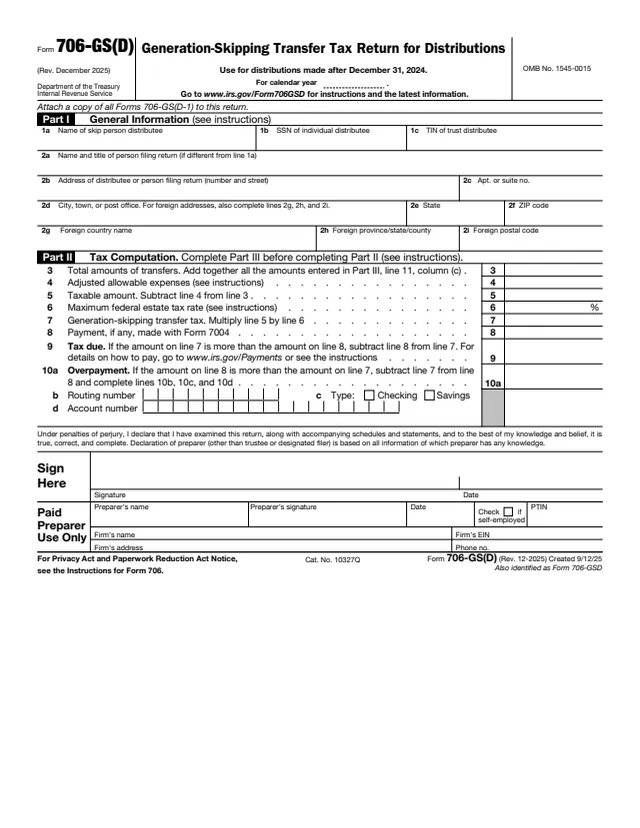
706-GS
191 fields, 2 pages
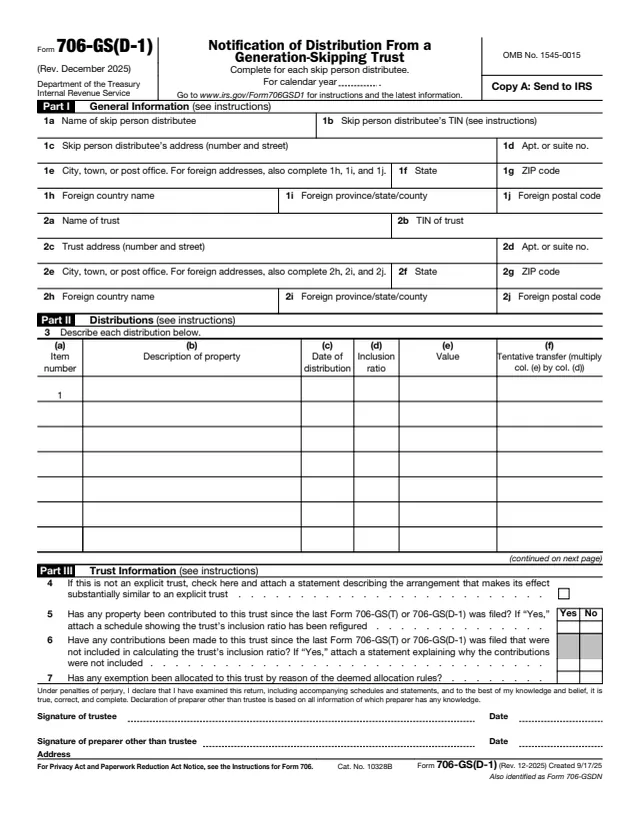
706-GS
386 fields, 5 pages
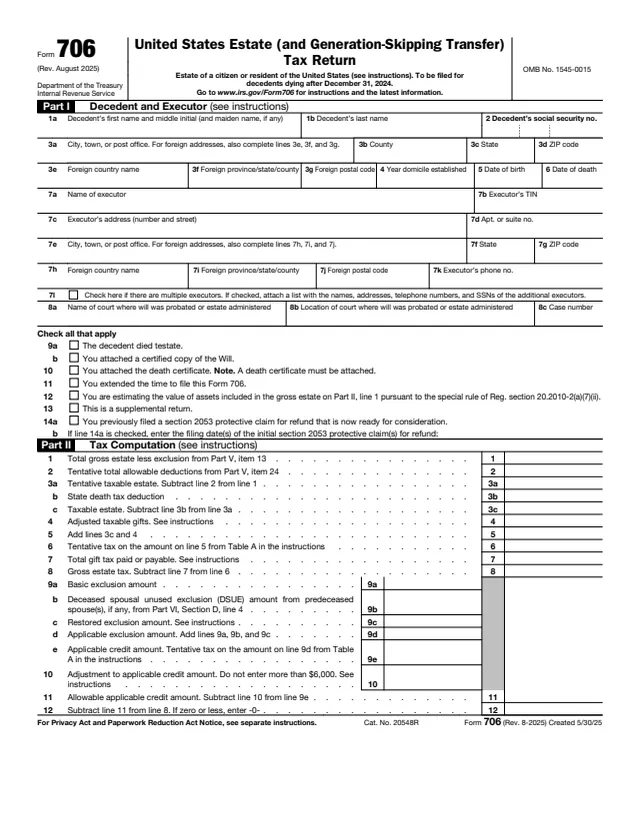
706
316 fields, 5 pages
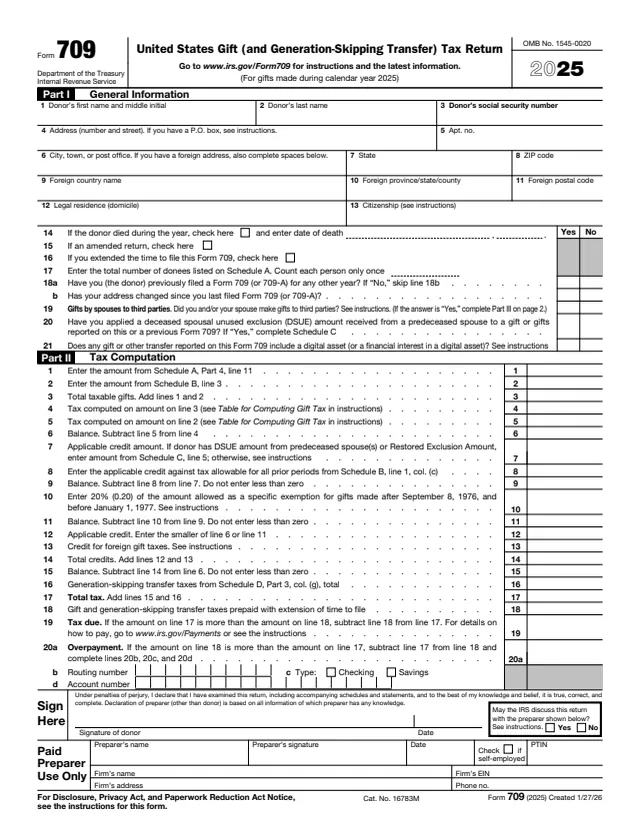
709
1,851 fields, 10 pages
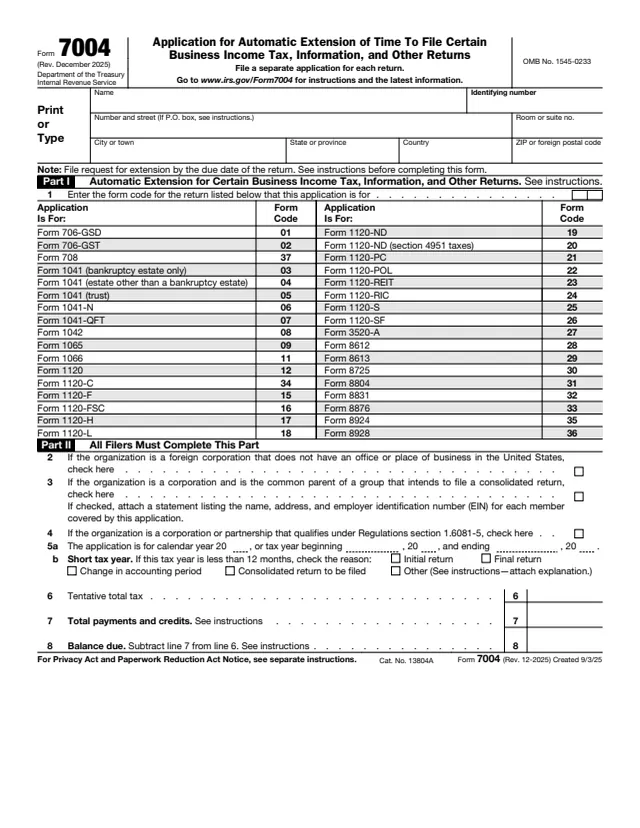
7004
26 fields, 1 page
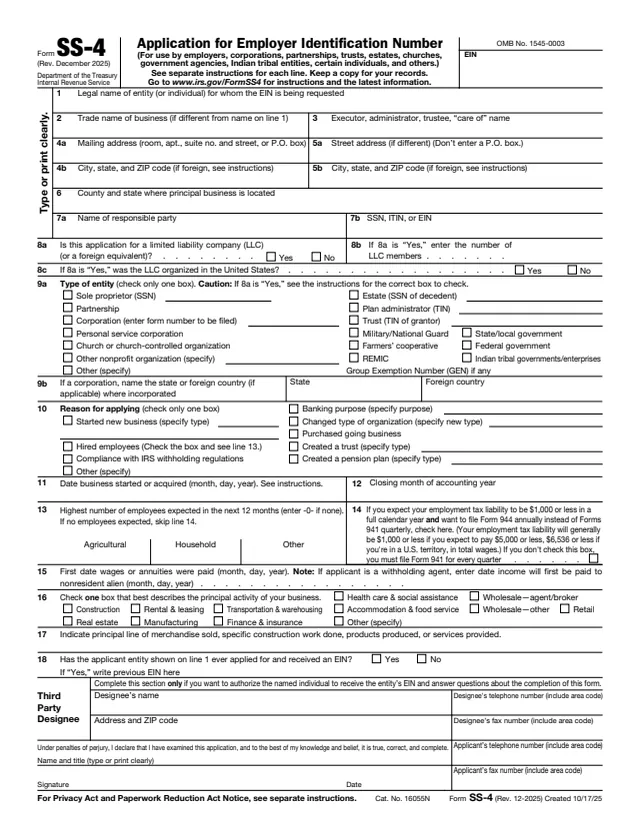
SS-4
89 fields, 2 pages
The form is filed by the trustee of a trust, not by the beneficiaries who receive the property. The instructions say that, in general, the trustee of any trust that has a taxable termination files Form 706-GS(T) for the tax year in which the termination occurred.
No tool matches that search.
The instructions say that, in general, the trustee of any trust that has a taxable termination files it for the tax year in which the termination occurred.
The instructions define it as the conclusion of an interest in property held in trust, unless a non-skip person has an interest in the property immediately afterward, or no distribution may ever be made from the trust to a skip person.
Generally by April 15 of the year following the calendar year in which the termination occurs. Form 7004 can be filed by that date for an automatic extension.
The December 2025 revision says to use it for terminations made after December 31, 2024.
The instructions say the settlor allocates the GST exemption on Form 709, or the executor of the settlor's estate does so on Form 706, so the trustee obtains it from them. They list $13,990,000 for transfers in 2025.
The instructions say to file another Form 706-GS(T) with "Supplemental Information" across the top of page 1, a statement of what changed and a copy of the original return.