Decedent information
The decedent's name as it appears on Form 706 and the decedent's Social Security number.
706 Sch. A
Real Estate
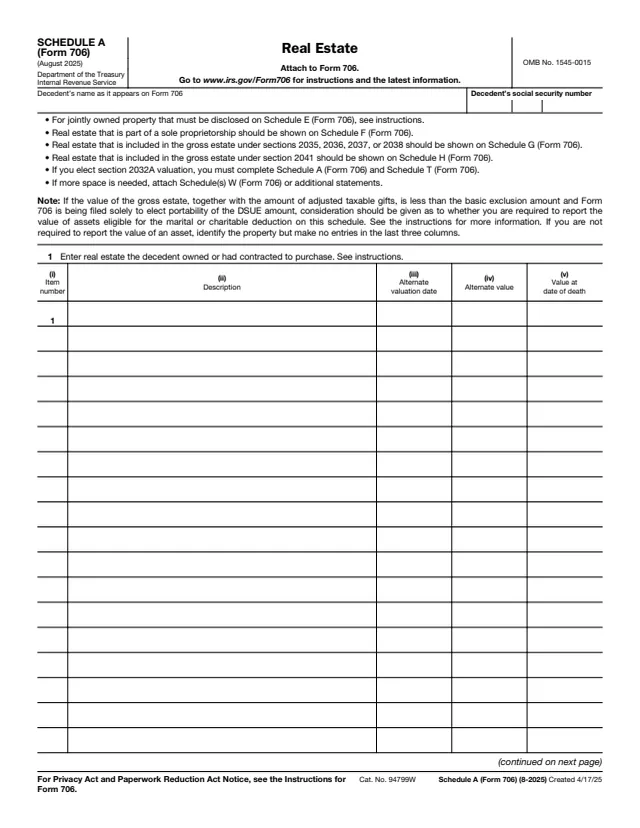
Schedule A (Form 706), Real Estate, is part of Form 706, the return the executor of a decedent's estate uses to figure the estate tax, the IRS About Form 706 page says. The page says that if the total gross estate contains any real estate, this schedule is used to report assets from real estate.
The schedule has one table, line 1, for real estate the decedent owned or had contracted to purchase, with columns for the item number, a description, the alternate valuation date, the alternate value and the value at the date of death. Lines 2 to 4 add up the values and any Schedule W (Form 706) continuation sheets, and the total goes on Form 706, Part V, item 1. Notes at the top send some real estate elsewhere: real estate of a sole proprietorship to Schedule F (Form 706), real estate included under sections 2035, 2036, 2037 or 2038 to Schedule G (Form 706), and real estate included under section 2041 to Schedule H (Form 706).
This page has the August 2025 edition. The PDF can be filled out free in the browser on this page and downloaded without an account.
The decedent's name as it appears on Form 706 and the decedent's Social Security number.
Bullets that point some real estate to Schedules E, F, G and H (Form 706), tie a section 2032A election to Schedule T (Form 706) and allow Schedule W (Form 706) for more space, plus a note on portability-only returns.
Real estate the decedent owned or had contracted to purchase, with columns (i) item number, (ii) description, (iii) alternate valuation date, (iv) alternate value and (v) value at date of death.
Page 2 continues the line 1 table with the same five columns for more parcels before the totals.
Line 2 adds column (iv) or column (v), as applicable, line 3 holds totals from attached Schedule W (Form 706) or statements, and line 4 is the total entered on Form 706, Part V, item 1.
The instructions say to list real estate the decedent owned or had contracted to purchase and to number each parcel under column (i).
Describe each parcel in enough detail for the IRS to locate it for inspection and valuation: the area and any improvements, the street and number, ward, subdivision, block and lot for city property, or the township, range and landmarks for rural property.
If the estate is liable for the mortgage, the instructions say to report the full value in column (v) and the mortgage amount in column (ii). The unpaid mortgage may then be deducted on Schedule K (Form 706). If the estate is not liable, only the equity of redemption is reported.
Columns (iii) and (iv) are filled in only if alternate valuation was elected on Form 706, Part III, line 1. The description then also shows what was distributed, sold, exchanged or otherwise disposed of within 6 months after death, with dates.
Report values without reducing them for a homestead or other exemption or for dower, curtesy or a statutory estate. The instructions say to explain how values were determined and attach copies of any appraisals.
Add column (iv) or (v) on line 2, enter any Schedule W totals on line 3, and carry the line 4 total to Form 706, Part V, item 1.
You get the real form, filled in a browser tab, with nothing standing between you and the finished PDF.
The schedule says "Attach to Form 706." Its total is entered on Form 706, Part V, item 1.
The Form 706 instructions say Form 706 is filed within 9 months after the date of the decedent's death, and Form 4768 is used to apply for an automatic 6-month extension of time to file.
The Form 706 instructions give Department of the Treasury, Internal Revenue Service, Kansas City, MO 64999. The About page points to Filing estate and gift tax returns for the latest address.
The schedule says to attach Schedule W (Form 706) or additional statements if more space is needed.
706
316 fields, 5 pages
706 Sch. K
132 fields, 2 pages
706 Sch. T
858 fields, 8 pages
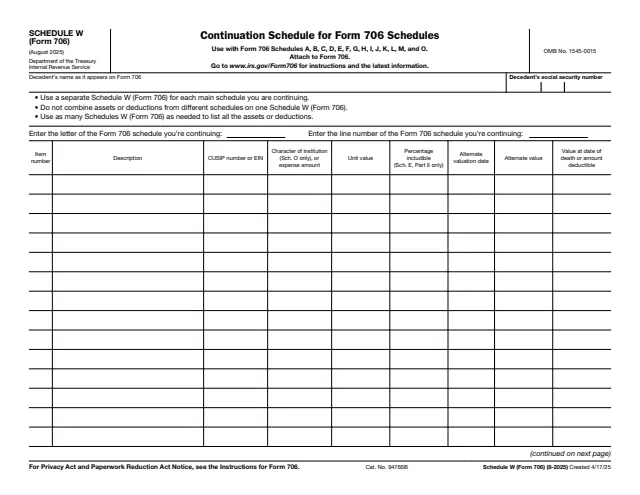
706 Sch. W
303 fields, 2 pages
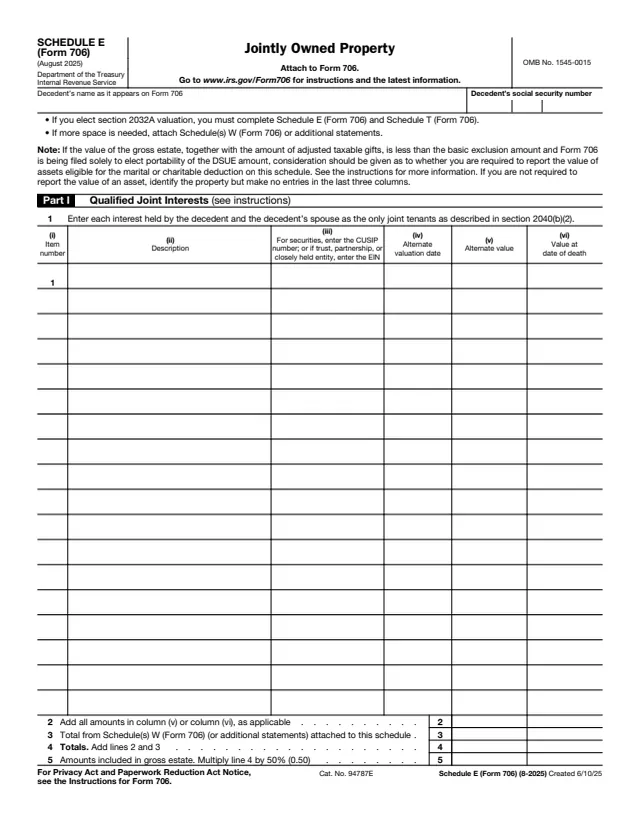
706 Sch. E
265 fields, 2 pages
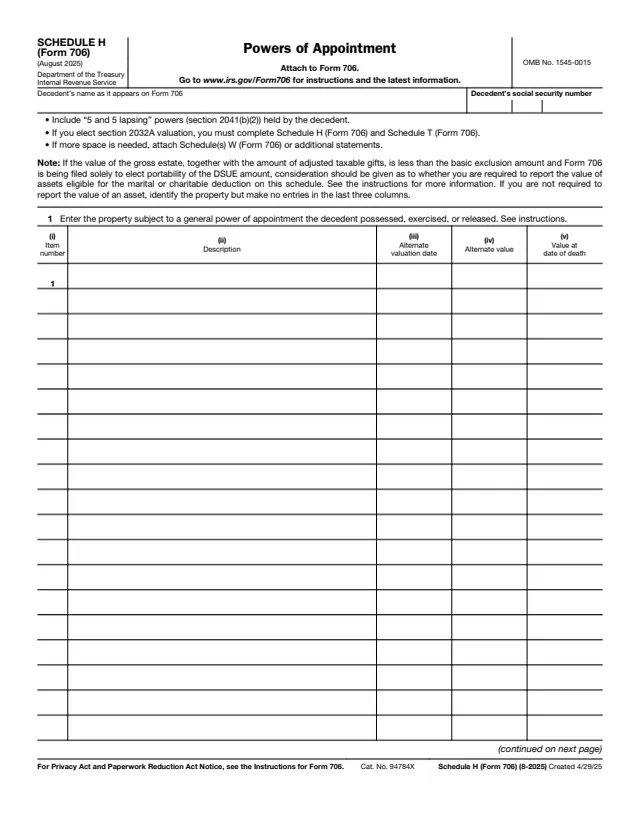
706 Sch. H
228 fields, 2 pages
The schedule is completed for a decedent's estate as part of Form 706 and goes to the IRS with that return. It is not an individual income tax form.
No tool matches that search.
The About Form 706 page says that if the total gross estate contains any real estate, this schedule is used to report assets from real estate.
The instructions say that if the estate is liable for the mortgage, the full value is reported and the unpaid mortgage may be deducted on Schedule K (Form 706). If it is not liable, only the equity of redemption is reported, never less than zero, and nothing is deducted on Schedule K.
The schedule says real estate that is part of a sole proprietorship is shown on Schedule F (Form 706).
The instructions say the alternate valuation date and alternate value columns are completed only if alternate valuation was elected on Form 706, Part III, line 1.
The instructions say rent accrued to the date of death on leased property is property of the gross estate, and their Schedule A examples list rent due and rent accrued as separate entries under the parcel.
The instructions say to explain how the reported values were determined and attach copies of any appraisals.