Decedent information
The decedent's name as it appears on Form 706 and the decedent's Social Security number.
706 Sch. M
Bequests, etc., to Surviving Spouse
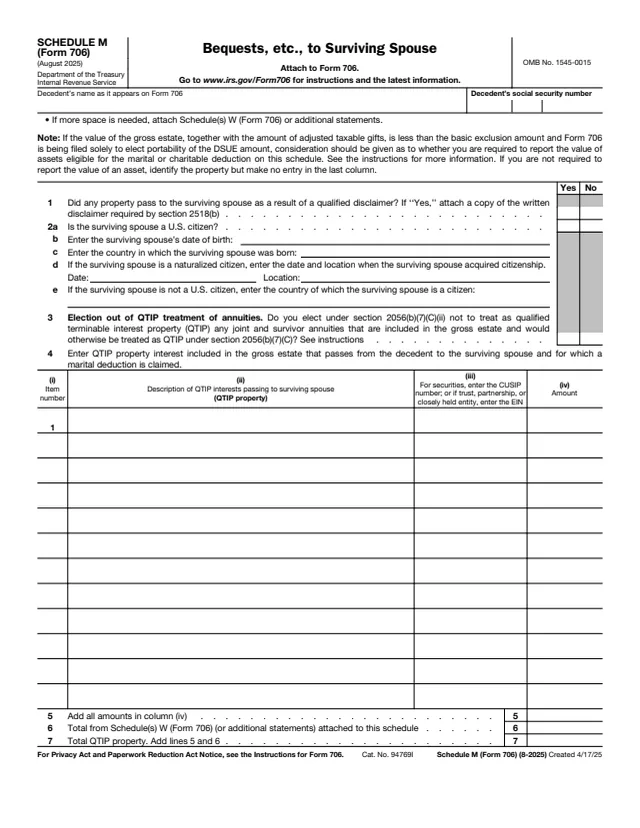
Schedule M (Form 706) is used to claim marital deductions for certain property interests that pass from the decedent to the surviving spouse, the IRS About Form 706 page says. It is attached to Form 706, the estate tax return the executor of a decedent's estate uses to figure the estate tax. The Instructions for Form 706 say to complete Schedule M and file it with the return if the estate claims a deduction on Form 706, Part V, item 21.
The schedule asks about qualified disclaimers and the surviving spouse's citizenship, offers an election out of QTIP treatment for certain joint and survivor annuities, and lists property in two tables: qualified terminable interest property (QTIP) on line 4 and all other property passing to the surviving spouse on line 8. Lines 13a to 13d subtract taxes payable out of those interests, and line 14 carries the net amount to Part V, item 21.
You can fill out Schedule M (Form 706) free in your browser on this page and download it without an account.
The decedent's name as it appears on Form 706 and the decedent's Social Security number.
A yes or no question on property passing by qualified disclaimer, then the surviving spouse's citizenship, date and country of birth, and naturalization date and location.
A yes or no question on electing under section 2056(b)(7)(C)(ii) not to treat certain joint and survivor annuities as QTIP.
A table with item number, description of QTIP interests, CUSIP number or EIN, and amount, then the column total, the Schedule W total and the total QTIP property.
The same table for non-QTIP property passing to the surviving spouse, its totals, and line 12 adding lines 7 and 11.
Federal estate taxes, other death taxes and federal and state GST taxes payable out of the listed interests, then the net amount entered on Part V, item 21.
The instructions say to check Yes if property passes to the surviving spouse as the result of a qualified disclaimer, and attach a copy of the written disclaimer required by section 2518(b).
Answer whether the surviving spouse is a U.S. citizen and enter the date and country of birth. Lines 2d and 2e cover a naturalized citizen and a spouse who is not a U.S. citizen.
The instructions say the executor can elect out of QTIP treatment for certain joint and survivor annuities by checking Yes, that the election is irrevocable, and that an annuity elected out cannot then be deducted here.
Number each item in column (i) and describe it in column (ii), including the will clause or law under which it passed and the schedule, line and item number of the asset. The instructions say listing QTIP here with its value makes the QTIP election.
List all other property passing to the surviving spouse. The instructions' example lists half of a jointly held house from Schedule E, life insurance proceeds from Schedule D and a cash bequest under the will.
Enter the taxes paid out of the listed interests. The instructions say to identify any state or other death or GST taxes on lines 13b or 13c and attach the computation. Subtract line 13d from line 12 for line 14.
You get the real form, filled in a browser tab, with nothing standing between you and the finished PDF.
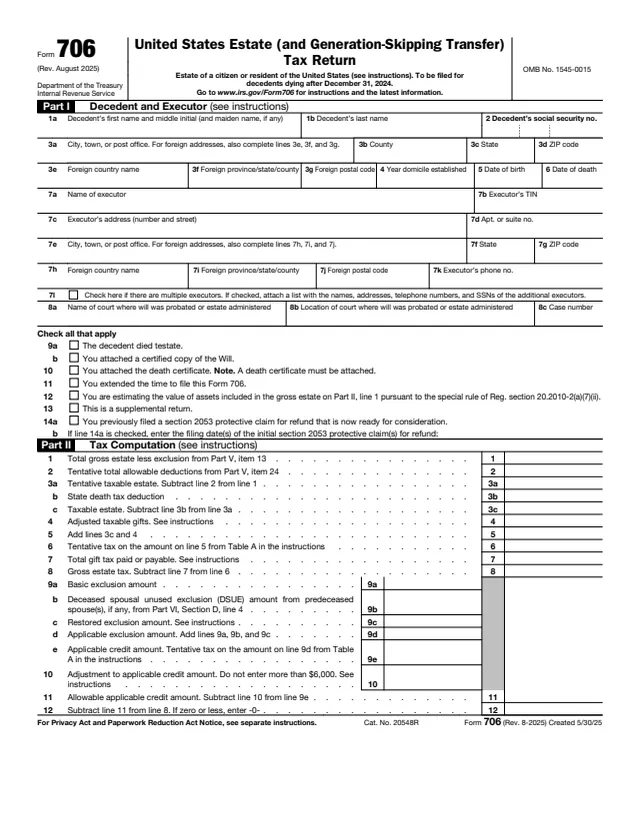
The schedule says "Attach to Form 706." The amount on line 14 is entered on Form 706, Part V, item 21.
The Form 706 instructions say Form 706 is filed within 9 months after the date of the decedent's death, and Form 4768 is used to apply for an automatic 6-month extension of time to file.
The Form 706 instructions give Department of the Treasury, Internal Revenue Service, Kansas City, MO 64999. The About page points to Filing estate and gift tax returns for the latest address.
For interests passing by will, the instructions say to attach a certified copy of the order admitting the will to probate, and any decree interpreting the will or order of distribution.
For a QDOT election, the instructions ask for an attachment with the name and address of every trustee, a description of each transfer that is the source of the trust property, and the trust's EIN.
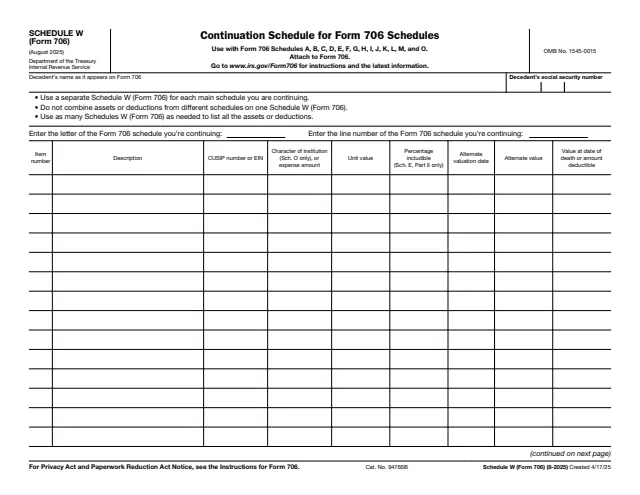
The schedule says that if more space is needed, attach Schedule(s) W (Form 706) or additional statements. Their totals go on lines 6 and 10.
706
316 fields, 5 pages
706 Sch. O
168 fields, 2 pages
706 Sch. W
303 fields, 2 pages
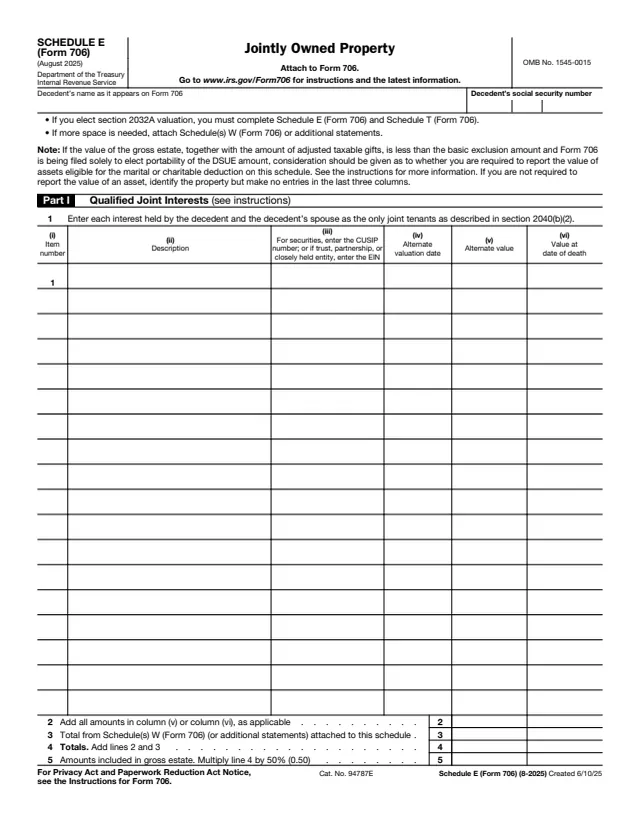
706 Sch. E
265 fields, 2 pages
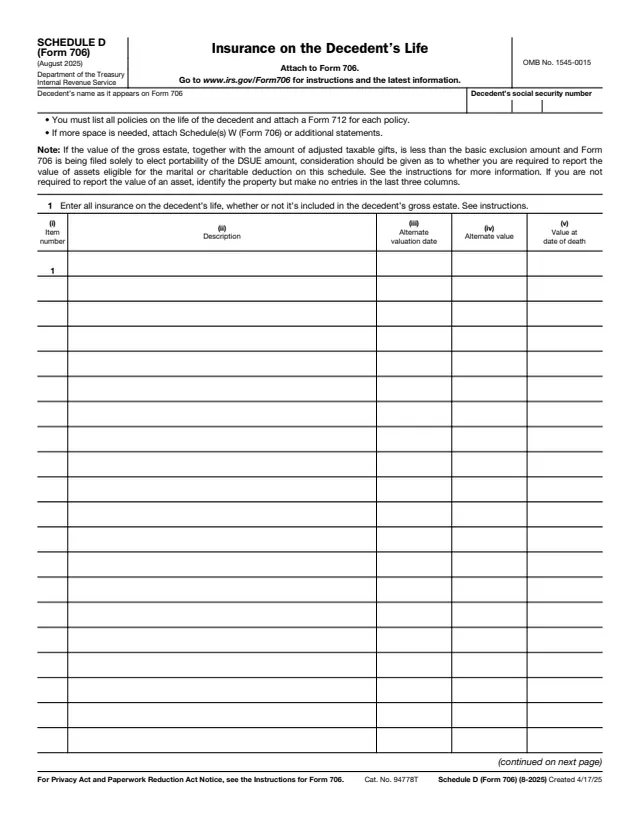
706 Sch. D
233 fields, 2 pages
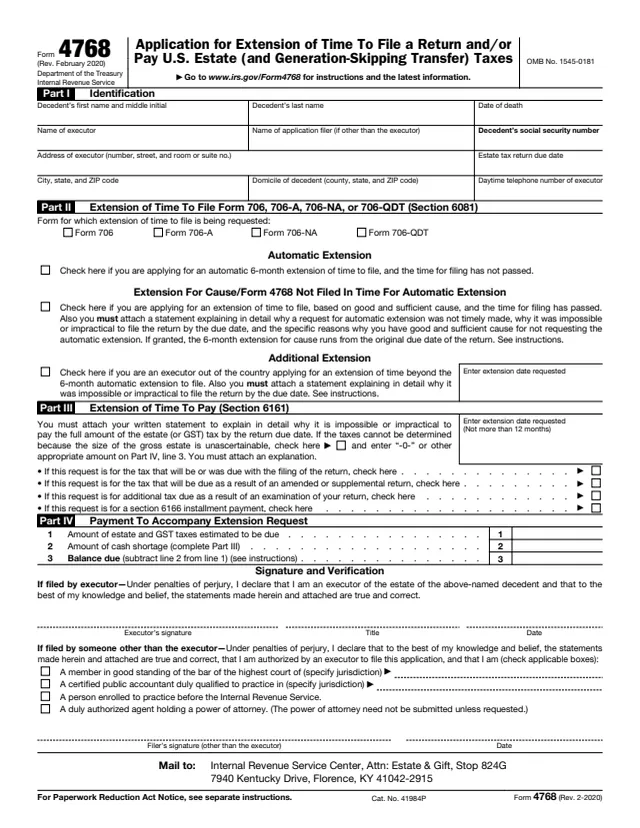
4768
35 fields, 1 page
The schedule is completed for a decedent's estate as part of Form 706 and goes to the IRS with that return. It is not an individual income tax form.
No tool matches that search.
The About Form 706 page says it is used to claim marital deductions for certain property interests that pass from the decedent to the surviving spouse.
The instructions say the QTIP election is made by listing the QTIP on line 4 of Schedule M and inserting its value, and that the election is irrevocable.
The instructions say the marital deduction is generally not allowed, except for property passing to the spouse in a QDOT or transferred or irrevocably assigned to a QDOT before the return is filed.
The instructions list property that does not pass to the surviving spouse, property not in the gross estate, nondeductible terminable interests unless a QTIP election is made, and interests the spouse disclaimed.
The instructions say to enter each value before taking into account the federal estate tax or any other death tax. Those taxes are subtracted on lines 13a to 13d.
The schedule says some of these estates may not have to report asset values here. If an asset's value is not reported, it says to identify the property but make no entry in the last column.