Part I, lines 1 to 14: decedent and policy
Decedent's name, SSN and date of death, the insurer's name and address, policy type and number, owner, issue date, assignor and date assigned, value at assignment, premium and beneficiaries.
712
Life Insurance Statement
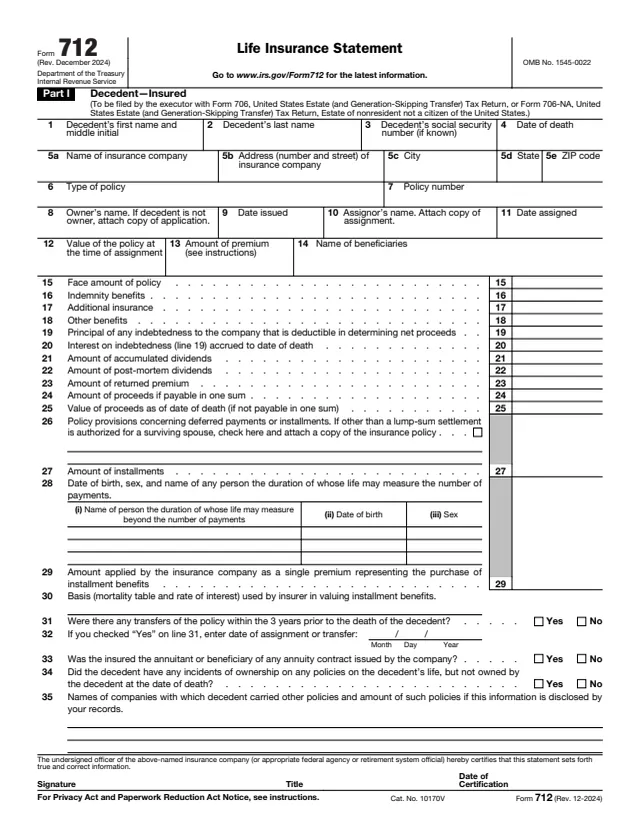
Form 712, Life Insurance Statement, reports the value of a life insurance policy for federal estate and gift tax returns. The IRS says Form 712 is filed by executors with Form 706, 706-NA, or 709 for insurance policy or premium amounts.
The statement itself is completed by the insurance company. The instructions on the form say it is made on behalf of the company that issued the policy by an officer of the company with access to its records, and that officer signs the certification. The form says to return it to the executor or representative who requested it, not to the IRS office for the tax return.
Part I covers a policy on the life of a decedent and is filed with Form 706 or 706-NA. Part II covers a living insured and is filed with Form 709 or 709-NA, or with Form 706 or 706-NA where the decedent owned insurance on the life of another. You can fill out the PDF free in your browser on this page and download it without an account.
Decedent's name, SSN and date of death, the insurer's name and address, policy type and number, owner, issue date, assignor and date assigned, value at assignment, premium and beneficiaries.
Face amount, indemnity benefits, additional insurance, other benefits, indebtedness and interest, accumulated and post-mortem dividends, returned premium, and proceeds in one sum or their value as of the date of death.
Deferred payment provisions, installments, the person whose life may measure payments, the single premium and valuation basis, transfers within 3 years of death, annuities, incidents of ownership and other policies.
The donor's or decedent's name and SSN, the date of gift or death being valued, and the living insured's policy: insurer, type, number, face amount, issue date, premium, assignee and any irrevocable beneficiary.
Line 58 values a policy that is not paid up, starting from the interpolated terminal reserve. Line 59 values a paid-up or single-premium policy. Both end with a net total value for gift or estate tax purposes.
Each part ends with the signature, title and date of certification of the insurance company officer or appropriate federal agency or retirement system official.
The instructions say to file a separate Form 712 for each policy.
Part I is for a policy on the life of a decedent, filed with Form 706 or 706-NA. Part II is for a living insured, filed with Form 709 or 709-NA, or with Form 706 or 706-NA as the form describes.
The instructions say to report the annual premium, not the cumulative premium to the date of death. If death occurred after the end of the premium period, report the last annual premium.
Line 8 asks for a copy of the application if the decedent is not the owner, line 10 a copy of the assignment, and line 26 a copy of the policy if other than a lump-sum settlement is authorized for a surviving spouse.
In Part II, use line 58 if the policy is not paid up and line 59 if it is paid up or a single premium. Each subtracts outstanding indebtedness to reach the net total value.
The officer signs and enters a title and the date of certification. The form says to return it to the executor or representative who requested it.
You get the real form, filled in a browser tab, with nothing standing between you and the finished PDF.
The form says not to send it to the office for the tax return it is filed with. Instead, return it to the executor or representative who requested it.
Part I is filed with Form 706 or 706-NA. Part II is filed with Form 709 or 709-NA, and may also be filed with Form 706 or 706-NA.
The instructions say a facsimile signature may be used in lieu of a manual signature and, if used, is binding as a manual signature.
The form estimates 18 hrs., 11 min. for recordkeeping, 6 min. for learning about the form and 23 min. for preparing it.
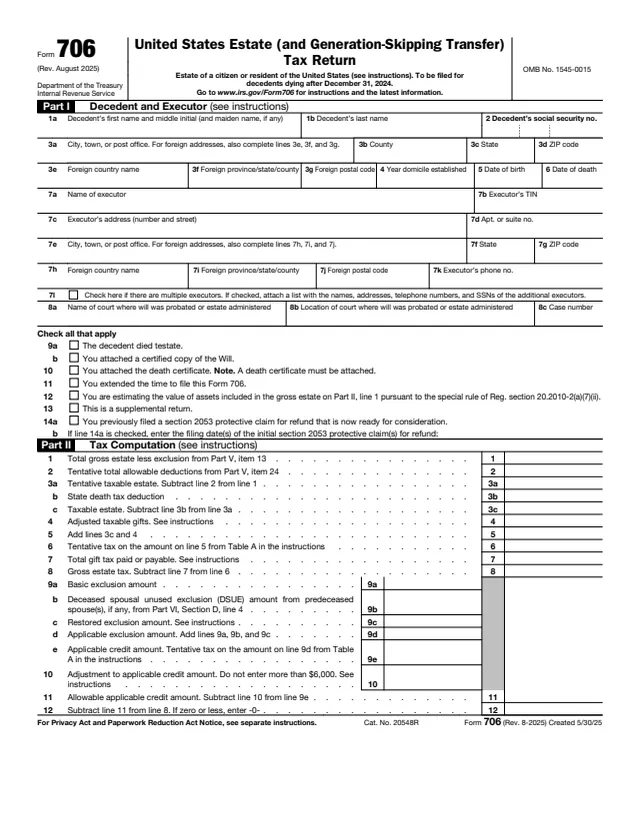
706
316 fields, 5 pages
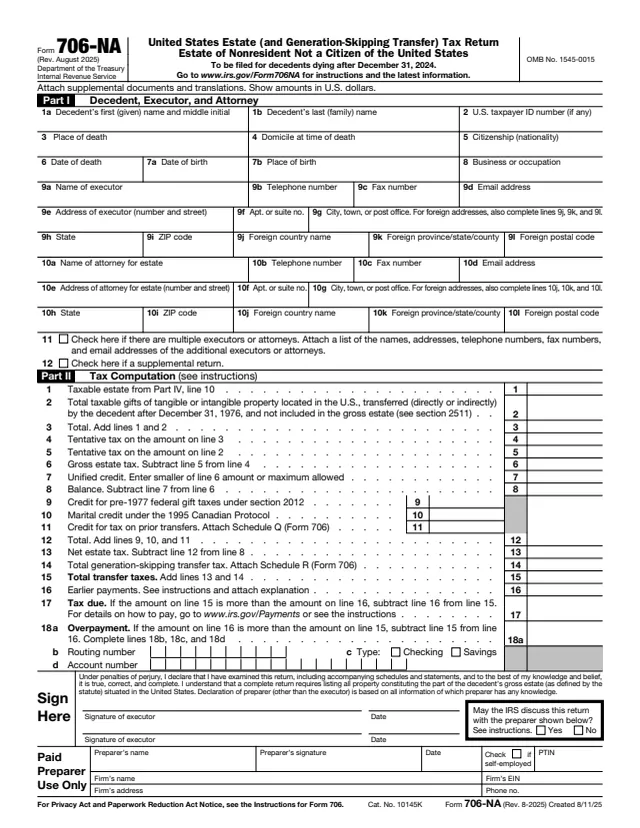
706-NA
259 fields, 3 pages
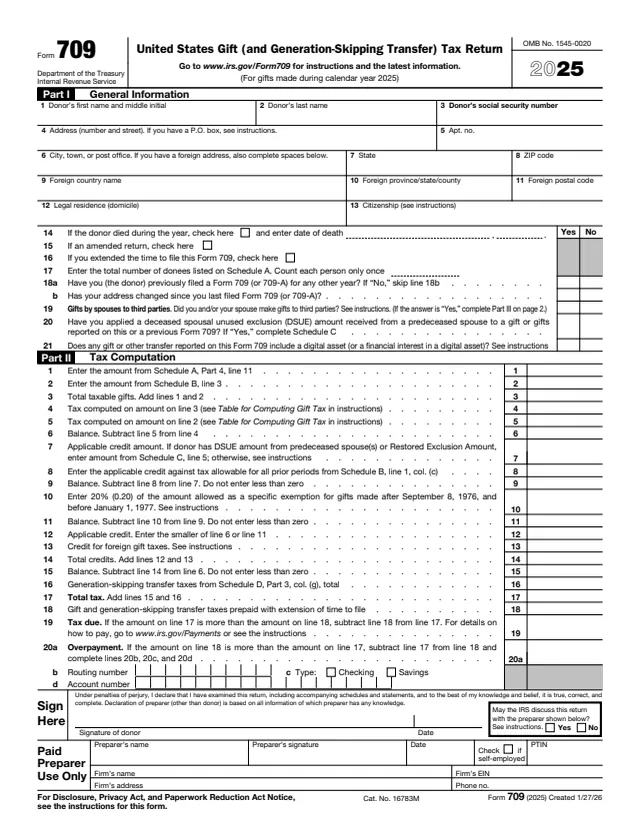
709
1,851 fields, 10 pages
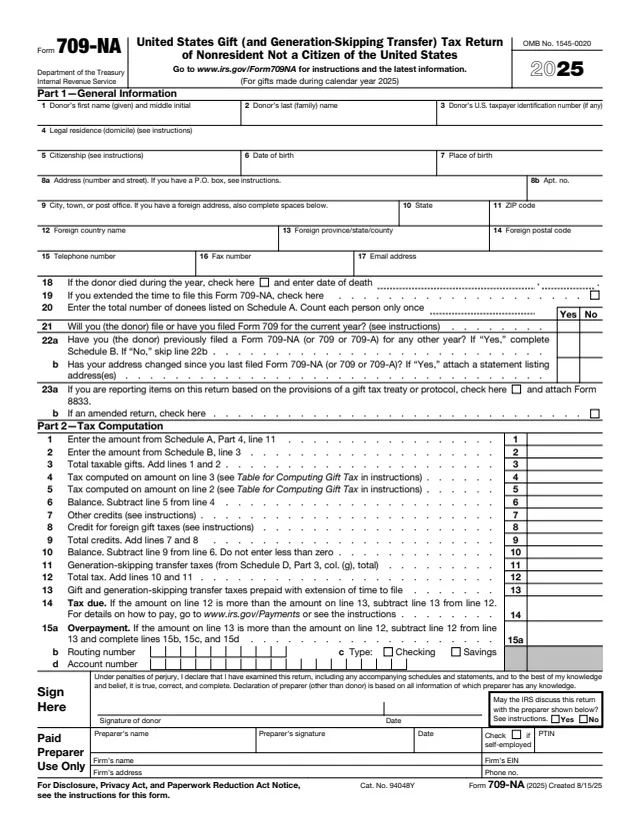
709-NA
889 fields, 8 pages
An officer of the insurance company completes and certifies the statement. The executor, donor or representative who requested it files it with the estate or gift tax return.
No tool matches that search.
The insurance company. The instructions say an officer of the company that issued the policy makes the statement, and the executor files it with the estate tax return.
No. The form says not to send it to the office for the tax return, and to return it to the executor or representative who requested it.
Part I goes with Form 706 or 706-NA. Part II goes with Form 709 or 709-NA, and may also go with Form 706 or 706-NA.
No. The instructions say to file a separate Form 712 for each policy.
The instructions say the annual premium, not the cumulative premium to the date of death, or the last annual premium if death occurred after the premium period ended.
Yes. The instructions say a facsimile signature may be used in lieu of a manual signature and is binding as one.