Tax year and entity details
The calendar year or tax year, the tax-exempt entity's name and employer identification number, an in care of line, and the entity's address.
8886-T
Disclosure by Tax-Exempt Entity Regarding Prohibited Tax Shelter Transaction
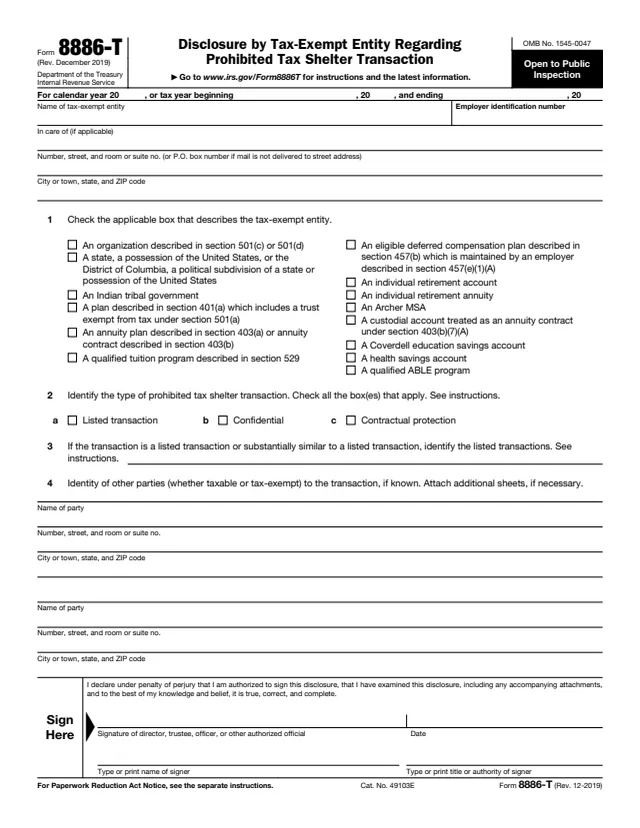
Form 8886-T, Disclosure by Tax-Exempt Entity Regarding Prohibited Tax Shelter Transaction, is filed by certain tax-exempt entities to disclose information about each prohibited tax shelter transaction to which the entity is a party. The instructions say a separate Form 8886-T is filed for each prohibited tax shelter transaction, and a single disclosure is required for each one.
The instructions say a prohibited tax shelter transaction is generally a listed transaction (including a subsequently listed transaction), a confidential transaction, or a transaction with contractual protection. The form is marked Open to Public Inspection.
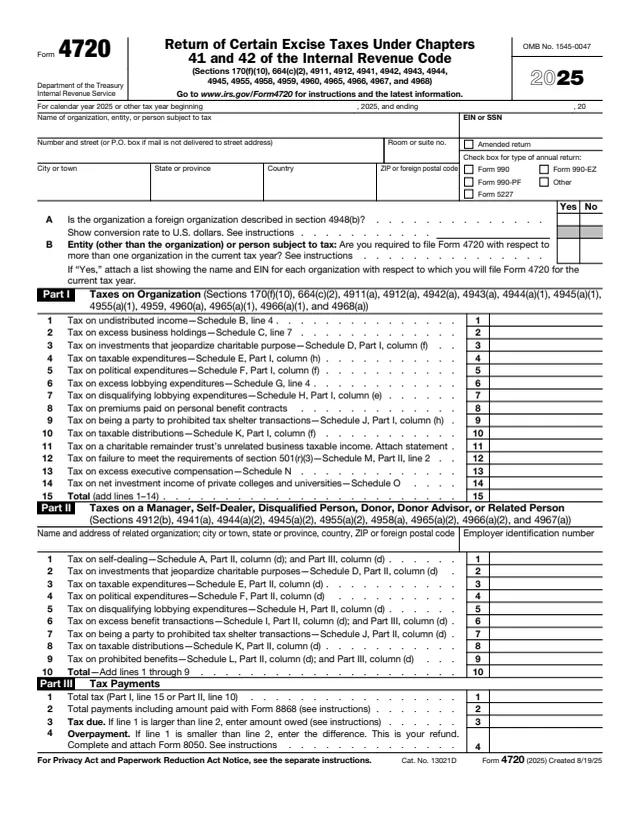
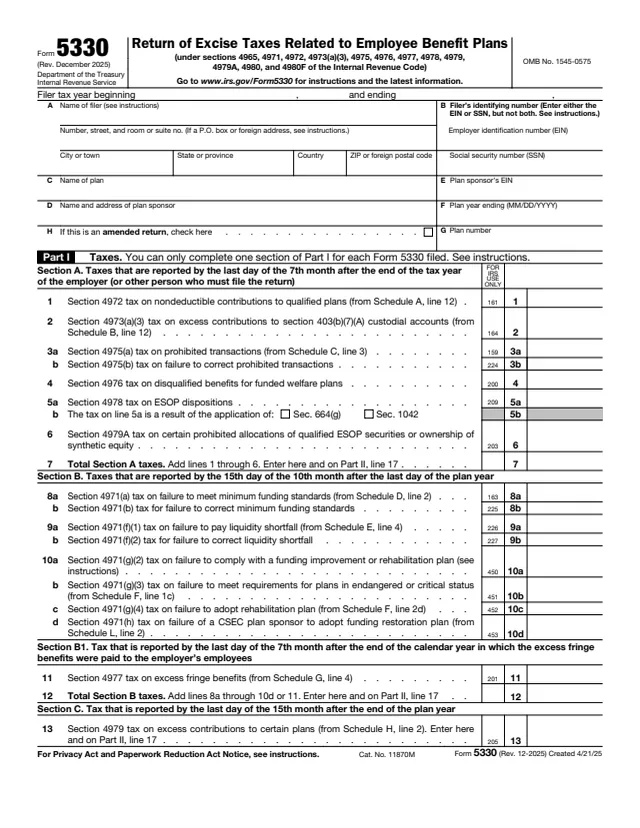
The instructions also say the entity or its entity managers may owe excise taxes reported on Form 4720 or Form 5330, and that a tax-exempt entity in a reportable transaction may also have to file Form 8886. You can fill out the PDF free in your browser on this page and download it without an account.
The calendar year or tax year, the tax-exempt entity's name and employer identification number, an in care of line, and the entity's address.
Boxes for each kind of entity, from section 501(c) or 501(d) organizations and Indian tribal governments to IRAs, Archer MSAs, Coverdell accounts, health savings accounts and qualified ABLE programs.
Three boxes: a, listed transaction; b, confidential; and c, contractual protection. The form says to check all the boxes that apply.
Space to identify the listed transactions when the transaction is a listed transaction or substantially similar to one.
Names and addresses of other parties to the transaction, taxable or tax-exempt, if known. The form has room for two parties and says to attach more sheets if needed.
A declaration under penalty of perjury, the signature of a director, trustee, officer or other authorized official, the date, and the signer's printed name and title or authority.
Enter the tax-exempt entity's name and address as shown on other forms filed with the IRS, and its EIN. The instructions say a fully self-directed qualified plan or IRA that has no EIN leaves the box blank, and not to enter a social security number.
Check the box for the type of tax-exempt entity that is a party to the prohibited tax shelter transaction.
Check every category that applies to the one transaction being reported. The instructions say a transaction substantially similar to a listed transaction gets the listed transaction box.
If listed transaction is checked, give a brief identifying description and name the notice, revenue ruling, regulation or other published guidance that identified it. The instructions point to Notice 2009-59.
Give the complete names and addresses of all other parties, if known. On each extra sheet, the instructions say to write Line 4 at the top with the entity's name and identifying number.
For a non-plan entity, the director, trustee, officer or other authorized official signs. For a plan entity, the instructions say the entity manager signs.
You get the real form, filled in a browser tab, with nothing standing between you and the finished PDF.
The instructions list Department of the Treasury, Internal Revenue Service Center, Ogden, UT 84201-0027.
For an entity that facilitates the transaction because of its tax-exempt, tax indifferent or tax-favored status, the instructions say on or before May 15 of the calendar year after the year it entered into the transaction. If published guidance names the entity by type, class or role, that guidance sets the due date.
The instructions say the form is due by May 15 of the calendar year after the year the transaction was identified as a listed transaction.
The instructions say not to write See Attached, Information provided upon request or similar statements. Extra sheets follow the order of the lines and show the entity name and identifying number.
The instructions list $105 for each day the failure continues, up to $54,000 for each required disclosure, and $105 per day after an IRS written demand, up to $10,500. They say these amounts are adjusted for inflation.
A completed Form 8886-T is available for public inspection. The instructions say the entity or entity manager keeps a copy of all records related to the transaction.
The instructions say who files depends on whether the tax-exempt entity is a non-plan entity or a plan entity. The form goes to the IRS.
No tool matches that search.
The instructions say a non-plan entity, such as a section 501(c) organization, files for itself. For a plan entity, such as a qualified plan or IRA, the entity manager files.
For a fully self-directed qualified plan, IRA or other savings arrangement, the instructions say the entity manager is the participant, beneficiary or owner who approved or caused the entity to be a party to the transaction.
One for each prohibited tax shelter transaction. The instructions say a single disclosure is required for each transaction and not to report more than one transaction on the form.
The instructions say it is generally a listed transaction, including a subsequently listed transaction, a confidential transaction, or a transaction with contractual protection, and they define each term.
The instructions say the minimum fee is $250,000 for a corporation, or a partnership or trust whose owners or beneficiaries are all corporations, and $50,000 for all others.
Yes. The form is marked Open to Public Inspection, and the instructions say a completed form is available for public inspection as required under section 6104.
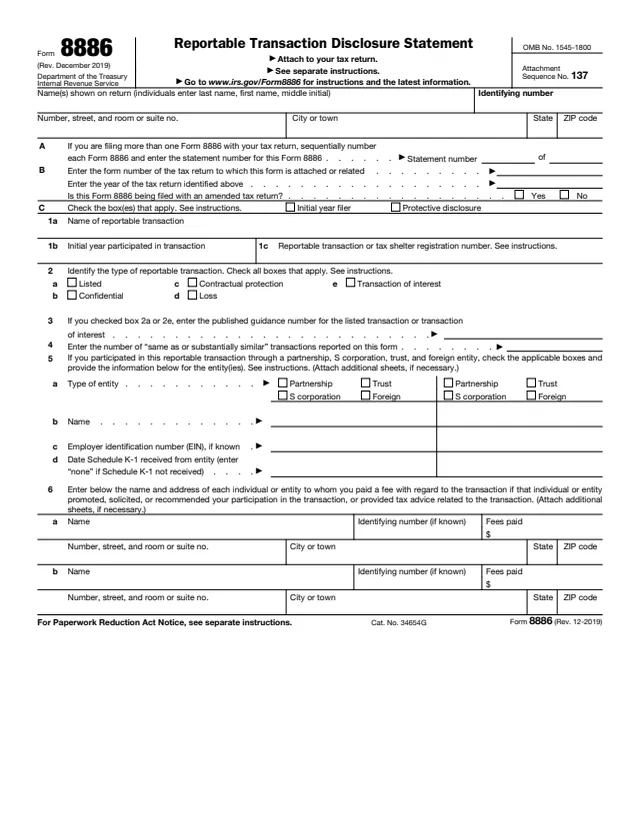
No. The instructions say a tax-exempt entity that participates in a reportable transaction may also have to file Form 8886, Reportable Transaction Disclosure Statement.