Header and lines A and B
Name and identifying number. Line A has boxes for gain reported from a Schedule K-1 from Form 1120-S, Form 1065 or Form 8865. Line B asks for that entity's EIN and name.
1062 Sch. A
Section 1062 Gain From the Sale or Exchange of Qualified Farmland Property to a Qualified Farmer
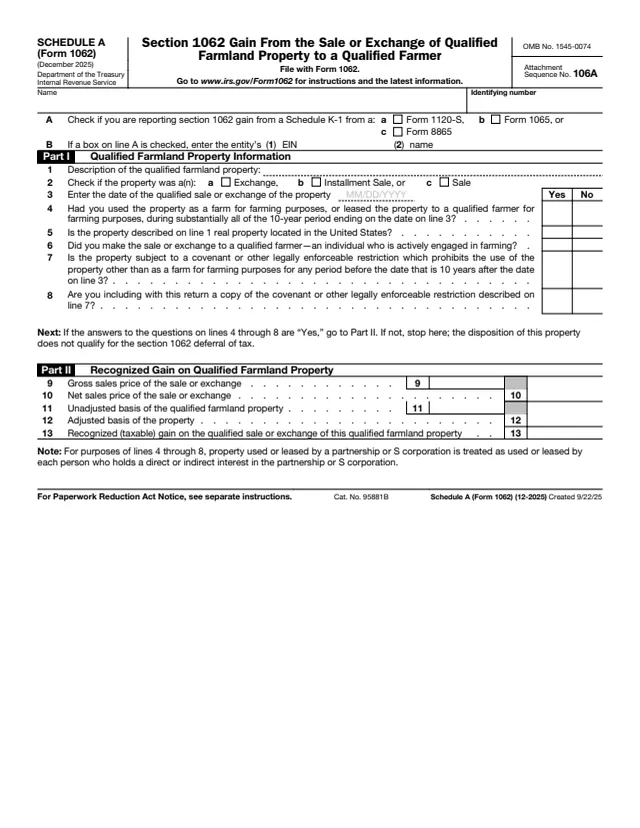
Schedule A (Form 1062) provides information on each qualified sale or exchange for which the section 1062 election is made. Form 1062 is used to elect to defer payment of the net income tax attributable to gain from a qualified sale or exchange of qualified farmland property to qualified farmers.
The instructions say section 1062 was created by P.L. 119-21 for tax years beginning after July 4, 2025, and allows the tax on that gain to be paid in four equal annual installments. A separate Schedule A, with a copy of the section 1062 covenant, is completed for each qualified sale or exchange. Part I asks whether the property qualifies; Part II figures the recognized gain that carries to Form 1062.
This is the December 2025 edition. You can fill out Schedule A (Form 1062) free in your browser on this page and download the result without an account.
Name and identifying number. Line A has boxes for gain reported from a Schedule K-1 from Form 1120-S, Form 1065 or Form 8865. Line B asks for that entity's EIN and name.
A description of the qualified farmland property, boxes for Exchange, Installment Sale or Sale, and the date of the qualified sale or exchange.
Five yes or no questions: farm use or lease during substantially all of the 10-year period, U.S. real property, sale to a qualified farmer, a covenant, and whether a copy of it is included.
Gross sales price, net sales price, unadjusted basis and adjusted basis of the qualified farmland property.
The recognized (taxable) gain on the qualified sale or exchange of this qualified farmland property.
A partner or S corporation shareholder who received an allocation of gain checks the box for the type of Schedule K-1 issued, then enters the EIN and name of the entity on line B.
Enter the description of the qualified farmland property, check the box for the type of transaction and enter the date of the sale or exchange. Partners and shareholders use the entity's Schedule A for lines 1 to 8.
Answer each question. The instructions say that if any answer is No, the sale is not a qualified sale or exchange: do not complete Part II and do not include it on Form 1062.
Line 9 is the gross proceeds, including money, the fair market value of property or services received and liabilities assumed by the buyer. Line 10 is the gross proceeds minus selling expenses.
Enter the unadjusted basis and the adjusted basis, then subtract line 12 from line 10 for line 13. Line 13 goes to Form 1062, line 7.
The instructions say a partner's or shareholder's Schedule A leaves lines 9 to 12 blank and reports on line 13 their share of the gain from Schedule K-1 code ZZ.
You get the real form, filled in a browser tab, with nothing standing between you and the finished PDF.
The instructions say to attach Form 1062, Schedule(s) A and a copy of each section 1062 covenant to the income tax return and file by the due date, including extensions.
The entity files Schedule A with its return and reports each owner's share of line 13 on Form 1065, Schedule K-1, box 20, or Form 1120-S, Schedule K-1, box 17, using code ZZ with an attached statement.
The instructions say the entity gives partners or shareholders each one's share of the gain, a copy of its Schedule A and a copy of the section 1062 covenant.
The instructions say the first installment is due by the return due date without extensions for the year of the sale, and each later installment by the return due date for each of the 3 following years.
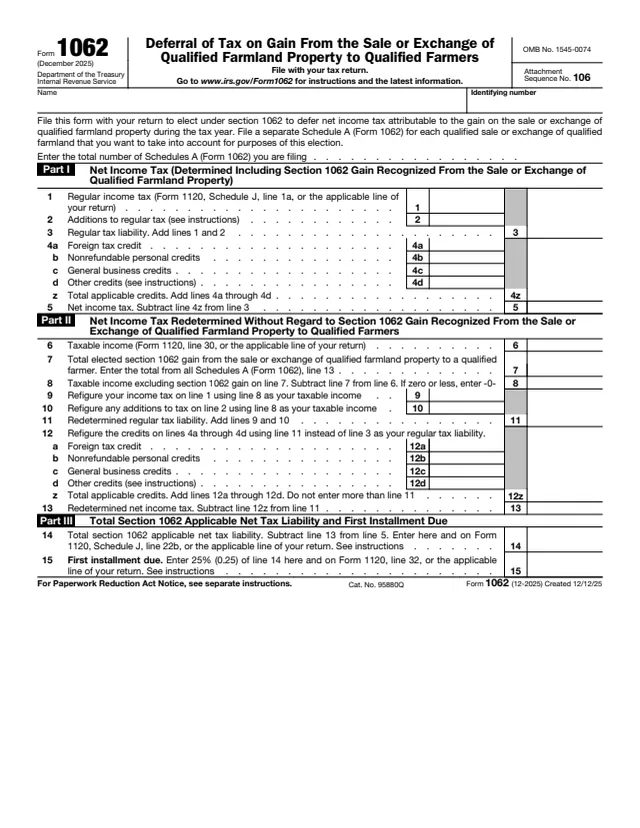
1062
26 fields, 1 page
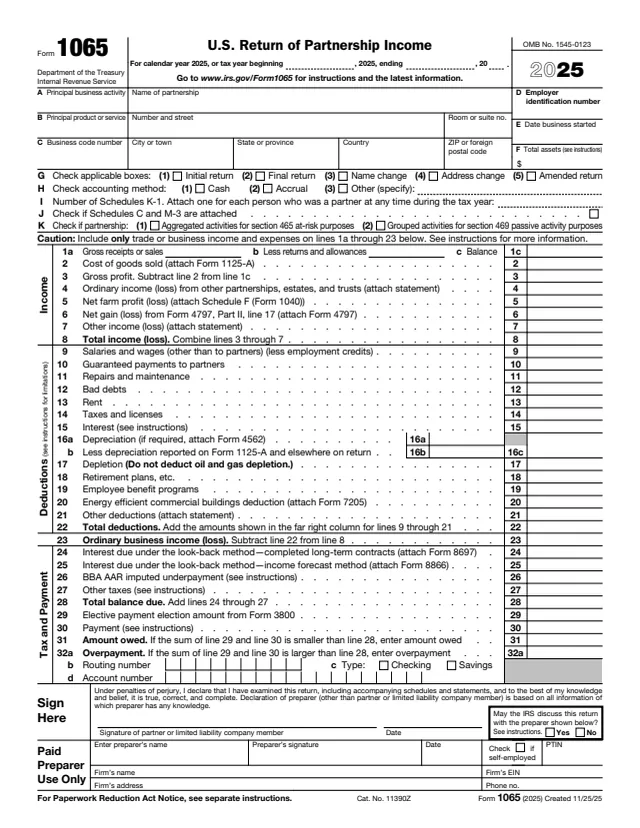
1065
440 fields, 6 pages
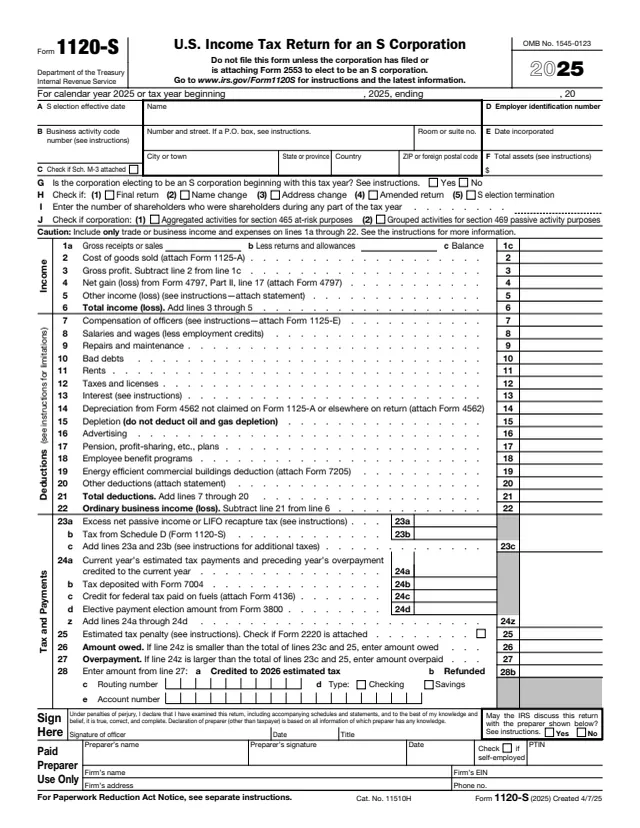
1120-S
390 fields, 5 pages
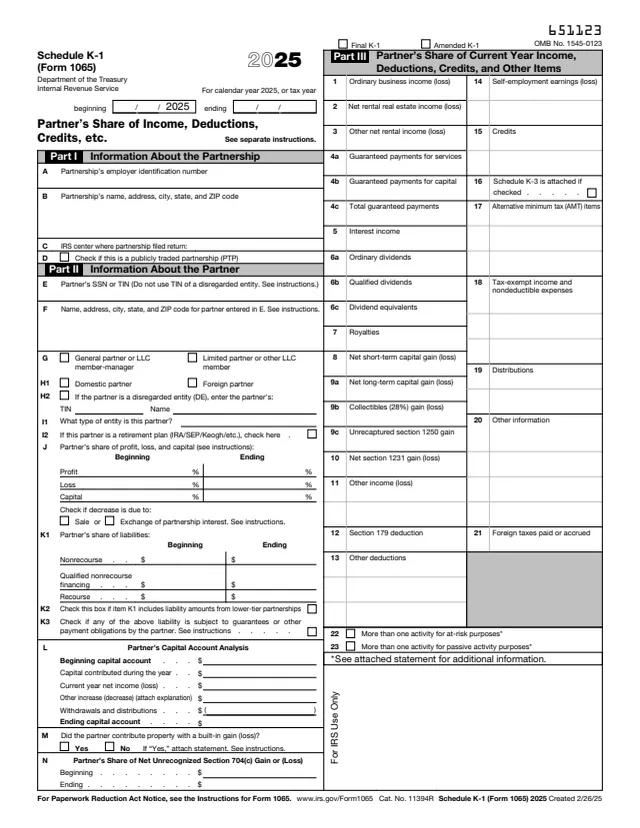
1065
111 fields, 1 page
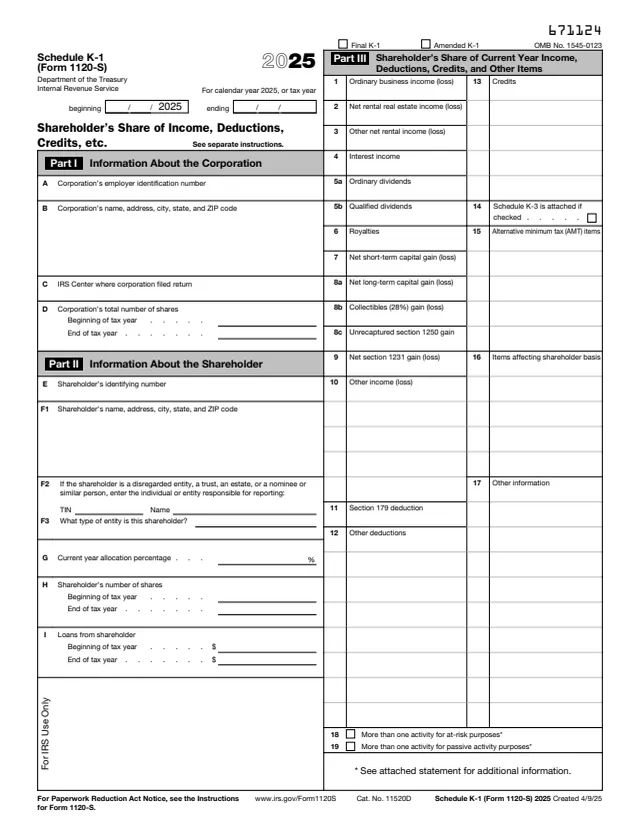
1120-S
114 fields, 1 page
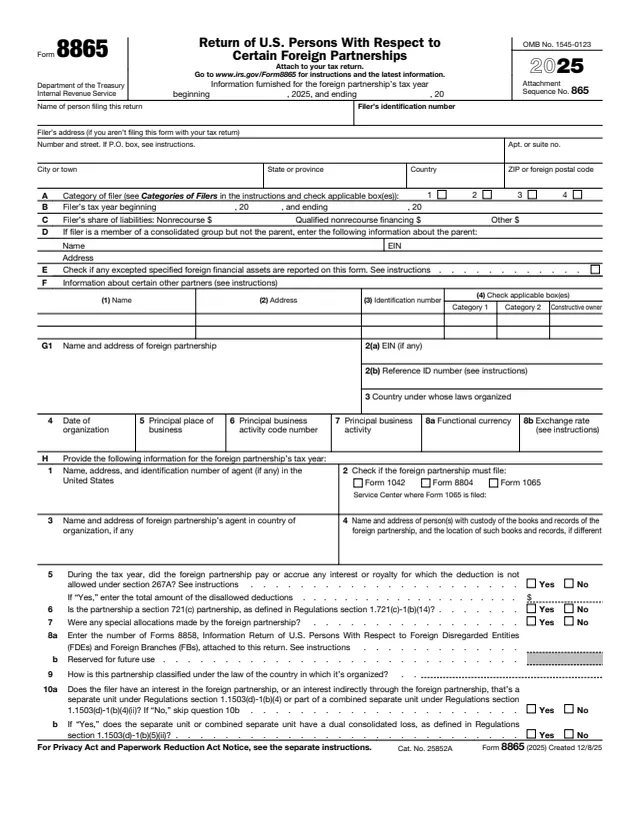
8865
461 fields, 6 pages
The instructions say the election is made by filing Form 1062, Schedule(s) A and a section 1062 covenant with the income tax return. The IRS receives it.
No tool matches that search.
For individuals and entities making the election, the instructions say it is attached with Form 1062 and the covenant to the income tax return. A partnership or S corporation files it with its own return.
Yes. The instructions say to complete a separate Schedule A and include a copy of the covenant for each qualified sale or exchange.
The form says to stop: the disposition does not qualify for the section 1062 deferral. The instructions add not to include it on Form 1062.
The instructions define it as any individual who is actively engaged in farming within the meaning of 7 U.S.C. 1308-1(b) and (c).
The instructions describe it as a covenant or other legally enforceable restriction that prohibits use of the real property for any purpose other than farming during the 10-year period that begins on the day after the sale or exchange.
The instructions for Form 1062, line 7, say to enter the amount from Schedule A, line 13, or the total from all Schedules A when there is more than one sale.