Boxes A to E
The reason the schedule is filed, with spaces for adjusted total assets, total receipts, and the name, identifying number and maximum percentage owned of each reportable entity partner.
1065 Sch. M-3
Net Income (Loss) Reconciliation for Certain Partnerships
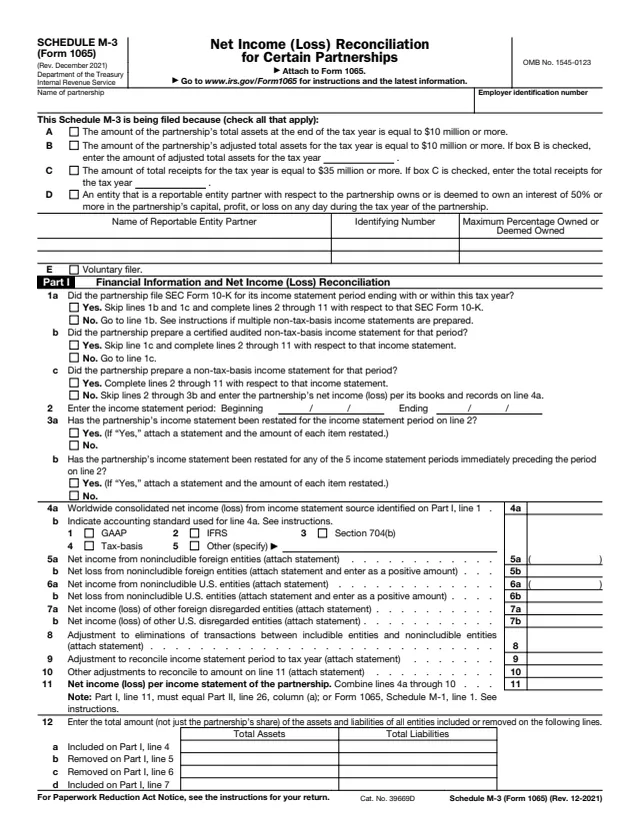
Schedule M-3 (Form 1065), Net Income (Loss) Reconciliation for Certain Partnerships, is a three-page schedule attached to Form 1065, U.S. Return of Partnership Income. The IRS About page says partnerships file it to answer questions about their financial statements, reconcile financial statement net income (loss) for the consolidated financial statement group to income (loss) per the income statement for the partnership, and reconcile that amount to line 1 of the Analysis of Net Income (Loss) on Form 1065.
Part I covers financial information and the net income (loss) reconciliation. Parts II and III reconcile income (loss) items and expense or deduction items in four columns: per income statement, temporary difference, permanent difference and per tax return.
The current revision is December 2021, and the instructions (Rev. November 2023) say to use it for tax years ending December 31, 2021, and until a new revision is available. You can fill out Schedule M-3 free in your browser on this page and download it without an account.
The reason the schedule is filed, with spaces for adjusted total assets, total receipts, and the name, identifying number and maximum percentage owned of each reportable entity partner.
Whether the partnership filed SEC Form 10-K or prepared a certified audited or other non-tax-basis income statement, the income statement period, and whether the income statement was restated.
Worldwide consolidated net income (loss), the accounting standard used, removal of nonincludible entities, other adjustments, net income (loss) per income statement on line 11, and assets and liabilities of included or removed entities.
Lines 1 to 26 cover items such as income from equity method corporations, dividends, partnership income, interest income, cost of goods sold, section 481(a) adjustments and gains or losses on dispositions, ending with reconciliation totals.
Lines 1 to 31 cover items such as income tax expense, equity-based compensation, meals and entertainment, fines and penalties, guaranteed payments, depreciation, interest expense and research and development costs.
Enter the partnership's name and EIN, then check every box A to E that applies. Enter adjusted total assets for box B, total receipts for box C, and each reportable entity partner for box D.
Answer lines 1a to 1c to show the source used: an SEC Form 10-K, a certified audited non-tax-basis income statement, another non-tax-basis income statement, or books and records on line 4a.
Enter worldwide consolidated net income (loss) on line 4a, mark the accounting standard on line 4b, and make the adjustments on lines 5 to 10. The form notes that line 11 must equal Part II, line 26, column (a), or Form 1065, Schedule M-1, line 1.
The instructions say a filer with at least $50 million total assets completes the schedule entirely. Others may complete it entirely, or complete Part I and Schedule M-1 instead of Parts II and III.
In Parts II and III, enter the income statement amount in column (a), temporary differences in column (b), permanent differences in column (c) and the tax return amount in column (d). The instructions say a difference that cannot be classified goes in column (c).
Attach the statements the lines call for, including statements for Part II, lines 1 to 10, and a detailed statement for Part II, line 22, and Part III, line 30. Some lines also call for Form 8916-A.
You get the real form, filled in a browser tab, with nothing standing between you and the finished PDF.
The schedule says "Attach to Form 1065." It is filed with the partnership's return, not on its own.
The instructions say a partnership that files Schedule M-3 files Form 1065 and all attachments and schedules at the Department of the Treasury, Internal Revenue Service Center, Ogden, UT 84201-0011.
The instructions say a reportable entity partner reports its name, address, EIN, ownership interest and related details to the partnership within 30 days of first becoming one, and within 30 days of any change in its interest.
The About page says some filers of Schedule M-3 (Form 1065) use Schedule C (Form 1065) to provide answers to additional questions.
The instructions are Rev. November 2023, for use with the December 2021 revision of the schedule. For earlier tax years, they point to the applicable earlier schedule and instructions.
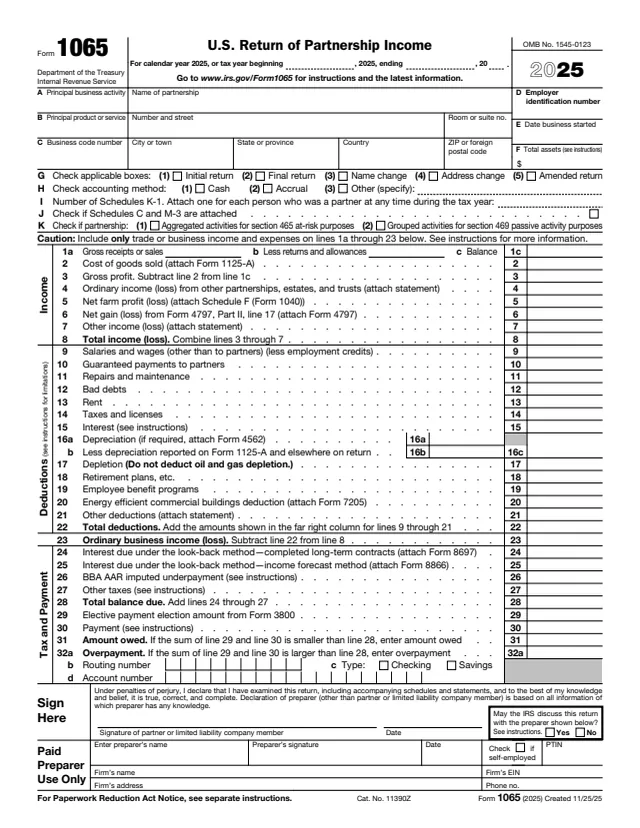
1065
440 fields, 6 pages
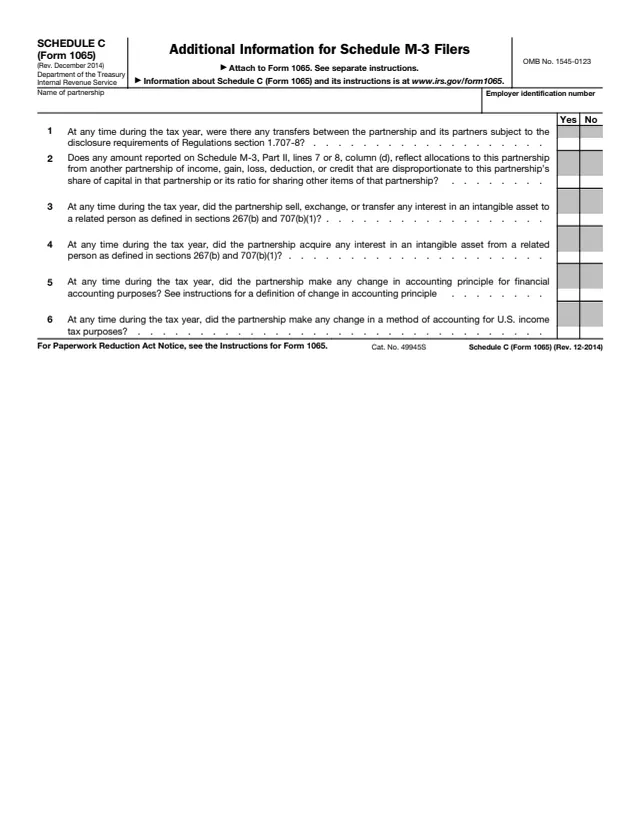
1065
14 fields, 1 page
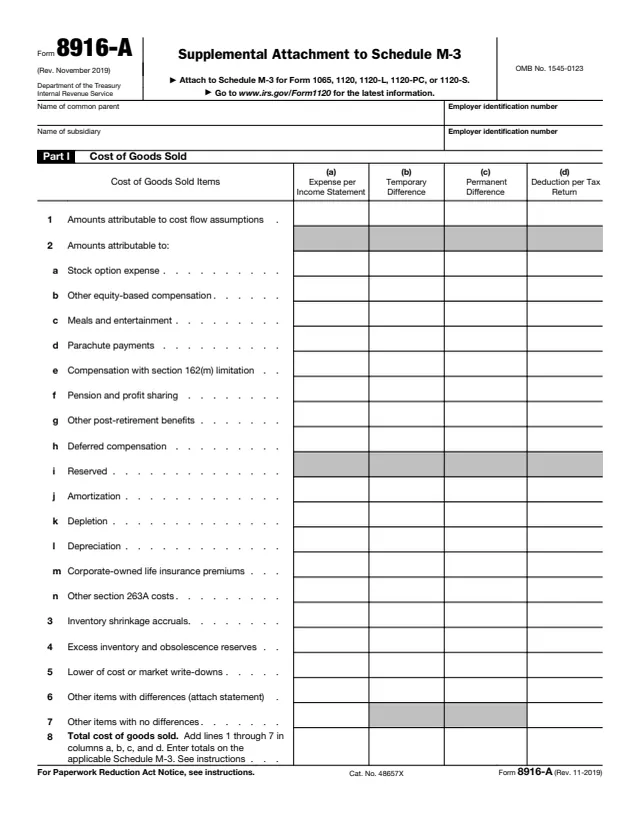
8916-A
140 fields, 4 pages
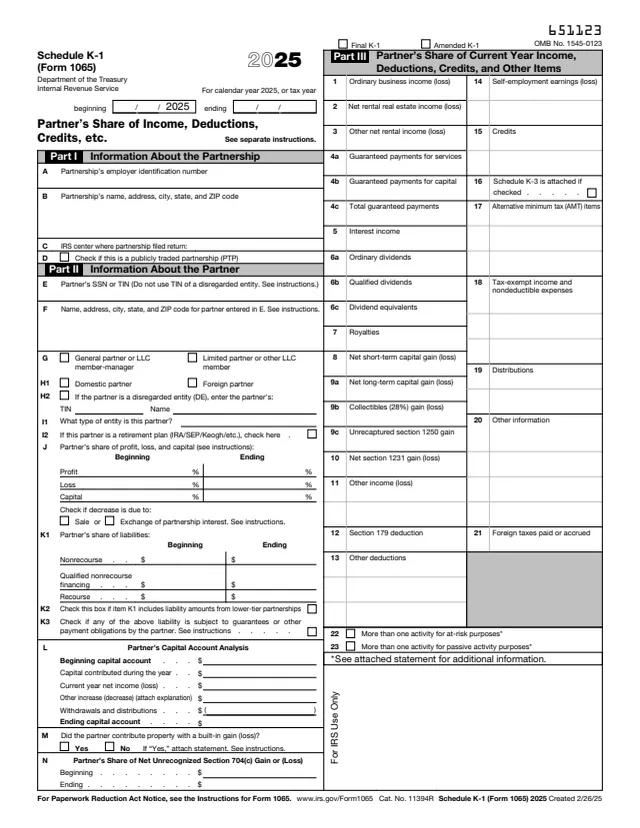
1065
111 fields, 1 page
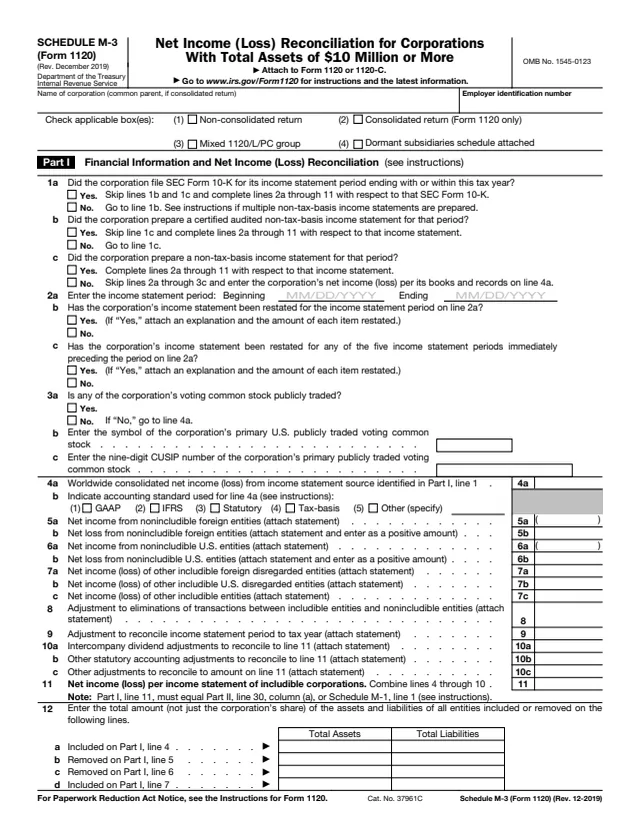
1120 Sch. M-3
380 fields, 3 pages
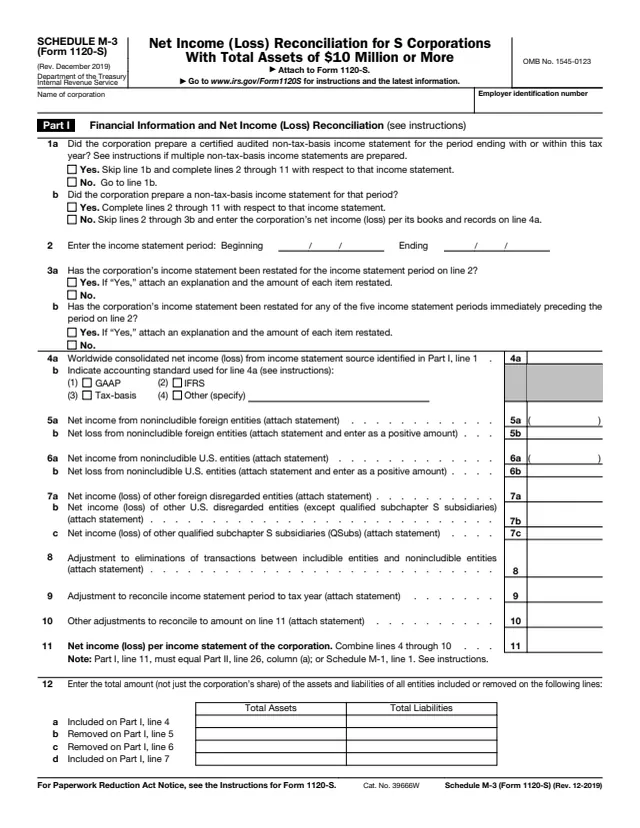
1120-S Sch. M-3
305 fields, 3 pages
A partnership completes Schedule M-3 and attaches it to its Form 1065. The instructions say any entity that files Form 1065 files Schedule M-3 if any one of four tests is true, and other partnerships may file it voluntarily.
No tool matches that search.
The instructions list four tests: total assets of $10 million or more, adjusted total assets of $10 million or more, total receipts of $35 million or more, or a reportable entity partner owning or deemed to own 50% or more.
Yes. The instructions say partnerships not required to file it may file it voluntarily and check box E above Part I.
The instructions say filers required to file with less than $50 million total assets, and voluntary filers, may complete Part I and Schedule M-1 instead of Parts II and III. At $50 million or more, the schedule is completed entirely.
Column (b) holds temporary differences. For filers without GAAP statements, the instructions describe these as differences the partnership believes will reverse in a future tax year, or reversals of earlier ones. Column (c) holds differences it believes will not reverse.
The form notes that Part I, line 11 must equal Part II, line 26, column (a), or Form 1065, Schedule M-1, line 1.
The PDF on IRS.gov is Rev. December 2021. The instructions say to use it until a new revision of the form and instructions is available.