Part I: Bond Issues
For each issue in rows A to D: issuer name and EIN, CUSIP number, date issued, issue price, purpose, and yes or no boxes for defeased, on behalf of issuer and pooled financing.
990 Sch. K
Supplemental Information on Tax-Exempt Bonds
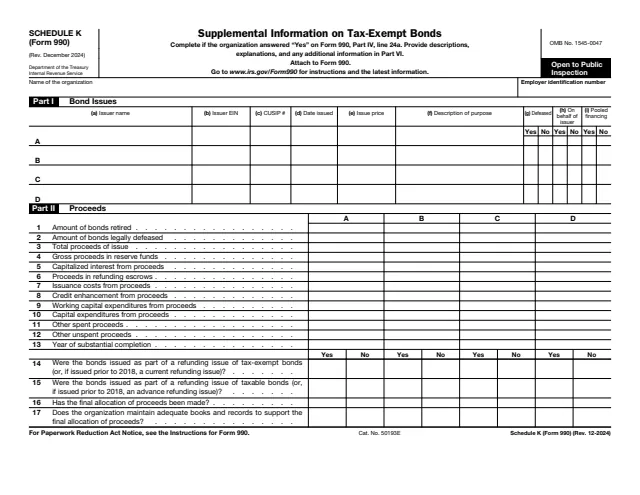
Schedule K (Form 990), Supplemental Information on Tax-Exempt Bonds, is used by an organization that files Form 990 to provide certain information on its outstanding liabilities associated with tax-exempt bond issues, the instructions say. They add that a bond issue associated with an exempt organization usually consists of qualified 501(c)(3) bonds, but all types of tax-exempt bonds benefiting the organization are reported.
The schedule covers up to four bond issues in rows A to D and asks about proceeds, private business use, arbitrage and written procedures for corrective action. The instructions say Schedule K and its instructions were converted from an annual revision to continuous use. The form is marked Open to Public Inspection.
You can fill it out free in your browser on this page and download the result without an account.
For each issue in rows A to D: issuer name and EIN, CUSIP number, date issued, issue price, purpose, and yes or no boxes for defeased, on behalf of issuer and pooled financing.
Lines 1 to 17: bonds retired and defeased, total proceeds, reserve funds, how proceeds were spent or remain unspent, the year of substantial completion, refunding questions and the final allocation of proceeds.
Partnership or LLC ownership, leases, management, service and research agreements, private business use percentages, the private security or payment test and sales of financed property.
Whether the issuer filed Form 8038-T, rebate exceptions, variable rate issues, qualified hedges, guaranteed investment contracts, temporary periods and written procedures under section 148.
One yes or no question per issue on written procedures to identify and correct violations through the voluntary closing agreement program.
Explanations for answers elsewhere on the schedule, such as an issue price that differs from Form 8038 or an alternative 12-month reporting period.
Enter the organization's name and employer identification number. The instructions say the schedule can use the same period as the Form 990, or another 12-month period described in Part VI.
Use one row per issue and keep the same row letter through Parts I to IV. The instructions say columns (a) to (d) should match the Form 8038 filed by the governmental issuer. With no CUSIP number, enter zeros.
Enter amounts as of the end of the 12-month period. The instructions note that lines 4 through 12 may not add up to line 3, because line 4 is gross proceeds and the others are proceeds.
Answer for each issue except post-2002 refundings of pre-2003 issues. The instructions say line 5 is the yearly average percentage rounded to the nearest tenth of a percentage point, for example 8.9%.
Answer each arbitrage question. If line 2c is Yes, give the date of the rebate computation in Part VI. The instructions say hedge and GIC terms are rounded to the nearest tenth of a year.
Answer the corrective action question for each issue, then give every explanation in Part VI, identifying the part and line. For more than four issues, the instructions say the schedule can be duplicated.
You get the real form, filled in a browser tab, with nothing standing between you and the finished PDF.
The form says to attach Schedule K to Form 990. The About page says organizations that file Form 990 use it for information on outstanding tax-exempt bond liabilities.
Up to four separate outstanding tax-exempt liabilities fit on each schedule. The instructions say it can be duplicated, and the first schedule's Part VI notes that more are included.
The instructions say issues legally defeased in whole need not be listed in Part I, but continued compliance with federal tax law requirements is required for defeased bonds.
The schedule is marked Open to Public Inspection.
The instructions say Schedule K and its instructions moved from an annual revision to continuous use and will be updated only as needed.
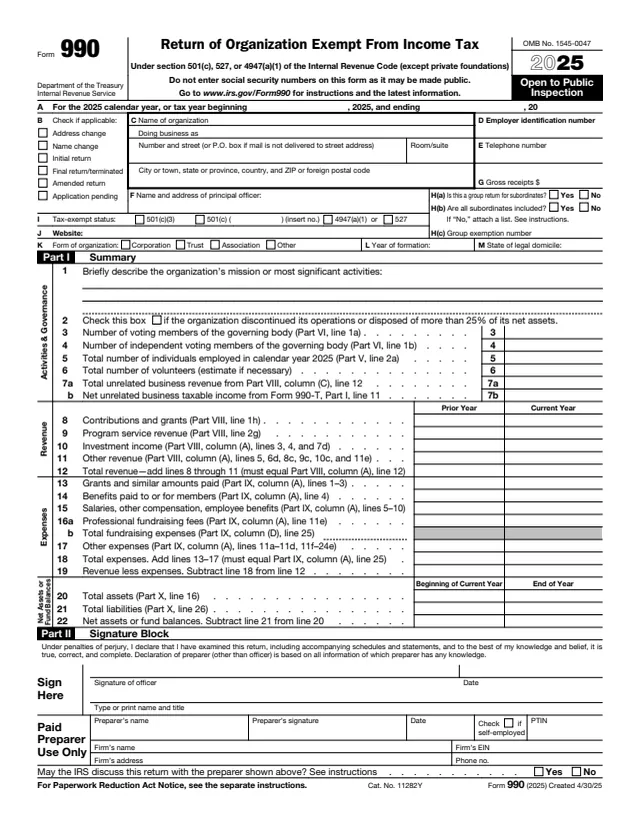
990
1,075 fields, 12 pages
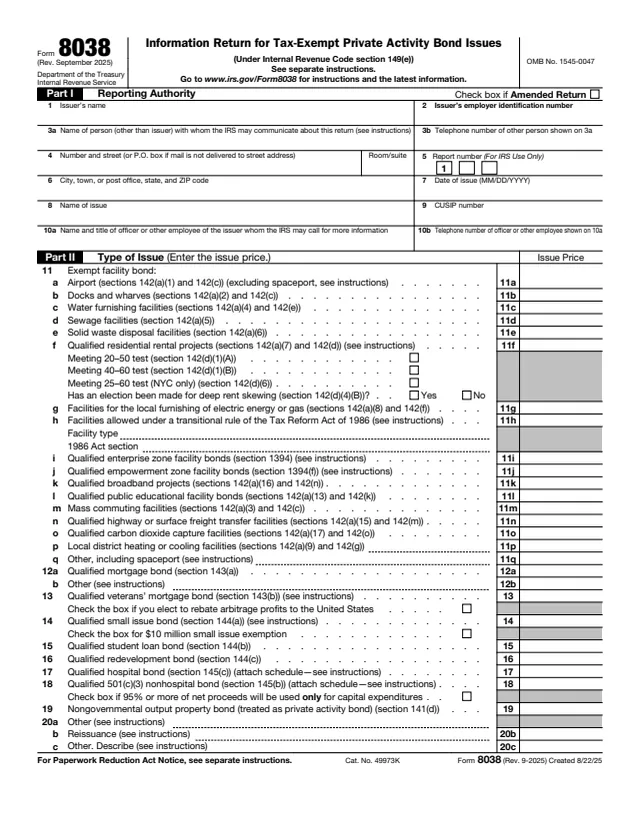
8038
137 fields, 3 pages
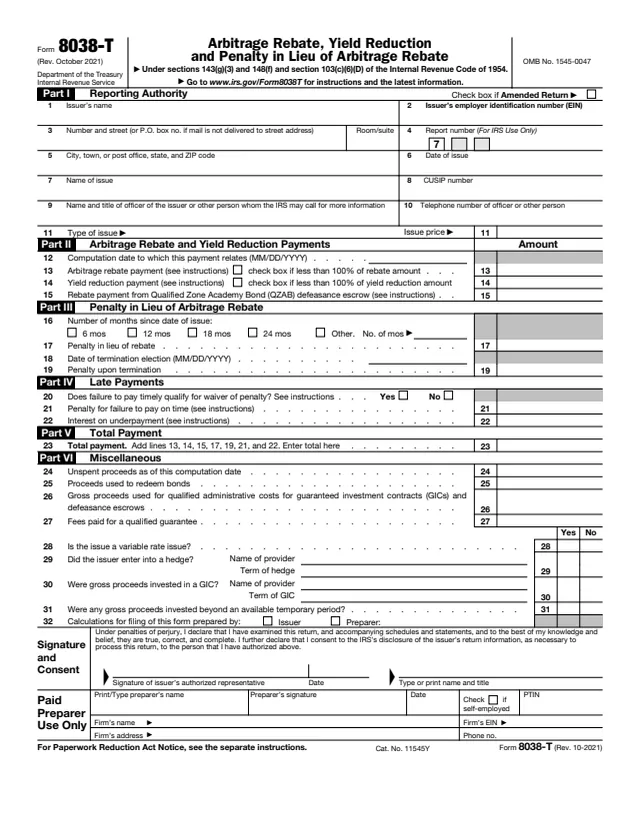
8038-T
60 fields, 1 page
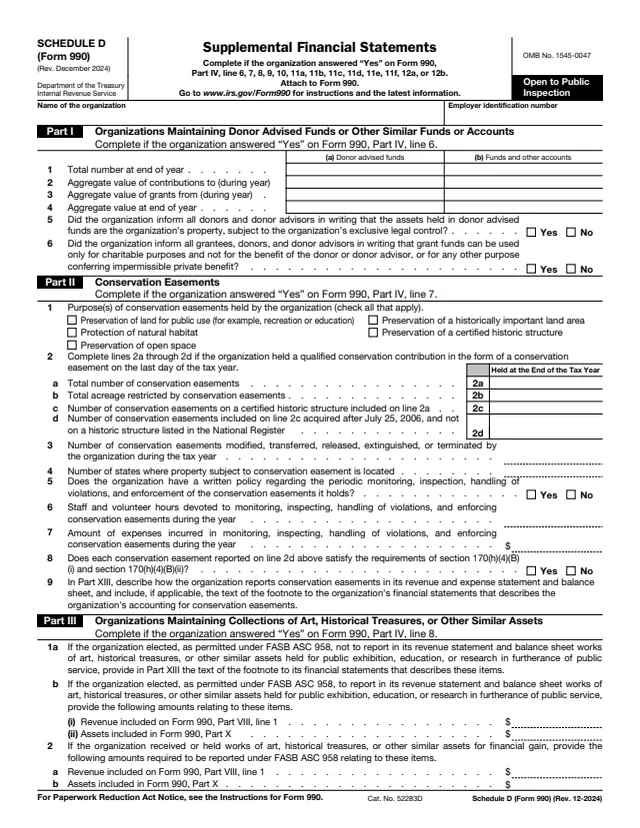
990 Sch. D
241 fields, 5 pages
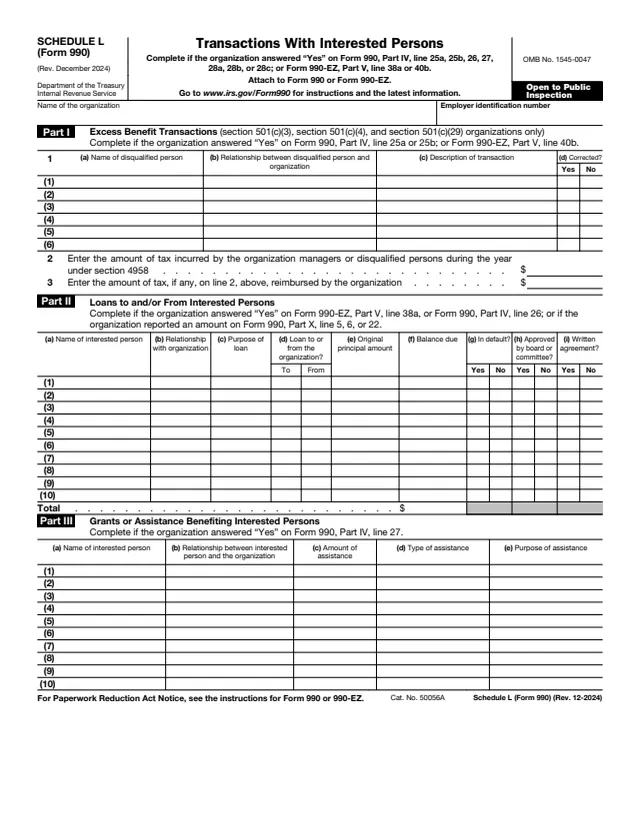
990 Sch. L
276 fields, 2 pages
The organization completes it and attaches it to its own Form 990. The instructions say details about the governmental issuer are copied from the Form 8038 filed for the issue.
No tool matches that search.
The instructions say each outstanding tax-exempt bond issue with an outstanding principal amount in excess of $100,000 as of the last day of the tax year, issued after December 31, 2002.
Four, in rows A to D. The instructions say the schedule can be duplicated to report more.
The instructions say the issuer name, EIN, CUSIP number and issue date should match the Form 8038 filed by the governmental issuer for the bond issue.
No. The instructions say the same liability shouldn't be reported by more than one of the related organizations.
Not for post-2002 refunding issues that refund pre-2003 bonds. The instructions also allow Part III to be omitted for qualified private activity bonds other than qualified 501(c)(3) bonds.
The form is marked Open to Public Inspection.