Part I: Reporting Authority
Lines 1 to 10b: issuer's name and EIN, an optional outside contact on lines 3a and 3b, address, date of issue, name of issue, CUSIP number and the officer or employee the IRS may call. Line 5 is for IRS use only.
8038-G
Information Return for Tax-Exempt Governmental Bonds
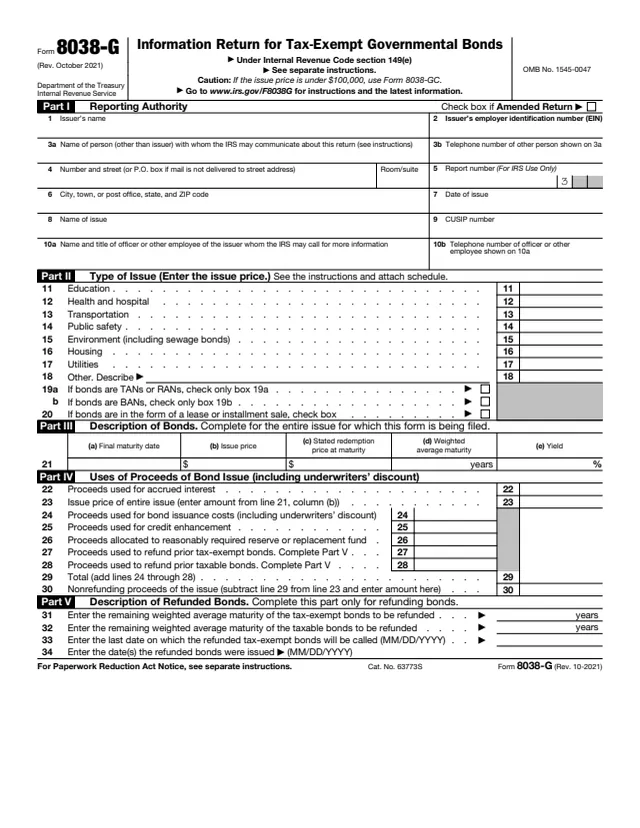
Form 8038-G is the Information Return for Tax-Exempt Governmental Bonds, filed under Internal Revenue Code section 149(e). The About page says issuers of tax-exempt governmental obligations use it to provide the IRS information required by section 149(e) and to monitor the requirements of sections 141 through 150.
The filer is the issuer of the bonds, not a bondholder or an individual taxpayer. The instructions say that for tax-exempt governmental bonds issued after December 31, 1986, an issue with an issue price of $100,000 or more is reported on a separate Form 8038-G, and an issue under $100,000 goes on Form 8038-GC. Private activity bonds use Form 8038.
The form asks about the issuer and the issue, the type of issue by purpose, the bonds' maturity and yield, how the proceeds are used, any refunded bonds and a set of compliance questions. This page hosts the October 2021 revision. You can fill out the PDF free in your browser on this page and download it without an account.
Lines 1 to 10b: issuer's name and EIN, an optional outside contact on lines 3a and 3b, address, date of issue, name of issue, CUSIP number and the officer or employee the IRS may call. Line 5 is for IRS use only.
Lines 11 to 18 take the issue price by purpose: education, health and hospital, transportation, public safety, environment, housing, utilities or other. Lines 19 and 20 flag TANs, RANs, BANs and leases or installment sales.
Line 21 has five columns: final maturity date, issue price, stated redemption price at maturity, weighted average maturity and yield.
Lines 22 to 30: accrued interest, the issue price, issuance costs, credit enhancement, reserve or replacement funds, refunding of prior tax-exempt or taxable bonds, and nonrefunding proceeds.
Lines 31 to 34, only for refunding bonds: remaining weighted average maturity of the refunded bonds, the last call date and the dates the refunded bonds were issued.
Lines 35 to 45b cover volume cap, guaranteed investment contracts, pooled financings, the small issuer exception, the arbitrage penalty election, hedges, written procedures and reimbursement. The issuer's authorized representative signs.
Enter the name of the entity issuing the bonds and its EIN. Lines 3a and 3b name an individual outside the issuer whom the IRS may contact. The instructions say to complete lines 10a and 10b even when lines 3a and 3b are filled in. Leave line 5 empty.
The date of issue is generally the first date the issuer physically exchanges a bond for the underwriter's funds; for a lease or installment sale, the date interest starts to accrue. Line 9 takes the CUSIP number of the bond with the latest maturity, or None.
Enter the issue price on the line for the type of bond. Attach a schedule of other organizations that use the proceeds, with a brief summary of the use. Check only one of boxes 19a and 19b.
Carry the yield to four decimal places, or write VR for a variable rate issue. For a lease or installment sale, write N/A in column (c), enter the years outstanding in column (d), and enter the effective rate of interest as the yield.
Line 24 is not left blank: enter zero if no proceeds pay issuance costs. Write N/A beside the titles of Parts IV and V for a lease or installment sale. Complete Part V only for refunding bonds.
Check the boxes that apply. If proceeds reimburse earlier expenditures, enter the amount on line 45a and the date the official intent was adopted on line 45b. The issuer's authorized representative signs and prints a name and title.
You get the real form, filled in a browser tab, with nothing standing between you and the finished PDF.
The instructions say to file Form 8038-G and any attachments with the Department of the Treasury, Internal Revenue Service Center, Ogden, UT 84201.
On or before the 15th day of the 2nd calendar month after the close of the calendar quarter in which the bond is issued. The form may not be filed before the issue date.
Relief may be granted under section 3 of Rev. Proc. 2002-48 if the late filing is not due to willful neglect. The instructions say to write the request at the top of the form and attach a letter explaining why it was late.
Check the Amended Return box, include all the original information with the corrections, and attach an explanation headed Amended Return Explanation.
Arbitrage rebate or a penalty in lieu of arbitrage rebate is paid with Form 8038-T. The instructions say not to make any penalty payment with Form 8038-G.
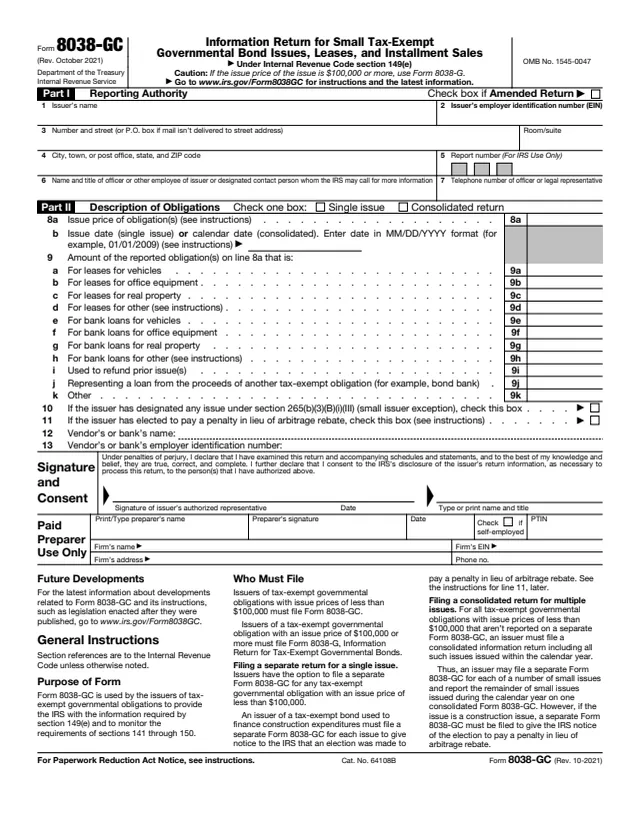
8038-GC
35 fields, 3 pages
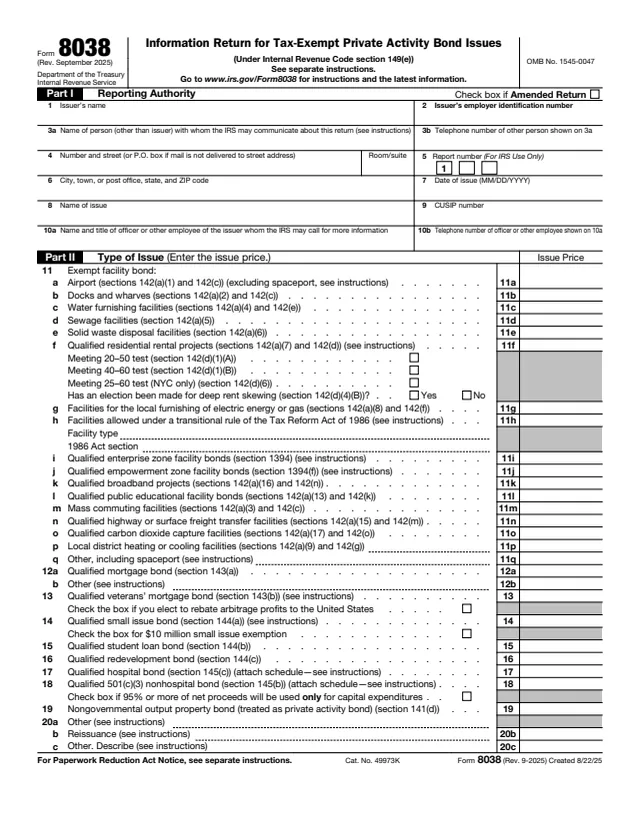
8038
137 fields, 3 pages
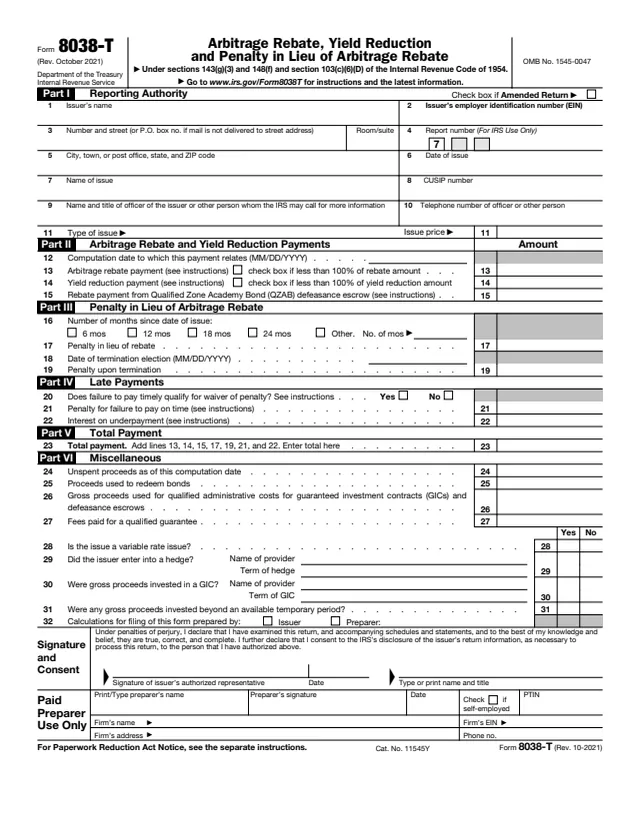
8038-T
60 fields, 1 page
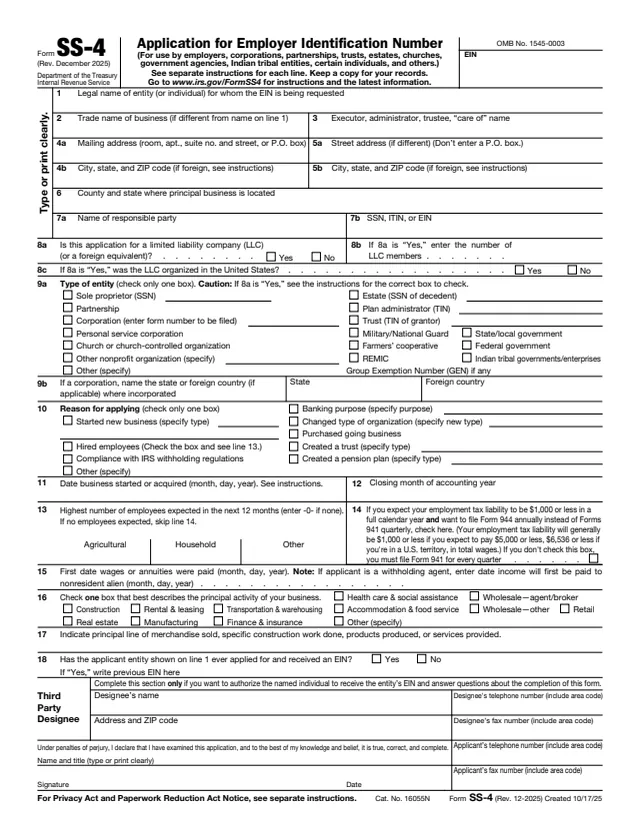
SS-4
89 fields, 2 pages
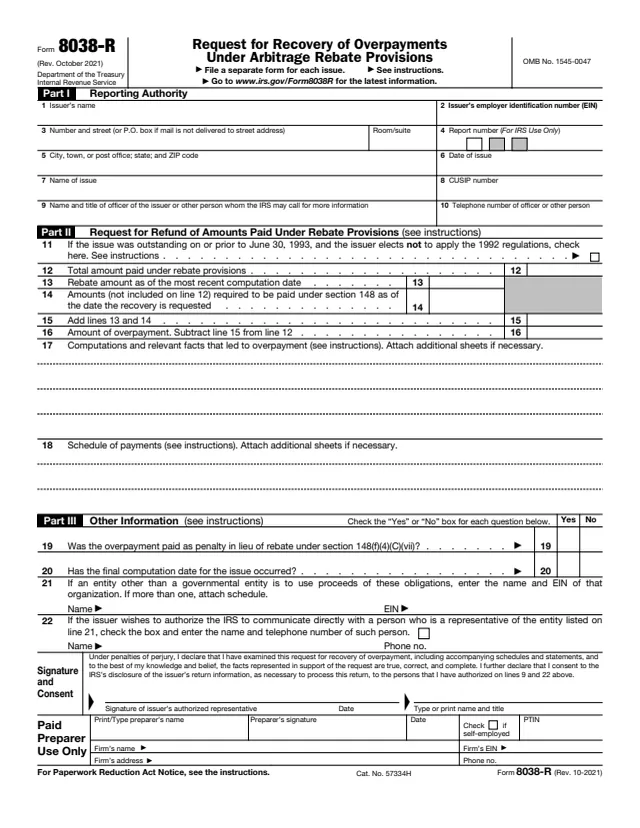
8038-R
40 fields, 3 pages
The instructions say issuers file a separate Form 8038-G for each issue of tax-exempt governmental bonds with an issue price of $100,000 or more.
No tool matches that search.
The issuer of tax-exempt governmental bonds, one form for each issue with an issue price of $100,000 or more. An authorized representative of the issuer signs it.
The form says to use Form 8038-GC.
No. The instructions say private activity bonds are reported on Form 8038.
The instructions say on or before the 15th day of the 2nd calendar month after the close of the calendar quarter in which the bond is issued.
The instructions say to write VR as the yield of the issue.
The instructions give Department of the Treasury, Internal Revenue Service Center, Ogden, UT 84201.