Part I: Reporting Authority
Lines 1 to 10: issuer's name and EIN, address, date of issue, name of issue, CUSIP number and the person the IRS may call. Line 4 is for IRS use only.
8038-R
Request for Recovery of Overpayments Under Arbitrage Rebate Provisions
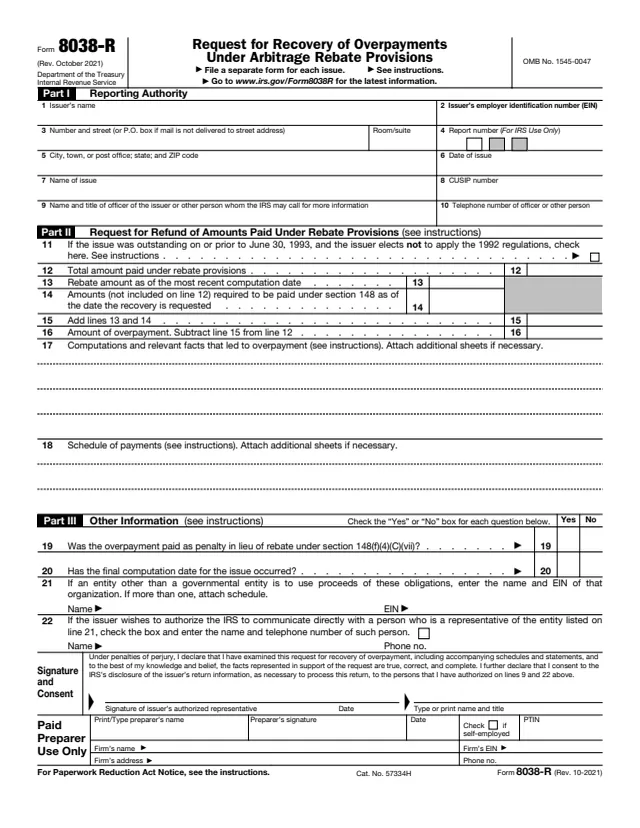
Form 8038-R is the Request for Recovery of Overpayments Under Arbitrage Rebate Provisions. The instructions say issuers of state and local bonds use it to request a refund of amounts paid with Form 8038-T, Arbitrage Rebate, Yield Reduction, and Penalty in Lieu of Arbitrage Rebate.
The instructions list four kinds of payments that may be recoverable: yield reduction payments, the arbitrage rebate to the United States, a penalty in lieu of rebating arbitrage, and a penalty to terminate the election to pay that penalty. An overpayment is the amount paid under section 148 above the rebate amount as of the most recent computation date plus any other amounts required under section 148 as of the date the recovery is requested.
The filer is the bond issuer, with a separate form for each issue. The instructions are printed on the form itself. This page hosts the October 2021 revision. You can fill out the PDF free in your browser on this page and download it without an account.
Lines 1 to 10: issuer's name and EIN, address, date of issue, name of issue, CUSIP number and the person the IRS may call. Line 4 is for IRS use only.
An election box for issues outstanding on or before June 30, 1993, then the total paid under the rebate provisions, the rebate amount, other amounts owed under section 148, and the overpayment on line 16.
The computations and facts that led to the overpayment, and a schedule of the payments made to the United States.
Yes or no questions on whether the overpayment was a penalty in lieu of rebate and whether the final computation date has passed, plus any nongovernmental user of the proceeds and its representative.
The issuer's authorized representative signs, with a Paid Preparer Use Only area below.
Enter the governmental entity that issued the bonds. The instructions say the date of issue, name of issue and CUSIP number on lines 6 to 8 should be identical to those on the corresponding Form 8038-T, Part I, lines 6 to 8.
Enter the name, title and telephone number of the officer the IRS may call, or of a designated person such as a legal representative or paid preparer.
Check the box only if the issue was outstanding before July 1, 1993, and the issuer elected not to apply the 1992 regulations.
Enter the total paid, the rebate amount as of the most recent computation date and other amounts owed under section 148. Add lines 13 and 14, then subtract line 15 from line 12 to get the overpayment.
Show the computations of the overpayment and any interest, with all cash flows from the issue date, and describe the facts. List the amounts and dates of payments, and attach copies of the Forms 8038-T.
Answer lines 19 and 20, name any nongovernmental user of the proceeds on line 21, and have the issuer's authorized representative sign and print a name and title.
You get the real form, filled in a browser tab, with nothing standing between you and the finished PDF.
The instructions say to file Form 8038-R and attachments with the Internal Revenue Service, Ogden Submission Processing Center, Ogden, UT 84201.
Claims cannot be filed later than 2 years after the date that is 60 days after the final computation date, or, for a portion paid more than 60 days after that date, 2 years after the payment date.
Except for overpayments of penalty in lieu of rebate, the instructions say an overpayment of less than $5,000 may not be recovered before the final computation date.
All copies of the Forms 8038-T related to the request, and the computations of the overpayment and any interest on line 17.
If the IRS makes a preliminary denial, additional information is due within 21 days of the request. A final denial comes by registered or certified letter, and the instructions say an issuer may appeal under Rev. Proc. 2021-10.
The instructions say the rebate overpayment is based on the amount actually paid, not the future value of the amount paid.
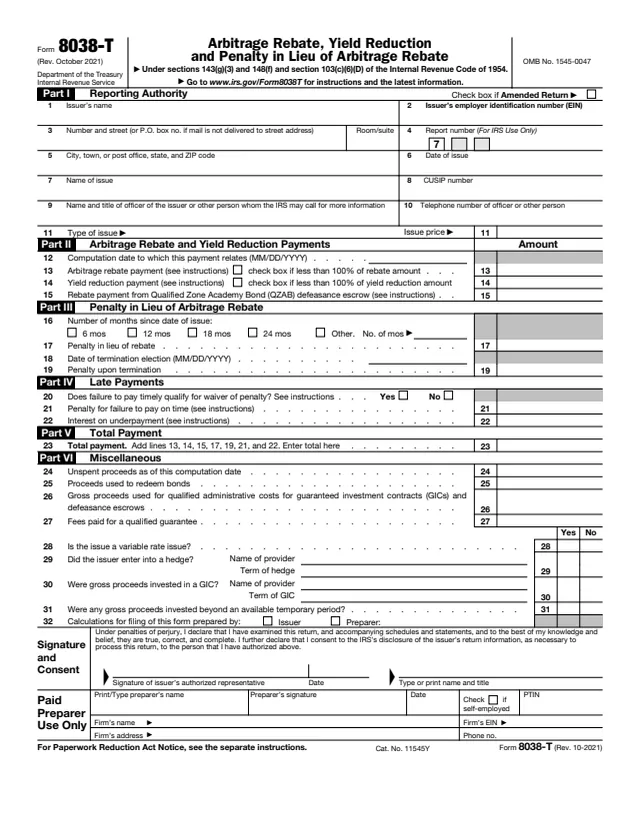
8038-T
60 fields, 1 page
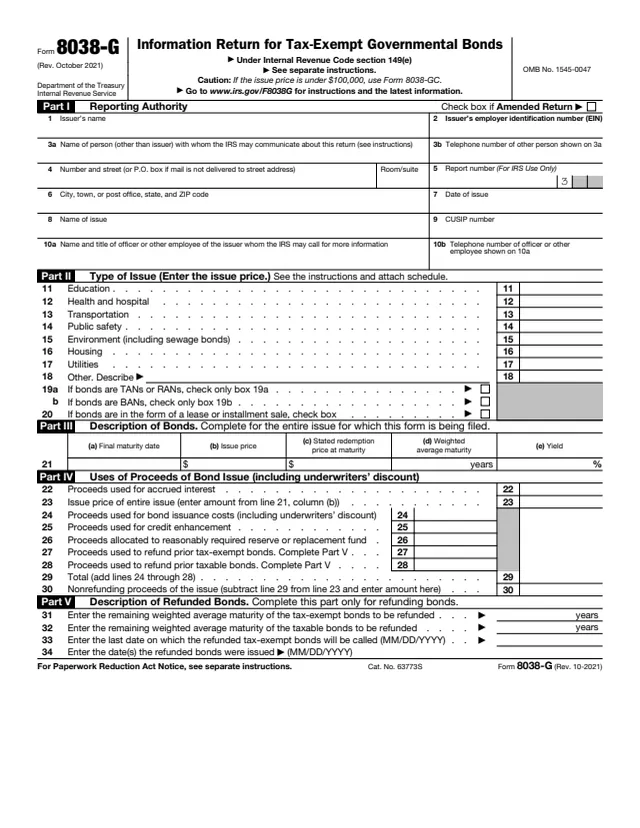
8038-G
72 fields, 2 pages
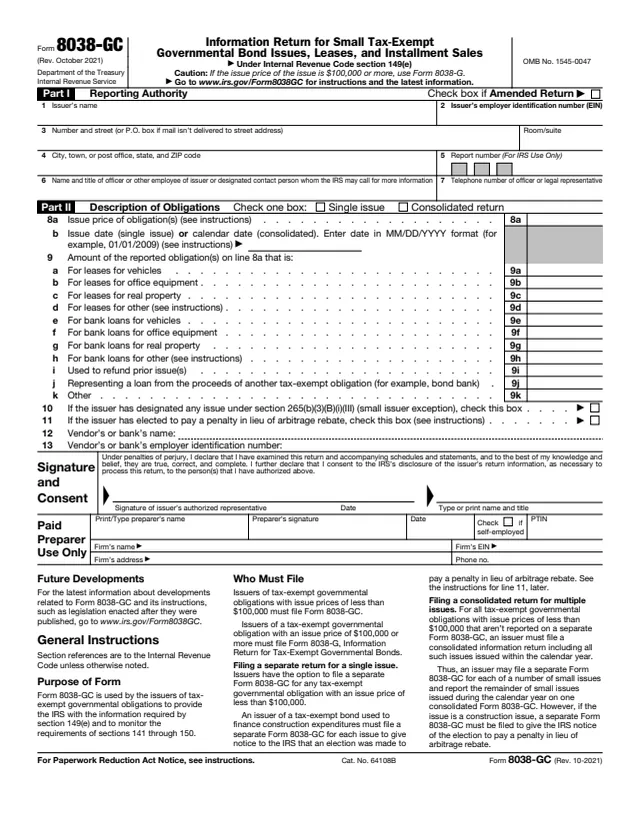
8038-GC
35 fields, 3 pages
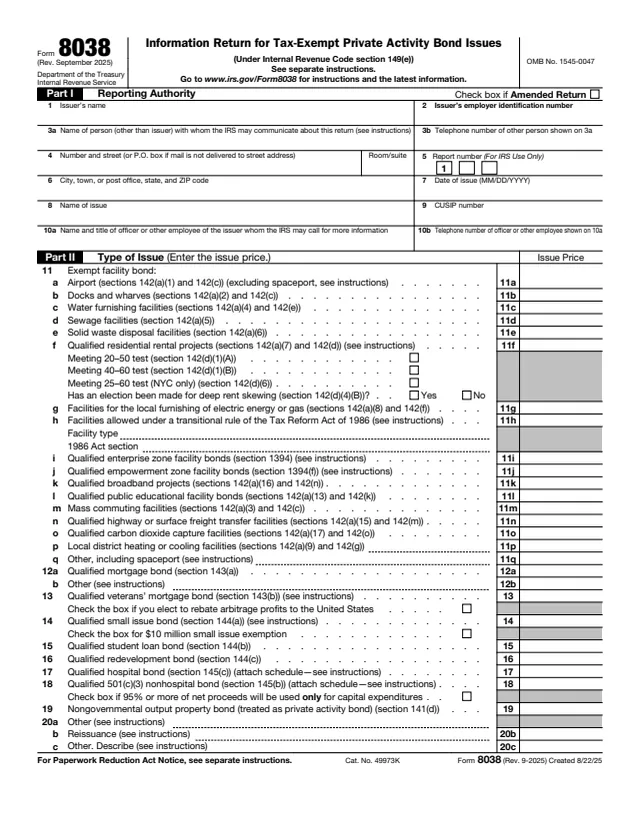
8038
137 fields, 3 pages
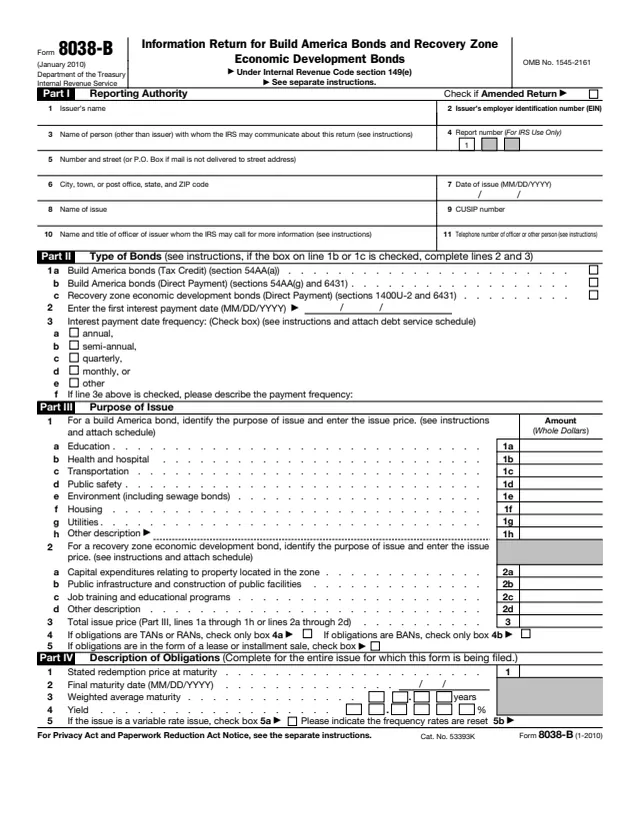
8038-B
92 fields, 2 pages
The form says to file a separate form for each issue. The filer is the issuer that made the payments with Form 8038-T.
No tool matches that search.
Overpaid amounts that were paid with Form 8038-T: yield reduction payments, arbitrage rebate, a penalty in lieu of rebating arbitrage, or a penalty to terminate that election.
The issuer of the bonds, using a separate form for each issue. An authorized representative of the issuer signs it.
Yes. The instructions say a claim cannot be filed later than 2 years after the date that is 60 days after the final computation date, with a later date for amounts paid after that point.
No. The instructions say the overpayment is based on the amount actually paid.
The instructions say the IRS notifies the issuer in writing that it may submit more information or participate in a conference. A final denial comes by registered or certified letter, subject to appeal.
The instructions give Internal Revenue Service, Ogden Submission Processing Center, Ogden, UT 84201.